The Wound of the Left
The essay argues that contemporary Taiwanese theater’s handling of White Terror memory and transitional justice often neutralizes the historical and political force of left-wing struggle, exposing the difficulty of making socialist, anti-imperial histories intelligible within Taiwan’s dominant cultural frame.
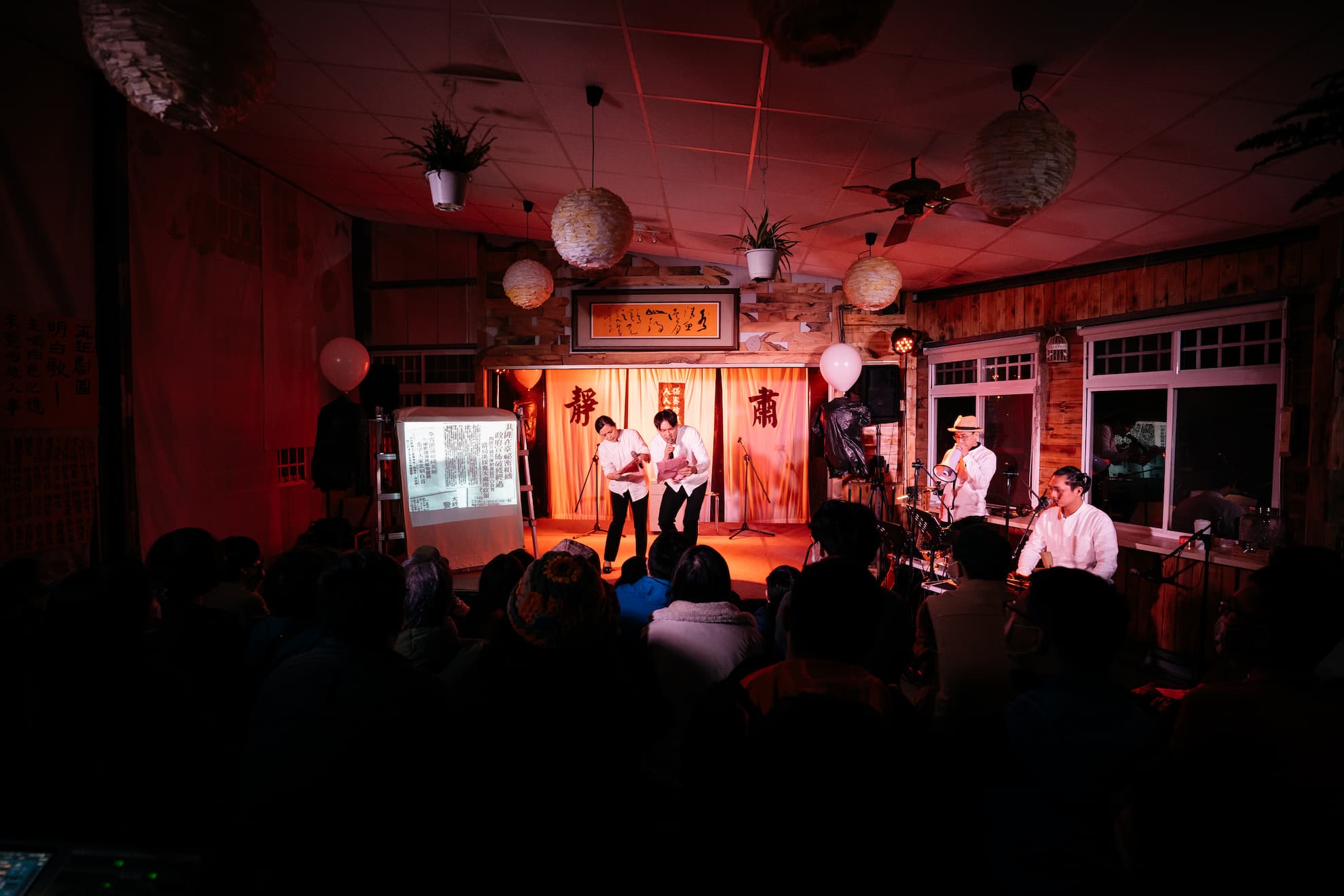
Text by Jian Weiqiao (2023 Project Critic)文 簡韋樵(2023年度專案評論人)
當劇場處理不義歷史的審視與轉型正義的回應成為文化場域的重要焦點,表演藝術評論界亦積極介入其中。這些討論涉及美學與歷史之間的辯證關係,更進一步反映出史觀與立場分歧何如何對記憶政治工程產生多重回響與批判,無可避免地成為不同立場創作者和劇評人交鋒的核心場域。
As the theater’s examination of unjust history and its response to transitional justice have become important focal points in the cultural field, performing-arts criticism has also actively entered the fray. These discussions concern the dialectical relation between aesthetics and history; further, they reflect how divergences in historical outlook and political position produce multiple echoes and critiques within the project of memory politics, and have inevitably become a central arena of confrontation among creators and theater critics of different positions.
何謂「站在國家對立面」?
What does it mean to “stand opposite the state”?
In “The Storyteller Borrows Authority from Death,” Huang Si-nong of Against Again Troupe declares: “For me, in creating works of white memory, my footing is already on the opposite side of the state, on the opposite side of Liefenstahl.” [1] Yet the standard by which “the opposite side of the state” is to be defined is precisely the core of the fundamental cognitive divergence between him and theater critics. In fact, left-wing critics adopt a socially structural perspective, holding that a work should not stop at exposing how state atrocity made tragedies of individuals or families, nor immerse itself purely in affective registers such as “healing” and “mourning”; still less can it evade the class contradictions behind the White Terror, the political struggle between left and right consciousness, and the manipulation of U.S. imperialism under the Cold War system. [2]
再拒劇團黃思農在〈說故事者從死亡那裡借來權威〉一文中宣稱:「對我而言,創作白色記憶的作品,我的立足點已然在國家的對立面、萊芬斯坦的對立面。」【1】然而,何謂「國家對立面」的標準界定,恰是他與劇評人之間根本性認知分歧的核心。事實上,持左翼立場的劇評人採取的是社會結構性的視角,認為作品不應僅止於揭露國家暴行如何針對個人或家庭造就悲劇,或浸潤於純粹「療癒」、「哀悼」等感性面,更無法規避白色恐怖背後的階級矛盾、左右意識的政爭、冷戰體系下美國帝國主義的操縱【2】等。
These historical and political factors, so often obscured by mainstream discourse, are precisely the limitations of the transitional-justice policies advanced by the current ruling party: “taking a Western conception of human rights as the benchmark, while refusing to face the left-wing purges of the Cold War anti-communist era.” [3] If theatrical creation stops at presenting the emotional experience of the oppressed, or reduces the White Terror to a binary framework of perpetrator and victim within a local political phenomenon, it may invisibly castrate the ideological substance borne by left-wing social movements and political prisoners, stripping history of its radical political dimension and, unintentionally, falling in step with the main melody of transitional justice’s narrative of “suffering.” Gradually, this treatment dissolves the vigilance we ought to maintain toward history and present structures of power, and thus becomes a cultural mechanism for domesticating the people’s agency. Wu Si-feng also observes: “In this reconstruction of Taiwan’s white history, at a new stage in the building of community, the dirty impurities are gradually erased: aseptic and bright.” [4]
這些經常被主流論述所遮蔽的歷史與政治因素,正是當前執政黨推行轉型正義政策以來的局限:「以西方人權觀作為標竿,卻不去正視冷戰反共年代的左翼肅殺」【3】。若劇場創作僅止於呈現被壓迫者的情感經驗,或將白色恐怖簡化為本土政治現象中的加害與被害二元框架,都可能在無形中閹割左翼社會運動與政治犯所承載的思想內涵,使歷史失去其激進的政治向度,更無意間配合轉型正義「受難」敘事的主旋律。漸漸地,這種處理消解我們對歷史與現行權力結構應有的警惕,從而成為馴化人民能動性的文化機制。吳思鋒亦察覺到:「這段白色的台灣史重建,在新一波的共同體建構階段逐漸被抹除了汙濁的雜質,無菌且潔亮。」【4】
Even if aesthetics or philosophy can deal with historical time, memories of collective trauma, or the remaking of landscape, without the support of historical consciousness the work can ultimately lapse only into fleeting sensory pleasure or technical display, lacking political tension.
即使美學或哲學能夠處理歷史時間、集體創傷記憶或是地景的再造等,但若無歷史意識的承載,作品最終只能淪為短暫的感官享受或技術展示,而缺乏政治張力。
The doubts Zhang Zong-kun raises from the touring performances of Against Again Troupe’s Understandable Songs: Singing the Unfinished Stories of White Memory’s Departed and Future Songs are these: “The violence of healing also brings a reductionist violence in narrative; in order to ‘let more people know,’ most creations still insist on hovering among shallow propositions such as exposing state atrocities and opposing the party-state.” [5] On the one hand, creation assumes the stance of the “enlightener,” implying a certain condescension toward the audience and casting the artist as an educator standing outside the people. On the other hand, genuinely critical artistic practice should not merely supply easily digestible historical knowledge, nor allow the audience to “stand in for” the suffering of victims and thereby gain psychological satisfaction; it should break open the audience’s existing cognitive frame, disclose the historical and ideological dimensions simplified and erased within collective memory, and summon once more those who once possessed social ideals and historical agency. A sacred and inviolable “narrative”?
張宗坤對再拒劇場《明白歌|走唱白色記憶未竟的故人事與未來歌》的巡迴演出所延伸的疑惑:「療癒暴力同時也帶來了敘事上的化約論暴力,為了『讓更多民眾知道』,多數創作仍堅持徘徊於揭露國家暴行、反對黨國等淺層命題間。」【5】一方面,創作採取「啟蒙者」的立場,暗含對觀眾的某種俯視,將藝術家塑造為站在民眾之外的教化者;另一方面,真正具批判性的藝術實踐不應僅止於提供容易消化的歷史知識或讓觀眾「代理」一場受難者的苦痛,從而獲得心理上滿足,而應該破除觀眾既有的認知框架,揭櫫在集體記憶中被簡化、抹除的歷史與思想維度,重新呼召曾經擁有社會理想與歷史能動性 神聖不可侵犯的「敘事」?
In genres that involve the restoration of unjust history and transitional justice, critics’ critiques extend further to the choice of aesthetic form. Wang Mo-lin, for instance, argues that Kao Chun-yao’s Princess Thank You (2023), with its “classical language that has a cleansing effect,” serves right-wing nationalism as an imagined cultural artifact; in reality, as a “White Terror play” across time and space, it provides a fantastical modern language and may further form a certain connection with the play-within-a-play. [6] The creator chooses newly composed nanguan to heighten sorrow, sets the loyalty and steadfastness in the Song-Yuan southern drama Zhu Bian against the defection of the underground party member “Old Zheng,” and applies a “purifying” treatment with tragic aesthetics. Although this can arouse the audience’s pity and sympathy, in Wang Mo-lin’s view it in effect rationalizes and depoliticizes the informer’s betrayal and is haunted by defeatism. He sharply points out: “The language of the left has here already been completely lost.” [7] Excessive poetic lyricism and the construction of a psychological space of stream of consciousness not only hollow out the revolutionary content, but, through the emotional dilution of classical phonology, shape a historical subject “full of self-pity, endlessly speaking sets of empty doctrines of life.” [8]
處理涉及不義歷史復權及轉型正義的體裁上,劇評人的批判更延伸至其美學形式的選擇,包含王墨林認為高俊耀編導的《感謝公主》(2023)「具有洗滌效果的古典語言,作為想像的文化人造物服務右翼國族主義,實則為跨時空下的『白恐戲』,提供了一種幻想式的現代語言,而可能進一步與戲中戲做出一定的連結。」【6】創作者選擇新編「南管」烘托悲戚,並以宋元南戲《朱弁》中的忠貞對比地下黨人「老鄭」的變節,並且帶有悲劇審美的「滌淨」處理,雖能喚起觀眾的憐憫與同情,卻在王墨林看來,實質上是將告密者的背叛合理化、去政治化、失敗主義作祟。他嚴厲指出:「左翼的語言在這裡已然完全喪失」【7】,過分的詩意抒情與意識流的心理空間構築,不僅抽空革命內涵,更通過古典音韻的情感稀釋,而塑造一位「自怨自艾、不斷說著一套套空洞的人生教義」【8】的歷史主體。
In fact, the severe scrutiny that Wang Mo-lin and others direct toward left-wing narratives in contemporary theater may arise from their adherence to idealist sentiment, from their refusal to allow revolutionaries who sacrificed themselves for belief, and the historical meaning they bear, to be simplified, distorted, or consumed in narrative. This almost sacralizing posture of defense both embodies the moral responsibility of guarding the left and reveals the contest and struggle over the right to interpret history in the contemporary political context. When the structure of feeling of “anti-communist and pro-American” sentiment is deeply rooted in Taiwanese society and hard to dispel, how are we, in the public sphere, to allow others to understand and feel what we wish to convey: that “left” which is regarded as eliminated by history and appears politically incorrect?
事實上,王墨林等人對當代劇場中左翼敘事的嚴苛審視,或許源於他們對理想主義情懷的堅守,對於那些信念犧牲的革命者及其歷史意義,而不容在敘事上被簡化、扭曲或消費。這種近乎神聖化的捍衛姿態,既體現守護左派的道德責任,也揭示在當代政治語境中,不同歷史詮釋權的競逐與鬥爭。當「反共親美」的感覺結構深植於台灣社會,難以驅散,我們又該如何在公共領域中,讓他者理解並感受到自身所欲傳達的——那些被視為歷史淘汰、顯得政治不正確的「左」?
Although theater criticism does not exert direct pressure on creators, the crux lies here: whenever an underground-party figure appears onstage in simplified, affected, or emotionally abusive form, if the work merely mobilizes the audience’s compassion while lacking depth of thought, must it inevitably be seen as a betrayal of the left and be labeled “right-wing” or as propaganda for the ruling bloc, and so forth? Such a critical standard places creators in a dilemma: in the cultural climate of contemporary neoliberalism, if they overemphasize the political ideals of left-wing figures, they may be accused of serving as doctrinaire mouthpieces; yet if they adopt a lyrical, romantic, or poeticized treatment, they may be denounced for violating the essence of revolution, compromising with the system, and often be cast as some kind of spectacularized representation. When critics approach “White Terror plays” with a preset position, are they not perhaps being overly paranoid and resentful, thereby blocking the bridge of communication with creators? More than that, they may invisibly push creators to the opposite side of class issues, so that a space for dialogue that should have been opened is instead sealed off by the tension of affective positions.
劇評雖不對創作者形成直接壓力,但癥結在於:當舞台上出現任何對地下黨人物的簡化、矯飾或情感濫用,倘若僅是調動觀眾惻隱之情而缺乏思辨深度之際,是否就必然被視為背離左翼,並遭扣上「右派」或為統治集團宣傳等保守主義帽子?這樣批判標準,便會使創作者陷入兩難困境:在當代新自由主義的文化氛圍中,若過度強調左翼人物的政治理想,可能被指責為教條式的傳聲筒;然而,若採取抒情、浪漫或詩意化的處理方式,又可能被斥為違背革命本質、對體制的妥協,且時常被打成某種景觀式的再現。當劇評人帶著對「白恐戲」的預設立場,是否過於偏執與鬱憤,反而阻斷與創作者之間的溝通橋樑?更甚者,在無形中,將創作者推向階級議題的對立面,使原應打開的對話空間,反倒被情緒性立場的緊張所封閉。
Princess Thank You (provided by Poor Theater; photograph by Kang Chih-hao). The Paralysis of Left-Wing Politicality《感謝公主》(窮劇場提供/攝影康志豪) 左翼的政治性癱瘓
Facing the rapid decline of Taiwan’s “left eye,” [9] Chung Chiao, a theater practitioner who emerged from the Renjian system, intends, beyond the main melody of transitional justice, to use drama to “examine the particularity of left-wing revolution under ‘de-imperialization,’ and, from the content and context of the people and the nation, to reaffirm human-rights values proceeding from a Third World perspective.” [10] Has such a concept been embodied in the works of the Assignment Theater he leads?
面對台灣「左眼」【9】極速衰退的現象,從《人間》體系出身的劇場實踐者鍾喬,意在轉型正義主旋律之外,從戲劇「檢視左翼革命在『去帝國』的特殊性下,從民眾的、民族的內涵與脈絡,重申以第三世界視野出發的人權價值。」【10】這樣的概念,是否有體現在他所領導的差事劇團作品上?
Take The Carriage Rehearsal, directed by Lin Ching-chieh (2016), as an example. After seeing it, Old Zheng wrote: “Through a nearly abstract, ‘dehistoricizing’ operation of ‘Chung Hao-tung’s individual subjectivity,’ The Carriage Rehearsal, castrating itself, creates through its dramatic ‘texture’ a replication of ‘non-understanding’; this is probably inevitable.” [11] And in the 2020 version of Fan Tianhan and His Brothers, directed by Wang Wei-lian, Chang Chih-chi’s review says: “Lin Shu-yang, who spent thirty-four years in prison and left behind a profound ideological legacy, is in the play reduced to a marginal figure whose words fail to become words, and who is neither accepted nor identified with by the young actors.” [12] Not only are left-wing political prisoners rendered “beyond recognition, without spirit, even somewhat ridiculous”; [13] when actors, standing on their own contemporary identities, interrogate historical figures, the “alienation” technique originally intended to prompt critical reflection in the audience may quietly turn into a form of symbolic violence resembling public humiliation.
以林靖傑執導的《幌馬車練習曲》(2016年)為例,在演完後老鄭寫下:「以近乎抽象的『鍾浩東個人主體性』的『去歷史』操作,自我閹割的《幌馬車練習曲》以其戲劇『織』理,造成『不理解』的複寫,恐怕是必然。」【11】而在王瑋廉執導的《范天寒和他的弟兄們》(2020年版本),張智琦的劇評則說道:「坐牢34年、留下深刻思想遺產的林書揚,在劇中倒成了一個話不成話、不被年輕演員接納和認同的邊緣人。」【12】不僅左翼政治犯塑造得「面目全非、神采全無,甚至有點可笑」【13】,當演員立足於自身當代身分對歷史人物進行質詢時,原本旨在促使觀眾批判思考的「間離」技法,卻可能悄然轉化為一種近似公開羞辱的象徵性暴力。
Even when Wang Mo-lin takes up again the form of the 1980s report drama, attempting in Black: Black Youth Wandering Between Poetry and Revolution to use the bodies of the people and historical testimony to mold the anarchist activists of the Japanese colonial period, he still never effectively manifests Wang Mo-lin’s own consistent political position. Perhaps precisely because the differences in identification within the collective creation of nonprofessional actors constrain the display of thought in the play, it appears vague and ambiguous when interpreting the left-wing path of the anti-Japanese movement. As a result, the experiences of resistance in the play lapse into a futile repetitive representation, not only diminishing resistance to the Japanese empire into a nihilistic fantasy, but also cutting off the space for reimagining the body as an instrument of resistance and weakening the historical perception and potential for action that theater might originally have inspired.
即使是王墨林重拾1980年代的報告劇形式,在《黑色-在詩與革命之間遊走的黑色青年》中試圖以民眾身體、歷史證言模塑日據時代的無政府主義運動者,卻始終仍未能有效彰顯王墨林本身一貫的政治立場。或許正因素人演員集體創作的認同差異,牽制劇作中的思想展現,使其在詮釋抗日運動的左翼路徑時顯得模糊曖昧。結果,劇中抵抗經驗流於徒勞無功的重複再現,不僅將對日本帝國的反抗行動貶抑為一種虛無幻想,也切斷了對身體作為抵抗工具的再想像空間,削弱了劇場原本可能激發的歷史感知與行動潛能。
In addition, Red Youth by the Taiwan Applied Theatre Development Center has also drawn questions from audiences: by the final development of the plot, it is only through blood relations that the third generation can gradually understand the red background possessed by the first generation, rather than through ideas themselves genuinely persuading the audience to understand the core values of their faith and action. Is this out of the creators’ fear of being labeled ideological? Even at the final moment when the underground party member Fang Xiaomin is executed by firing squad in the play, what he cries out is the phrase broadly acceptable in Taiwanese society, “Down with imperialism,” rather than the controversial phrase in Taiwan, “Long live the Chinese Communist Party.” [14]
另外,台灣應用劇場發展中心的《紅色青春》也曾引發觀眾的質疑:劇情發展至最後,卻只能透過血緣關係才能讓第三代漸漸理解第一代所擁有的紅色背景,而未能以理念本身真正說服觀眾理解其信仰與行動的核心價值。這是否出於創作者對被貼上意識形態教標籤的恐懼?乃至在劇中表現地下黨員方孝敏被槍斃的最後時刻,他喊出的是在台灣社會普遍能接受的「打倒帝國主義」,而非喊出在台灣具有爭議性的「中國共產黨萬歲」【14】。
To comment on these works one by one is not meant to flog them once again, but to reveal through them the predicament of creators with left-wing consciousness in contemporary theater: a fundamental limitation and internal contradiction faced by the writing of transitional justice itself, and also the reason why the red left, socially or culturally, has always found it difficult to establish an effective dialogue with Taiwan’s mainstream society or to find a shared language. Especially amid the present political atmosphere of rising right-wing populism and xenophobic sentiment, they appear still more isolated and struggling. Thus, when theatrical works tend to use affective appeals and narrative modes readily accepted by the public as strategies of communication, they may evasively avoid those highly politically sensitive “land mines,” causing revolutionary history gradually to slide toward a “village-worthy” representation, losing its transformative force and ultimately sinking into a collective gloom powerless to change the status quo.
將這些作品逐一點評,目的並非為了再度鞭撻,而是藉此揭示當代劇場中具有左翼意識的創作者之困境,是轉型正義書寫本身所面臨的根本侷限與內在矛盾,亦是社會上或文化上紅色左派始終難以與台灣主流社會建立有效對話、找不到共通語言的原因。尤其他們在當前右翼民粹與排外情緒高漲的政治氛圍中,更顯孤立與掙扎。於是,當戲劇作品傾向以感性訴求與大眾易於接受的敘事模式作為溝通策略,可能性地迴避那些具有高度政治敏感性的「地雷」,使革命歷史逐漸滑向「鄉愿」化的再現,失去變革性,最終陷入無力改變現狀的集體憂悶。
The 2024 public performance of Red Youth (National Cheng Kung University Taiwanese Literature Lecture Hall) (provided by the Taiwan Applied Theatre Development Center; photographs by Yang Ren-lin and Liu Rong-zhen). Affective Traps and the Dissolution of Politicality《紅色青春》2024年公演(成功大學台文講堂)(台灣應用劇場發展中心提供/攝影楊人霖、劉容真) 感性陷阱與政治性的消解
As the Cold War partition system continues to dominate the framework through which Taiwanese society understands history, the spiritual legacy of the “red hat” gradually loses its multilayered interpretive meaning. Amid the fragments and ruptures of memory, it becomes increasingly difficult for us to begin a genuine historical dialogue. Starting from aesthetic reflection, we must ask further: while constructing, questioning, and sensing historical images in artistic practice, how can we continue to dialecticize what seems an old tune but has not yet ended: “Cold War, colonialism, and imperialism”? This is the most central concern of left-wing critics. In their eyes, beneath the surface democratization of Taiwanese society there still exists what Guo Liang-ting calls, after the lifting of martial law, the “long martial law” in which “the White Terror changed into another face,” [15] causing the socialist historical perspective and political imagination to be systematically repressed and excluded.
隨著冷戰分斷體制持續主導台灣社會的歷史理解框架,「紅帽子」的精神遺產逐漸失去其多層次的詮釋意義。在記憶的碎片與斷裂中,我們愈發難以展開真正的歷史對話。從美學的思考出發,我們必須進一步叩問:在藝術實踐中建構、質疑與感受歷史意象的同時,如何持續對看似老調,卻尚未終結的「冷戰、殖民與帝國主義」進行辯證?這正是左翼評論者最核心的關懷所在——在他們眼中,台灣社會表面上的民主化進程之下,實質上依然存在著郭亮廷所謂在解嚴後,「白色恐怖改換了另一副面貌的『長戒嚴』」【15】,使社會主義歷史視角與政治想像持續遭到系統性的壓抑與排除。
Looking back, the overwhelming majority of political prisoners executed by firing squad in the 1950s were Communist Party members and their followers, comrades, and successors. If dramatic works view the history of the White Terror only through the surface appearance of human-rights persecution, we cannot deeply analyze how left-wing narratives in contemporary theater involve historical debt. Still less can we transcend the ideological framework constructed by the official cultural machine, with the result that an accounting with Japanese colonial rule and U.S. Cold War hegemony remains entirely absent; today, transformed in form, they lie concealed within the neoliberal global order, waiting for the chance to operate.
回溯在1950年代遭槍斃的政治犯絕大多數為共產黨籍及其追隨者、同志與後輩,倘若在戲劇作品只見人權迫害的表象來看待白色恐怖歷史,我們便無法深入探析當代劇場中的左翼敘事如何涉及歷史債務。更遑論能夠超越官方文化機器所構築的意識形態框架,導致對日本殖民統治與美國冷戰霸權的清算始終付之闕如,如今已轉化形式潛藏於新自由主義的全球秩序之中伺機運作。
Therefore, to take “the wound of the left” as a title is not merely to utter words of mourning for the defeat of socialism in the last century and the passing of idealists. It is, rather, through tracing the ruins of memory destroyed by the White Terror, amid the left’s resentment and bewilderment, to grope for those ruptures and silences from which not even embers could remain, and for the multitudes who were buried along with their spiritual legacy. When left-wing narrative is dramatized, only by summoning anew the sparks of thought of those who were repressed and denied the right to write history can the language and action of the Third World recover, in the present, their historical weight and political edge, opening a space in which a people’s view of history may freely contend.
因此,以「左翼之殤」為題,並非僅是對上世紀社會主義挫敗與理想主義者傷逝悼亡之辭,而是透過追溯白色恐怖所摧毀的記憶廢墟,在左派鬱憤和徬徨的情狀下,踅摸那些連餘燼都無從留存的斷裂與沉寂,及遭到掩埋的諸眾與其精神遺產。當左翼敘事被戲劇化,惟有重新召喚那些被壓抑、無權書寫歷史者的思想火種,第三世界的語言與行動才可能在當代重獲其歷史的重量與政治的鋒利,為從屬於人民史觀開創一個得以自由爭鳴的空間。
Notes注解
1. Huang Si-nong, “The Storyteller Borrows Authority from Death: A Creator’s Response to the Necessity of ‘Transitional Justice’ Cultural Policy,” PAR Performing Arts Magazine (February 18, 2025).
1、黃思農:〈說故事者從死亡那裡借來權威|一個創作者回應「轉型正義」文化政策之必要〉,《PAR表演藝術雜誌》(2025年2月18日)。
2. As an outpost of the United States’ global anti-communist strategy, Taiwan, during the White Terror and authoritarian rule, consolidated the regime with American support, continued the civil war, and used the state apparatus to exterminate red socialist forces on the island. As Chen Chieh-jen points out: “The ruler behind it all, the United States/capitalism, skillfully avoided responsibility for supporting the martial-law system and successfully transformed its identity into that of an aid to Taiwan’s ‘democratization,’ continuing to advance the process of capitalist globalization in Taiwan.” This reveals the international-political dimension systematically ignored in contemporary transitional justice and its theatrical works. Cheng Hua-hui, ed., Art and Society: Essays and Interviews by Contemporary Artists (Taipei: Taipei Fine Arts Museum, 2009), p. 75.
2、作為美國全球反共戰略的前哨,台灣在白色恐怖與威權統治時期藉美方扶植鞏固政權,延續內戰,並運用國家機器剿滅島內紅色社會主義勢力。如陳界仁所指:「背後的支配者——美國/資本主義,卻巧妙避開其支持戒嚴體制的責任,並成功轉換身份成為台灣『民主化』的助力,繼續在台灣推進資本主義全球化的進程。」揭示當代轉型正義及其劇場作品中被系統性忽視的國際政治維度。鄭華慧編著:《藝術與社會:當代藝術家專文與訪談》(台北:台北市立美術館,2009年),頁75。
3. Chung Chiao, “Though the Flowers Wither, I Have Never Forgotten You: Seeing Left-Wing History Beyond Transitional Justice in the Theater,” Independent Opinion (August 24, 2020).
3、鍾喬:〈花朵凋零,我也不曾忘記你:在劇場,看見轉型正義以外的左翼歷史〉,《獨立評論》(2020年8月24日)。
4. Wu Si-feng, “The ‘Post’ Theater of Transitional Justice,” Artouch (February 24, 2023).
4、吳思鋒:〈轉型正義的「後」劇場〉,《典藏ARTouch》(2023年2月24日)。
5. Zhang Zong-kun, “A History of Violence, a Seamless Theater: A Review of Understandable Songs: Singing the Unfinished Stories of White Memory’s Departed and Future Songs,” Artouch (March 8, 2022).
5、張宗坤:〈暴力的歷史,無縫的劇場:評《明白歌:走唱白色記憶未竟的故人事與未來歌〉,《典藏ARTouch》(2022年3月8日)。
6. Wang Mo-lin, “Left-Wing Aphasia Unable to Escape the History of Martial Law: On White Terror Drama,” CLABO Experimental Wave (August 19, 2024).
6、王墨林:〈走不出戒嚴史的左翼失語:白色恐怖戲劇論〉,《CLABO實驗波》(2024年8月19日)。
7. Ibid.
7、同前注。
8. Ibid.
8、同前注。
9. On the metaphor of the “left eye,” Chen Yingzhen once said: “In 1950, under the armed guard of the United States, Taiwan cleansed Marxism in a pool of blood and ushered in more than fifty years of long rule by American liberalism and market ideology. Taiwan’s intellectual and cultural circles were thus gouged of their ‘left eye’; for many years they became accustomed to seeing the world with the ‘right eye,’ losing the capacity for critique and reflection.” Chen Yingzhen, “I Am Absolutely Not a Righteous Man: Preface to Taiwan’s Melancholy,” included in Li Xiangping, Taiwan’s Melancholy (Taipei: Renjian, 2003).
9、關於「左眼」的比喻,來自於陳映真曾說道:「一九五〇年,在美國武裝守衛下,台灣在血泊中清洗了馬克思主義,迎來五十多年美式自由主義和市場意識形態的長期統治。台灣的思想、文化界於是被剜去了『左眼』,長年來習慣以『右眼』看世界,喪失了批判和反省的能力。」陳映真:〈我絕不是一個義人——《台灣的憂鬱》序〉,收錄於黎湘萍:《台灣的憂鬱》(台北:人間,2003年)。
10. Chung Chiao, “Facing a History of Suppression and Killing: From Fan Tianhan to Wall in the Play,” New International (August 30, 2020).
10、鍾喬:〈面對壓殺的歷史:從《范天寒》到《戲中壁》〉,《新國際》(2020年8月30日)。
11. Old Zheng, “This Road Is Closed: Whose Story Does The Carriage Rehearsal Tell?” Coolloud (May 15, 2016).
11、老鄭:〈此路不通——《幌馬車練習曲》說誰的事?〉,《苦勞網》(2016年5月15日)。
12. Chang Chih-chi, “Fragments of History in a Colored Fog: On the 2020 Version of Fan Tianhan and His Brothers,” Coolloud (October 20, 2020).
12、張智琦:〈彩色迷霧中的歷史碎片 談談2020版《范天寒和他的弟兄們》〉,《苦勞網》(2020年10月20日)。
13. Ibid.
13、同前注。
14. The political slogan “Long live the Chinese Communist Party” can be traced back to the 1922 Manifesto of the Second National Congress of the Chinese Communist Party, and was a core political program established by the Chinese Communist Party during the period of revolutionary struggle. According to the oral-history materials of Mr. Chen Ming-chung, a Taiwanese political victim, during Taiwan’s White Terror period some underground party members shouted this slogan before execution, manifesting their revolutionary convictions.
14、「中國共產黨萬歲」這一政治口號,溯源於1922年《中國共產黨第二次全國代表大會宣言》,是中國共產黨在革命鬥爭時期確立的核心政治綱領。根據台灣政治受難者陳明忠先生的口述史料記載,在台灣白色恐怖時期,有地下黨員臨刑前高呼此口號,展現其革命信念。
15. Guo Liang-ting, History Has Never Ended: The Liberatory Geographies of Wang Mo-lin and Chen Chieh-jen (New Taipei: Zebra Crossing Press, 2025), p. 79.
15、郭亮廷:《歷史從未終結:王墨林與陳界仁的解放地誌學》(新北:斑馬線文庫,2025年),頁79。