Forging His Own Path: Kabuki Actor Nakamura Kyozo
Nakamura Kyozo’s life in kabuki shows how discipline, apprenticeship, and artistic individuality can open a path even to an outsider in a world long governed by lineage.
A Young Boy and Kabuki
Forging His Own Path: Kabuki Actor Nakamura Kyōzō Culture Entertainment Work- English - 日本語 - 简体字 - 繁體字 - Français - Español - العربية - Русский A Young Boy and Kabuki
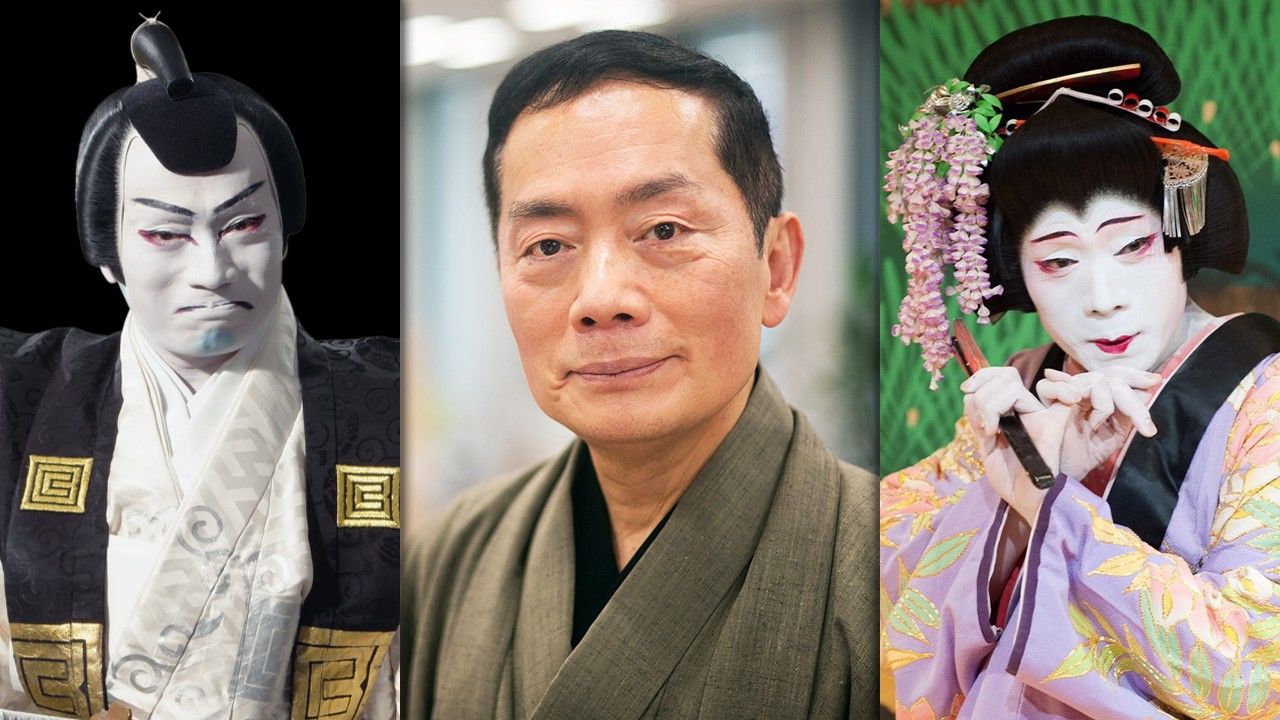
Nakamura Kyozo, born in 1955 into an ordinary family outside the kabuki world, has built his career as an onnagata, a male actor specializing in female roles, playing everything from old women in jidaimono historical dramas to wives in sewamono domestic plays. Trained at the National Theatre’s Traditional Performing Arts Training Institute, he has now stood on the kabuki stage for more than forty years.
Nakamura Kyōzō, born in 1955 into an ordinary family outside the kabuki world, has built a career as an onnagata—a male actor specializing in female roles—playing everything from old women in jidaimono historical plays to wives in sewamono domestic plays. Trained at the National Theatre Traditional Performing Arts Training Institute, he has been on the kabuki stage now for over 40 years.
Looking back on his first encounters with kabuki at a very young age, Nakamura says: “Both my parents worked, and my grandmother, who loved kabuki, would take me to the theater to see plays. For as long as I can remember, I wanted to become a kabuki actor. I was too young to understand the stories, but even so, the plays moved me. I would even skip school to go and see kabuki.”
Recalling his introduction to kabuki at a tender age, Nakamura says: “My parents both worked, and my grandmother, who loved kabuki, would take me to theaters to watch the plays. From as far back as I can remember, I wanted to be a kabuki actor. I was too young to understand the stories, but even so, the plays moved me. I would even skip school to go and see kabuki.”
After repeatedly pleading with his parents, he began lessons in nihon buyo, classical Japanese dance, around the age of ten. In his early teens, by chance, he came to frequent the dressing room of the legendary onnagata Nakamura Utaemon VI (1917-2001). Serving as a kurogo stagehand, he assisted Utaemon, but gradually began to draw away from kabuki.
After pestering his parents, he began taking lessons in nihon buyō classical Japanese dance around the age of 10. In his early teens, he was, by chance, frequenting the dressing room of the legendary onnagata Nakamura Utaemon VI (1917–2001). Working as a kurogo stagehand, he assisted Utaemon, but gradually distanced himself from kabuki.
“Utaemon and the other actors were all very kind to me, but little by little I came to understand that in the kabuki world, pedigree matters above all. For an ‘outsider’ like me, it would not be an easy road, and I could not see a future for myself as an actor in that world. I resigned myself to remaining a spectator and decided to go on to university.”
“Utaemon and the other actors were all very kind to me, but I gradually came to realize that in the kabuki world, pedigree is all-important. For an ‘outsider’ like me, it would not be an easy path, and I couldn’t see a future for myself as an actor in that world. I resigned myself to being just a spectator, and I decided to go on to university.”
Against All OddsAgainst All Odds
At university Nakamura studied modern Japanese literature, where he encountered writers such as Ueda Akinari (1734-1809) and Ihara Saikaku (1642-93), creators of new genres of popular fiction. “I was still going to kabuki performances, and I became utterly captivated by Nakamura Jakuemon IV (1920-2012). A promising tachiyaku, an actor of young adult male roles, Jakuemon was drafted into the Imperial Japanese Army and spent six years fighting on distant battlefields during World War II.” After demobilization, Nakamura explains, Jakuemon began training as an onnagata at the age of twenty-seven, and later, through his outstanding performances in such roles, was designated a Living National Treasure and received the Order of Culture.
At school Nakamura studied modern Japanese literature, which exposed him to writers like Ueda Akinari (1734–1809) and Ihara Saikaku (1642–93), who created new genres of popular fiction. “I was still attending kabuki plays, and I became completely enthralled by Nakamura Jakuemon IV [1920–2012]. A promising tachiyaku, or a player of young adult male roles, Jakuemon was drafted into the Imperial Japanese Army and spent six years fighting in far-flung battlefields during World War II.” After demobilization, explains Nakamura, at the age of 27 Jakuemon began training as an onnagata and went on to be designated a living national treasure and recipient of the Order of Culture for his outstanding performances in such roles.
“He was simply extraordinary: he danced with such mastery while giving off a sensuous feeling. Kabuki is often described as a ‘beauty of form,’ but at its root it also requires realism. Jakuemon brought those elements together harmoniously and created a highly individual style of onnagata performance. I found that deeply moving, and became an ardent admirer.”
”He was simply sensational in how he danced so expertly while exuding sensuous feeling. Kabuki is often said to be ‘beauty of form,’ but at bottom it also needs to be realistic. Jakuemon harmoniously integrated these elements to create a highly individualistic style of onnagata performance. I found that very moving and became an ardent fan of his.”
Around that time, Nakamura belonged to a kabuki troupe led by the theater critic and stage and film director Takechi Tetsuji (1912-88). “I was no longer satisfied simply watching kabuki; I had begun to feel regret that I had abandoned my dream of becoming a kabuki actor,” he recalls. “When I asked Takechi-sensei for advice, he said, ‘Rather than regretting that you never tried, it is better to try, and if you do not succeed, to resign yourself then.’ That was when I decided I had to aim for my dream after all.”
Around that time, Nakamura was a member of a kabuki troupe headed by the theater critic and stage and film director Takechi Tetsuji (1912–88). “I wasn’t satisfied any longer with simply watching kabuki; I had begun feeling sorry that I had abandoned my dream of becoming a kabuki actor,” he recalls. “When I approached Takechi-sensei for advice, he said, ‘Rather than regretting that you never tried, it’s better to try and resign yourself to failure if you don’t succeed.’ That’s when I decided I had to shoot for my dream after all.”
The National Theatre’s Traditional Performing Arts Training Institute accepts trainees only every other year, so Nakamura had to wait a year before applying. In the meantime he worked part-time, and in 1980 he applied. Of the twenty applicants, he was among the ten accepted, and began training as a member of the Institute’s sixth cohort.
The National Theatre Traditional Performing Arts Training Institute takes on trainees only every second year, so Nakamura had to wait a year to apply. In the meantime, he took part-time jobs, and applied in 1980. Out of 20 applicants, he was one of 10 accepted, and began training as part of the Institute’s sixth cohort.
“Our twenty-two months of training covered every aspect of kabuki performance. We had to learn both tachiyaku and onnagata roles, and study music and dance: nihon buyo, nagauta and other shamisen music, gidayu narrative recitation, and the small and large taiko drums, as well as the koto, a zither-like stringed instrument. We had to practice tachimawari, simulated sword fighting; learn how to apply makeup for the various roles in the kabuki repertoire; and familiarize ourselves with the tea ceremony. After the first six months there were practical examinations, and depending on our progress, we could fail. Of the ten members in our original class, only five remained after that.”
“Our twenty-two months of training covered every aspect of kabuki performance. We had to learn both tachiyaku and onnagata roles and study music and dance, such as nihon buyō, nagauta and other shamisen music, gidayū narrative recitation, and playing the small and large taiko drums and the koto, a stringed instrument akin to a zither. We had to practice tachimawari simulated sword fighting, to learn how to apply makeup for the different roles in the kabuki repertoire, and to familiarize ourselves with the tea ceremony. After the first six months, there were practical examinations, and we could be failed depending on how we had progressed. Out of our initial class of ten members, only five remained after that.”
Prior knowledge or experience in any of these arts was no guarantee of success. Many trainees who began from nothing absorbed the lessons quickly and made rapid progress. Kyozo, who had studied nihon buyo since childhood, was told to forget everything he had learned and begin anew. After graduating from the Institute, he chose without hesitation to study under Nakamura Jakuemon IV.
Prior knowledge or experience in any of these artistic practices was no guarantee of success. Many trainees who were starting from zero were quick to absorb the lessons and made rapid progress. Kyōzō, who had been learning nihon buyō since childhood, was told to forget everything he had learned and start afresh. After graduating from the Institute, he unhesitatingly chose to study under Nakamura Jakuemon IV.
“At the end of my interview with Jakuemon, he asked me, ‘Do you know what is most important for an actor?’ I thought he might mean mental toughness, but no. He said, ‘Actors need physical strength. You look rather slight, so you had better build yourself up.’”
“At the conclusion of my interview with Jakuemon, he asked me, ‘Do you know what’s most important for an actor?’ I thought that might refer to mental toughness, but no, he said ‘Actors need to be physically strong. You look sort of puny, so you’d better work on getting fit.’”
After successfully passing the practical examinations, he was given the name Kyozo, in the hope that he would build up a ‘storehouse’ of artistry, the zo in his name carrying that meaning. His mentor guided him through every step required to become an onnagata, from the way he held his body and carried himself to the application of stage makeup.
Having successfully passed the practical examinations, he was given the name Kyōzō, in the hope that he would build “a storehouse” of artistry, the zō in his name representing that term. His mentor guided him through all the steps necessary for becoming an onnagata, from how to hold his body and his comportment through to applying stage makeup.
“To cultivate the supple slenderness of a woman, I was instructed to soften my knees and move from the hips. To make my shoulders slope, I had to relax them, draw my shoulder blades together, keep my arms at my sides, and bring my chest forward. I practiced those movements over and over until they came naturally.” Nakamura explains that this posture is also essential for wearing onnagata costumes properly. Onnagata must train themselves to use muscles not ordinarily engaged in order to bear the heavy costumes and wigs required by the roles, and he quickly realized that he had to strengthen his lower body.
”To cultivate a woman’s willowy slenderness, I was instructed to soften my knees and move from the hips. To slope my shoulders, I had to relax them, bringing my shoulder blades together, keeping my arms to my sides, and bringing my chest forward. I practiced those movements again and again until they came naturally.” This posture is also essential for wearing onnagata costumes properly, Nakamura explains. Onnagata need to train to use muscles not ordinarily in play so as to support the roles’ heavy costumes and wigs, and he quickly realized that he had to strengthen his lower body.
Jakuemon often told Kyozo, “Move beneath your bones; move your internal organs,” insisting that “doing so will make you feel like a woman. That is a fundamental step.” By watching Jakuemon put on his stage makeup, Kyozo also learned how to do the same through observation.
Jakuemon often told Kyōzō to “move under your bones, move your internal organs,” asserting that “doing so will make you feel like a woman. That’s a fundamental step.” Watching Jakuemon apply his stage makeup, Kyōzō also learned to do the same by observation.
“It is very strange, but when an actor puts on his makeup, he ends up resembling his mentor. The same is true for me. Although Jakuemon and I have different features, people often tell me that we look alike. I take that as a real compliment.”
“It’s very strange, but when an actor puts his makeup on, he ends up resembling his mentor. It’s the same for me. Even though Jakuemon and I have different facial features, I’m often told that we look similar. I take that as a real compliment.”
Kyozo as Cultural AmbassadorKyōzō as Cultural Ambassador
Thanks to assiduous practice, Kyozo came to be recognized for his artistry and began receiving offers to appear in works outside the kabuki repertoire. Among other challenges, he took on roles in foreign dramas adapted for kabuki and performed alongside flamenco dancers. In 2015, he played all three witches in Ninagawa Macbeth, directed by the celebrated theater director Ninagawa Yukio (1935-2016). In 2023, he self-produced Phedre, a play based on the Greek myth of the title character’s illicit passion for her stepson, and performed the title role himself.
Thanks to assiduous practice, Kyōzō became recognized for his artistry and began receiving proposals to act in works outside the kabuki repertoire. Among others, he tackled foreign drama roles adapted for kabuki and performed alongside flamenco dancers. In 2015, he played all three witches’ roles in Ninagawa Macbeth, directed by the famed theater director Ninagawa Yukio (1935–2016). In 2023, he self-produced Phèdre, a play based on a Greek myth recounting the title character’s illicit passion for her stepson, in which he played the title role.
Since 1998, when Kyozo began serving as a cultural ambassador for the Japan Foundation and as a Japan Cultural Envoy for the Agency for Cultural Affairs, he has traveled the world introducing Japanese culture through kabuki. To date he has visited sixty cities in thirty-four countries. He has presented onnagata dances from works such as Sagimusume, popular with overseas audiences for its dramatic force; performed the lion’s mane dance in Shakkyo; and explained how onnagata convey female emotion through stylized movement.
Since 1998, when Kyōzō began acting as a cultural ambassador for the Japan Foundation and a Japan cultural envoy for the Agency for Cultural Affairs, he has traveled around the world introducing Japanese culture through kabuki. Up to now, he has visited 60 cities in 34 countries. He has presented onnagata dancing roles in Sagimusume, popular among foreign audiences for its drama, and other works, performed the lion’s mane dance in Shakkyō, and explained how onnagata communicate female emotions through stylized movements.
In his spoken presentations, he says, “I explain how onnagata portray women’s emotions. For example, a young woman discreetly covers her mouth with her sleeve when she titters delicately. When she is sad, she dissolves into a flood of tears, pressing her sleeve to her eyes while restraining her sobs. I have the audience imitate my gestures, and everyone seems to enjoy it very much.”
In his spoken presentations, he says, “I explain how onnagata portray women’s emotions. For example, a young woman will discreetly cover her mouth with her sleeve as she titters daintily. When sad, she will dissolve in a flood of tears while restraining sobs as she presses her sleeve against her eyes. I have audiences copy my gestures, and everyone seems to really enjoy doing that.”
Along with lectures that encourage active audience participation, Kyozo demonstrates how an apparently ordinary older man can transform himself, through dance, into a character expressing the emotions of a young maiden driven mad by passion. These performances invariably overwhelm foreign audiences encountering kabuki for the first time, and they answer him with thunderous applause. He says he is often approached by diplomats who saw him in one country and then invite him to give lectures and performances in other countries to which they have newly been posted.
In addition to his lectures promoting active audience engagement, Kyōzō demonstrates how an ordinary-looking older man can transform himself into a character expressing the emotions of a maiden crazed by passion through dance. Such performances never fail to bowl over foreign audiences exposed to kabuki for the first time, who acknowledge him with thunderous applause. He said that he is often approached by diplomats who saw him in one country and invite him to lecture and perform in other countries to which they have been newly posted.
Individuality BlossomsIndividuality Blossoms
“Long ago,” Nakamura says, “the kabuki scholar and Waseda University professor Gunji Masakatsu (1913-98) told me that ‘kabuki needs two strands: one that respects tradition, and another that moves away from it.’ Mastering the classical repertoire is essential, of course, but at the same time we must create new works using kabuki techniques. Fundamentally, we look at the art our predecessors developed, absorb it physically, and imitate them. We younger actors learned by watching, practiced diligently, and only then could we finally develop our own style, ‘breaking the mold,’ as it were. That is what allowed our individuality to emerge.”
“A long time ago,” says Nakamura, “the kabuki scholar and Waseda University professor Gunji Masakatsu [1913–98] said to me that ‘there need to be two strands in kabuki: one that respects tradition, and another that moves away from it.’ Mastering the classical repertoire is essential, of course, but at the same time we must use kabuki techniques to create new works. Basically, we need to look at the art that our predecessors developed, physically absorb it, and imitate them. We younger actors learned by observing, practiced diligently, and then could finally develop our own style, ‘breaking the mold,’ so to speak. That allowed our individuality to come through.”
In addition to his stage performances, Kyozo is currently a lecturer at the Training Institute, where he oversees the development of young actors. In recent years each cohort had only one or two prospective entrants, but the popularity of the film Kokuho drew six new entrants to the latest class. There are no doubt major differences between the abilities of sons born into illustrious kabuki families and those of actors who undergo training at the Institute as adults. Seen from the vantage point of his forty-year career in kabuki, one wonders what Kyozo makes of this.
In addition to stage performances, Kyōzō is currently a lecturer at the Training Institute, overseeing the development of young actors. While in recent years there were only one or two prospective entrants in each cohort, the popularity of the film Kokuhō attracted six new entrants in the latest class. There are no doubt major differences in the proficiencies of the sons of illustrious kabuki families, on the one hand, and actors who have undergone training at the Institute as adults on the other. Viewed from the perspective of his 40-year career in kabuki, one wonders what Kyōzō feels about this.
With a smile on his lips, he replies without hesitation: “Yes, it is true that boys born into kabuki families and performing from earliest childhood have an advantage. But over time, the talent, diligence, and ambition of Institute trainees can certainly overcome that difference.”
With a smile on his lips, he unhesitatingly replies: “Yes, it’s true that boys born into kabuki families who have been performing since their earliest days are advantaged. But Institute trainees’ talent, diligence, and aspiration can certainly overcome that difference over time.”
Kyozo offered this parting message to people who want to enjoy kabuki: “Ask someone knowledgeable about it, and go see plays that are easy for beginners to understand. Once your interest has been kindled, study kabuki. When you understand it well, I hope you will come to appreciate it.”
Kyōzō offered this parting message to people who want to enjoy kabuki: “Ask someone knowledgeable about it, and see plays that are easy for beginners to understand. Once your interest is piqued, study kabuki. Once you understand it well, I hope you’ll come to appreciate it.”