Fukushima Nuclear Plant Report: The Long Fight Continues; Decommissioning Has Only Just Begun
At Fukushima Daiichi, visible progress in cleanup and access masks the immense unresolved burdens of contaminated water and nuclear fuel debris that will determine the fate of decommissioning.
Fukushima Nuclear Plant Report: The Long Fight Continues; Decommissioning Has Only Just Begun. Science. Society - English - Japanese - Simplified Chinese - Traditional Chinese - French - Spanish - Arabic - Russian. Reactor buildings changing form.
福島原発ルポ:続く長き闘い 緒に就いたばかりの廃炉 科学 社会- English - 日本語 - 简体字 - 繁體字 - Français - Español - العربية - Русский 姿を変える原子炉建屋
It was in late October 2024 that I reported from the Fukushima Daiichi Nuclear Power Station. At the time of the 2011 accident, I had overseen coverage of the disaster as the desk chief of a national newspaper’s reporting team, but this was my first time entering the site itself. Measures have been taken throughout the grounds to prevent radioactive material from scattering, and the “red zones” and “yellow zones,” where radiation levels are high and full-face masks and protective suits covering the entire body are required, are now limited to certain areas such as the reactor buildings. Most of the site is a “green zone,” where protective clothing is unnecessary; during the reporting trip, too, our gear was light: helmets, masks, cotton work gloves, and the like.
福島第1原発を取材したのは2024年10月下旬。11年の事故発生当時、全国紙の取材班キャップとして事故の取材活動を統括していたが、現場に入るのは今回が初めてだ。敷地内は放射性物質の飛散を防ぐ措置が取られ、放射線量が高く全面マスクや全身を包む防護服が必要な「レッドゾーン」「イエローゾーン」は、原子炉建屋など一部区域だけになっている。敷地の大半が防護服の着用が不要な「グリーンゾーン」で、取材時もヘルメット、マスク、軍手などの軽装備だった。
According to Tokyo Electric Power Company, as of the end of August this fiscal year, 7,594 outside visitors, excluding media, had inspected the plant. In fiscal 2023, the number was 18,516, roughly twenty times the 913 visitors recorded in fiscal 2011. Although visits declined for a time during the COVID-19 pandemic, they are once again on the rise. Immediately after the accident, TEPCO restricted entry because of the dangers posed by high radiation levels at the site and scattered debris, but it has expanded access for inspections in order to give the public a broader understanding of the progress of work, including the release of treated water into the sea. There is no record of the number of media visitors, but a TEPCO official says, “Recently the number of reporters, including overseas media, has been increasing.”
東京電力によると、メディア取材を除く外部からの視察者は今年度8月末現在で7594人。23年度は1 万8516人で、11年度の913人から約20倍になった。コロナ禍の一時期は減少したものの、再び増加傾向にある。東電は事故直後、現場の高放射線量や散乱したがれきなど、危険性が高いことから入域を制限していたが、処理水の海洋放出といった作業の進捗(しんちょく)について広く知ってもらうため視察受け入れを増やしている。メディア取材者数の記録はないが、東電担当者は「最近は海外メディアを含め取材者数が増えている」と話す。
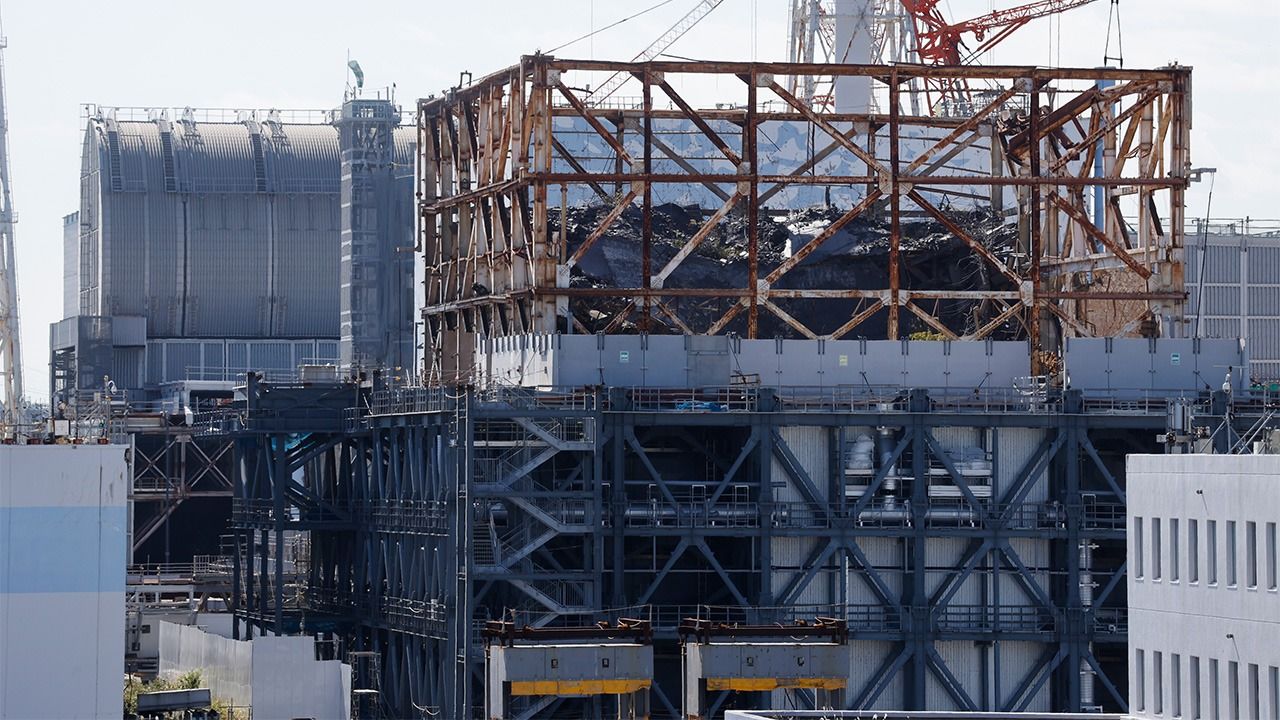
Standing on a rise from which the reactor buildings of Units 1 through 4 can be seen, one can tell at a glance that progress differs from unit to unit. Unit 1, its steel frame still exposed by the hydrogen explosion, conveys the ferocity of the accident. In the spent fuel pool inside, 392 nuclear fuel assemblies still remain, but debris from the building and large cranes have been left in place, obstructing the work of removal. In a separate area, assembly is underway on a large cover that will enclose the building to prevent radioactive material from scattering during the work.
1~4号機の原子炉建屋を見渡せる高台に立つと、各号機で作業の進捗(しんちょく)状況が異なることが一目で分かる。水素爆発によって建屋の鉄骨がむき出しになったままの1号機は、事故の苛烈さを伝える。内部の使用済み燃料プールには、現在も核燃料392体が残されているが、建屋のがれきや大型クレーンなどは放置され、取り出し作業の障害となっている。作業時の放射性物質飛散を防ぐために建屋を覆う大型カバーの組み立ては、別エリアで進められている。
Unit 2, which suffered a meltdown but escaped explosion, is surrounded by steel structural members for the work now being carried out. Unit 3 has an especially conspicuous appearance. A long, narrow domed roof has been installed on top to remove spent fuel, and it gleams with a dull silver sheen. All 566 fuel assemblies have already been removed. Unit 4, which was undergoing regular inspection at the time of the accident, avoided meltdown, but hydrogen flowed into it through piping from Unit 3 and caused an explosion. A structure installed to remove the 1,535 assemblies that had been in the fuel pool covers the building, making its overall form hard to discern.
メルトダウンしたものの爆発を免れた2号機は、作業のための鉄骨部材に囲われている。3号機はひときわ目立つ外観だ。上部に使用済み燃料を取り出すために長細いドーム屋根が設置され、鈍い銀色に輝く。すでに燃料566体は全て取り出しが終わっている。事故当時、定期点検(定検)中だった4号機はメルトダウンを免れたが、3号機から配管を通じて水素が流れ込み、爆発を起こした。燃料プールにあった1535体を取り出すための構造物が覆いかぶさるように設置され、全体像はうかがいにくい。
Directly beneath the buildings, radiation levels rise.建屋の直下、高まる放射線量
From the window of the minibus moving across the vast site, one notices rows upon rows of tanks storing treated water from which radioactive materials have been removed, clusters of containers holding waste, and large power-generation turbines once used here, left rusting in various places. Most of the debris has been cleared away, but here and there remain objects preserved as traces of the accident, such as a water storage tank badly dented by the tsunami. On a deck overlooking Units 5 and 6, part of the “shield machine” used to excavate the tunnel for discharging treated water into the sea has been preserved as a memorial object.
広大な敷地を移動するマイクロバスの車窓からは、汚染水から放射性物質を除去した処理水を貯蔵するタンク群、廃棄物を保管するコンテナ群が所狭しと並び、かつて使われていた発電用の大型タービンなどがさびたままあちこちに放置されているのが目につく。がれきはおおむね撤去されているが、津波によって大きくへこんだ貯水タンクなど、事故を伝える遺構として残されている物も点在する。5~6号機を望むデッキには、処理水を海洋放出するためのトンネル掘削に使われた「シールドマシン」の一部が記念として保存されている。
We get off the bus and walk around Unit 4 from the seaward side to the landward side. As we proceed, looking up at the buildings and structures we had seen from the rise, the severed cross-section of a huge duct reveals itself in a pitiful state. It once connected Units 1 through 4 to the exhaust stack, but it was cut away because it obstructed decommissioning work. On the structure of Unit 3, faint traces remain of the green agent that was sprayed on to keep adhering radioactive material from scattering, a sign left from the immediate aftermath of the accident.
バスを降りて4号機の海側から陸側へ徒歩で回り込む。高台から見た建屋、構造物を見上げるように進むと、巨大なダクトの切断面が無残な姿を見せている。かつては1〜4号機から排気塔へつながっていたが、廃炉作業の邪魔になるため切断されたものだ。3号機の構造物には、付着した放射性物質を飛散させないよう吹き付けられていた緑色の薬剤がうっすらと残り、事故直後の痕跡を示している。
As we continue north from Unit 3 toward the base of Unit 2, the radiation level rises. I find myself worrying about the reading on the personal dosimeter tucked into the chest pocket of the vest I am wearing. At Unit 2, work is underway to remove “nuclear fuel debris,” the mixture of nuclear fuel that melted and fell during the accident with surrounding structural materials; near the removal exit, workers clad in protective suits can be seen.
3号機からさらに北へ、2号機の足元へ進むに従い、放射線量が高まってくる。着用したベストの胸ポケットにしまった個人線量計の数値が気にかかる。2号機では、事故で溶け落ちた核燃料と周囲の構造物が混ざり合った「核燃料デブリ」の取り出し作業が行われており、搬出口付近では防護服に身を包んだ作業員の姿が見える。
To return to the seaward side, we pass between Units 2 and 3. The number on the ambient dose meter climbs, reaching 240 microsieverts per hour. Before there is time to study the extent of the damage to the buildings, the official guiding us urges us on and we break into a trot. “A few years ago it was over 300 microsieverts per hour,” the official says, but even now the effects of radiation are by no means something that can be ignored.
再び海側に向かうため、2、3号機の間を通り抜ける。空間線量計の数字は高まり、毎時240マイクロシーベルトを示した。建屋の損傷具合をじっくり見る間もなく、案内する担当者に先を促されて小走りする。担当者は「数年前は毎時300マイクロシーベルト以上ありました」と話すものの、いまなお放射線の影響は決して無視できない。
Once we emerge on the seaward side, a seawall completed in March this year stretches roughly one kilometer from north to south as a tsunami countermeasure. A wall 13.5 to 16 meters high, built from assembled concrete components, protects Units 1 through 4 from tsunami waves. It is designed to withstand even a Japan Trench tsunami, whose occurrence is assessed as imminent, and TEPCO explains that “even in the unlikely event of such a disaster, it can reduce the risk that contaminated water will flow outside the site and pollute the environment.”
海側に出ると、今年3月に完成した津波対策の防潮堤が南北約1キロにわたって延びている。コンクリートの部材を組み合わせて高さ13.5~16メートルの壁が築かれ、1~4号機を津波から保護する。発生が切迫していると評価される日本海溝津波にも対応できるもので、東電は「万一の際にも汚染水が外部へ流出して、環境を汚染するリスクを低減できる」と説明する。
The double burden of “water” and debris.「水」とデブリの「二重苦」
On November 7, TEPCO completed the removal from Unit 2’s primary containment vessel of a piece of debris about five millimeters in size, grasped with a specialized device. The operation will be used in considering methods for full-scale debris removal. A total of 880 tons of debris is estimated to exist inside the containment vessels of Units 1 through 3, and this has become “the greatest obstacle to decommissioning.” Takahiro Kimoto, deputy director of the Decommissioning Communication Center, says, “Thirteen and a half years after the accident, we have finally taken a step toward decommissioning. But the work is still only at the stage where it has just begun.”
東電は11月7日、専用の装置を使ってつかんだ5ミリ程度のデブリを2号機の原子炉格納容器から取り出す作業を完了した。本格的なデブリ取り出し工法の検討に生かされる。1~3号機の格納容器内には計880トンのデブリがあると推定され、「廃炉最大の難関」となっている。廃炉コミュニケーションセンターの木元崇宏副所長は「事故から13年半経ち、ようやく廃炉の一歩を踏み出したことになる。だが、作業は緒に就いたばかりの段階だ」と語る。
Although steady progress is being made in various areas, there is still no prospect of a fundamental solution to contaminated water, one of the major obstacles to decommissioning. Groundwater and rainwater flowing into the reactor buildings amount to 60 tons per day. Water injection to cool the reactors also continues, and 80 tons of contaminated water are generated every day, on average in fiscal 2023.
各所で着実な前進はあるものの、廃炉の大きな障害の一つとなっている汚染水の抜本的解決は見えていない。原子炉建屋へ流入する地下水や雨水は日量60トン。原子炉冷却のための注水も続けており、汚染水は毎日80トン(23年度平均)発生している。
TEPCO treats the contaminated water using the Advanced Liquid Processing System, or ALPS, and other equipment, and continues to store it in tanks on the site. It began releasing treated water into the sea in August 2023, and by November 5, 2024, had carried out ten releases totaling 78,285 tons. The total amount of tritium, a radioactive substance that cannot be removed because its chemical properties resemble those of water, came to about 14.8 trillion becquerels, but TEPCO says monitoring of the surrounding sea area has found no abnormalities.
東電は多核種除去設備(ALPS)などで汚染水を処理したうえで、敷地内のタンクで貯蔵を続けている。23年8月から処理水の海洋放出を始め、24年11月5日までに計10回、7万8285トンを放出した。化学的な性質が水に似ていて除去できない放射性物質トリチウムの総放出量は約14.8兆ベクレルになるが、東電は周辺海域のモニタリングで異常はないとしている。
Yet the release into the sea of treated water stored on the site is expected to take another thirty years, and it is difficult to reduce completely to zero the generation of contaminated water caused by the inflow of groundwater and rainwater. If the rows of tanks, multiplied by the struggle to deal with “water,” do not decrease, the overall decommissioning plan will be affected, including the installation of storage facilities for debris whose removal is expected to advance in the years ahead.
だが、敷地内に貯蔵される処理水の海洋放出には今後30年かかるとみられているうえ、地下水や雨水の流入による汚染水発生を完全にゼロすることは困難だ。「水」の処理に手間取って林立するタンクが減らなければ、今後取り出しが進むとみられるデブリの保管施設の設置など、廃炉計画全体に影響する。
Water and debris. How is the “double burden” of decommissioning work to be overcome? Deputy Director Kimoto says, “The challenge is how to curb the amount of contaminated water. If we can keep it from increasing and hold it stable, we will also be able to see a path for the decommissioning plan.”
水とデブリ。廃炉作業の「二重苦」をどう克服するのか。木元副所長は「汚染水の量をどのように抑制するかが課題だ。安定的に増えないようにできれば、廃炉計画のメドもつけられる」と語った。
Banner photo: Unit 1 of the Fukushima Daiichi Nuclear Power Station, its steel frame left exposed after the hydrogen explosion, in the foreground. The cylindrical dome visible behind it is Unit 3. Photographed on October 21, 2024, at TEPCO’s Fukushima Daiichi Nuclear Power Station. Photo by Hashino Yukinori, nippon.com editorial department.
バナー写真:水素爆発を起こし、鉄骨がむき出しのままになっている福島第1原発1号機(手前)。円筒形のドームが見えるのは3号機=2024年10月21日、東京電力福島第1原発(nippon.com編集部・土師野幸徳撮影)