Slavery was the air the Romans breathed
Classical reception changes when Rome’s political and cultural achievements are read through the labor regime that made them possible.
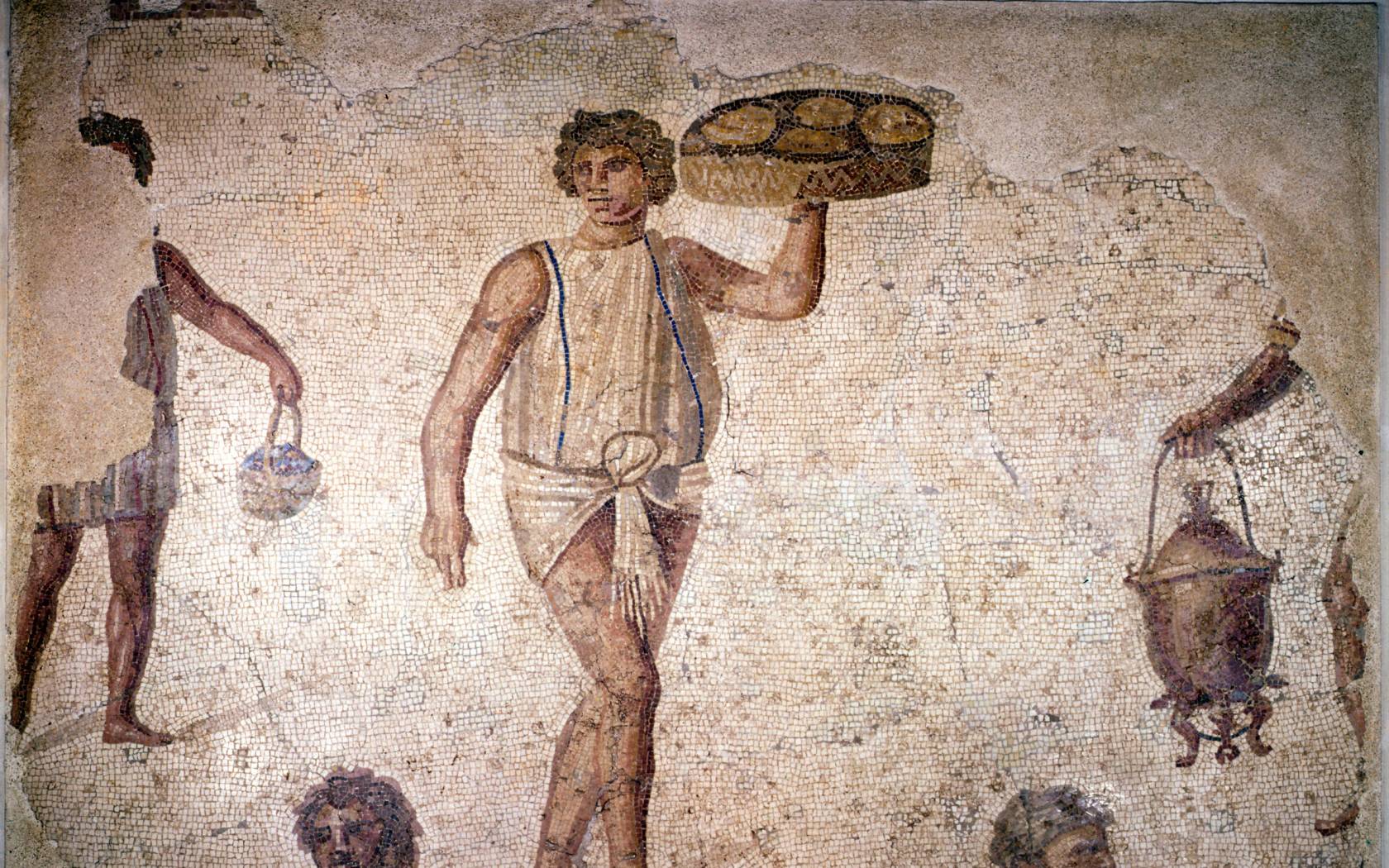
Slavery was the air the Romans breathed - June 15, 2026 - Orlando Gibbs - Themes: Ancient History, Books, Rome
With no first-person narratives surviving, Emma Southon draws skilfully on epigraphy to recover the lives of enslaved Romans. But her thin treatment of Roman comedy leaves a valuable source underexplored.
Servus: How Slavery Made the Roman Empire, Emma Southon, Hodder & Stoughton, £25
The focus of Emma Southon’s Servus – which diligently examines the evidence of the lives of enslaved people in imperial Rome – is more social than economic. It aims to be ‘an act of remembrance’ for these human beings and the daily brutality they faced. It was worryingly easy to become enslaved in Rome, whether through captivity in war, kidnapping by pirates and sale at a market, or simply by being born into it as a uerna (‘household slave’). Southon paints a visceral picture of the degrading violence that slavery made constantly possible. These were people viewed legally and culturally as living objects. Her vivid descriptions of the flagellum, the Roman whip, are gruesome but necessary. They allow the modern reader to truly comprehend the experience of being beaten.
Grisly tales of such violence include the famous story of Crassus, the richest Roman man in the 1st century BCE, defeating rebels led by Spartacus in the Third Servile War and crucifying 6,000 of them every three metres along the Appian Way, one of the major roads into Rome. We also shudder at the less well-known slaveowner Vedius Pollio, who would throw the ‘disobedient’ or ‘unsatisfactory’ into a pond to be eaten by huge moray eels. Southon prints the more typical translation of murenae as ‘lampreys’, but lampreys only eat cold-blooded creatures, and morays are big and aggressive enough to plausibly eat human beings. When it comes to this gruesome eel anecdote, we must bear in mind that such evidence has its limitations, often preserved over stories of everyday reality because it documents extreme cases. Even ancient figures such as Augustus, Seneca, and Dio criticised Pollio’s punishments as excessively severe.
Southon’s narrative of the three Servile Wars in the 2nd and 1st centuries BCE, led by Eunus in Sicily, Athenion in Sicily, and Spartacus in Italy and all around the Mediterranean, balances thrilling storytelling with meticulous source analysis. Her version of Eunus’ narrative is particularly compelling, and made me re-evaluate my own interpretation of his character according to Diodorus Siculus’ version; I should have given Eunus’ initial victories in Sicily more credit for being truly astonishing. The conclusion she draws from these wars is that enslaved people could and did mount temporarily successful challenges to Rome, that Rome’s response was merciless, but, most interestingly, that the system of Roman slavery had to adapt as a result. Stick could not remain the only tool of domination; carrot had to be used too.
The normalised cruelty of carrot and stick varied depending on location. Slavery in the imperial household differed drastically from the experience of slaves in the mines, mills, fields, or poorer areas of the city. In one of her strongest sections, Southon investigates the lives of those who were used for sex. Southon also explores manumission, its likelihood, and its priceless value to those who had been freed. She ends on a sobering but realistic note, pondering why Rome never saw its own abolition movement, and concluding that the system of slavery was so entrenched in ancient life that to replace it with anything else was unthinkable. It was simply the air that the Romans, and many other peoples, breathed.
The lively engagement with epigraphy is the book’s primary achievement. It extrapolates stories from the little text left behind: no complete first-person narrative of life as a Roman slave survives. Southon makes the salient point that, in the funerary inscriptional record, enslaved people did not always commemorate work or job title, but often their family lives. These stories are skilfully fleshed out, revealing brutal and short lives like those of the gladiators; love affairs between enslaved members of the same household; or hard-won but eventually easier existences like Pallas’ or Callistus’, both freedmen working for the Emperor Claudius who gained considerable influence over free aristocrats in the Senate. Some enslaved people may have been farm managers, forced to balance the demands of the slaveowner and labourers, like the possibly married Felix and Veneria; others may have been like Amica and Detfri, two friends who commemorated their friendship on a roof tile.
Southon’s style is informal. Her colloquial tone effectively captures quotidian life and aligns with some of the evidence included, such as domestic graffiti about who wants to kiss whom. It also repeatedly manifests in her calling any slaveowner a ‘f*cking prick’, or responding to flawed, sanitised descriptions of Roman slavery with ‘f*ck that’. Any Roman aristocrat, especially Cato the Elder, is given short shrift. When Cato’s life and thoughts about slavery are explained, he emerges as a thoroughly nasty character by modern standards; I am not sure, however, what this absolutist, expletive tone meaningfully adds to the strength of the analysis.
Part of this relaxed style is Southon’s humour, but this sits oddly with the book’s rigorous approach to the topic. Sexual innuendos about erect penises are accompanied by ‘(lol)’; the number 69 in a reference is accompanied by ‘(nice)’. As laudable as it is to make the subject relatable to modern readers, the frequent deployment of language such as ‘lol’, ‘prick’, and ‘dickhead’ detracts from the seriousness of what she has to say. The book is good without it. To Southon’s credit, I did chuckle at her discussion of attitudes towards enslaved bodies as constantly sexually available, typified in Horace Satires 1.2.116-19, a poem which culminates in ‘any hole’s a goal where slavery is concerned’. Sadly the reference, ‘Hor. Satires 2.116-19’ leaves it unclear whether book 1 or 2 of Horace’s Satires is being quoted.
Evidence impressively spans historiography, oratory, epigraphy, graffiti, satire, epigram, law, and some (but not enough) Roman comedy. This range is unsurprising, given that Southon’s career was once in academia, specialising in late antiquity, before leaving university teaching and research to write ancient history for a broader audience. These credentials, however, make the errors in the book concerning. The story of Emperor Vitellius brutally re-selling Asiaticus, an enslaved sex worker who had rejected Vitellius and tried to escape, into a gladiator school occurs in Tacitus’ Histories, not, as the endnote contends, his Annals. It is jarring that the columbarium, a burial chamber in an aristocratic house with dove-shaped niches where many serui in the household left inscriptions, is defined 118 pages after its first mention on page 30. The same goes for the poet Martial, whose biography arrives on page 257 after he has been used as evidence for most of the book. Secondary literature is referred to but not fully cited: influential works by the historians Boudewijn Sirks and Keith Hopkins are both in endnotes but not in the bibliography; this feels especially unfair for Keith Hopkins, who is slated for his arguably naive discounting of enslaved male farmers having sex with each other, but it is not possible to learn his opinion without knowing the publication date of the work in question, his highly influential Conquerors and Slaves.
There are methodological obstacles in using Roman comedy as a historical source, but the paucity of Southon’s treatment is a pity, especially in the case of Plautus. Southon finds that repeated references by enslaved characters to punishment are ‘troubling’, as she compares Plautus’ representation of slavery to Punch and Judy representations of domestic violence, which appears to preclude the usefulness of his plays. Conditions of slavery may, however, have been lived experience for Plautus and for those performing the plays.
Despite her excellent analysis of the brutality of enslaved mill-work, Southon does not mention Aulus Gellius’ story of Plautus labouring in mills to clear debts (Noctes Atticae 3.3). The anecdote is probably apocryphal, but adds depth to the ethos of his plays, in which oppressed characters are victorious for a limited time, and may suggest more tacit critique in mentions of punishment than first meets the eye. Equally, Southon’s moving analysis of pederasty could usefully include the intriguing monologue of an enslaved and anonymous boy in Plautus’ Pseudolus. The dialogue between a slaveowner and a freedman at the beginning of Terence’s Andria, for example, would have added depth to Southon’s material on freed people. Terence was Plautus’ celebrated successor and was allegedly brought to Rome as a child from Carthage and enslaved, but gained manumission through his wit, much like the later Syrian-born playwright Publilius Syrus, who is rightly celebrated by Southon.
Servus should be read by anyone with an interest in what imperial Rome was really like. Southon reveals the desensitised omnipresence of slavery in Roman life, most compellingly in her thought experiments that take readers on guided tours of a Roman street. In spite of the book’s flaws, it certainly delivers as an act of remembrance. A rebuttal of the view that Roman slavery ‘wasn’t that bad’, a refutation long established by academics, is now widely available.