Between Resistance and Fragmentation: The UGTT at a Crossroads
Between Resistance and Fragmentation: The UGTT at a Crossroads
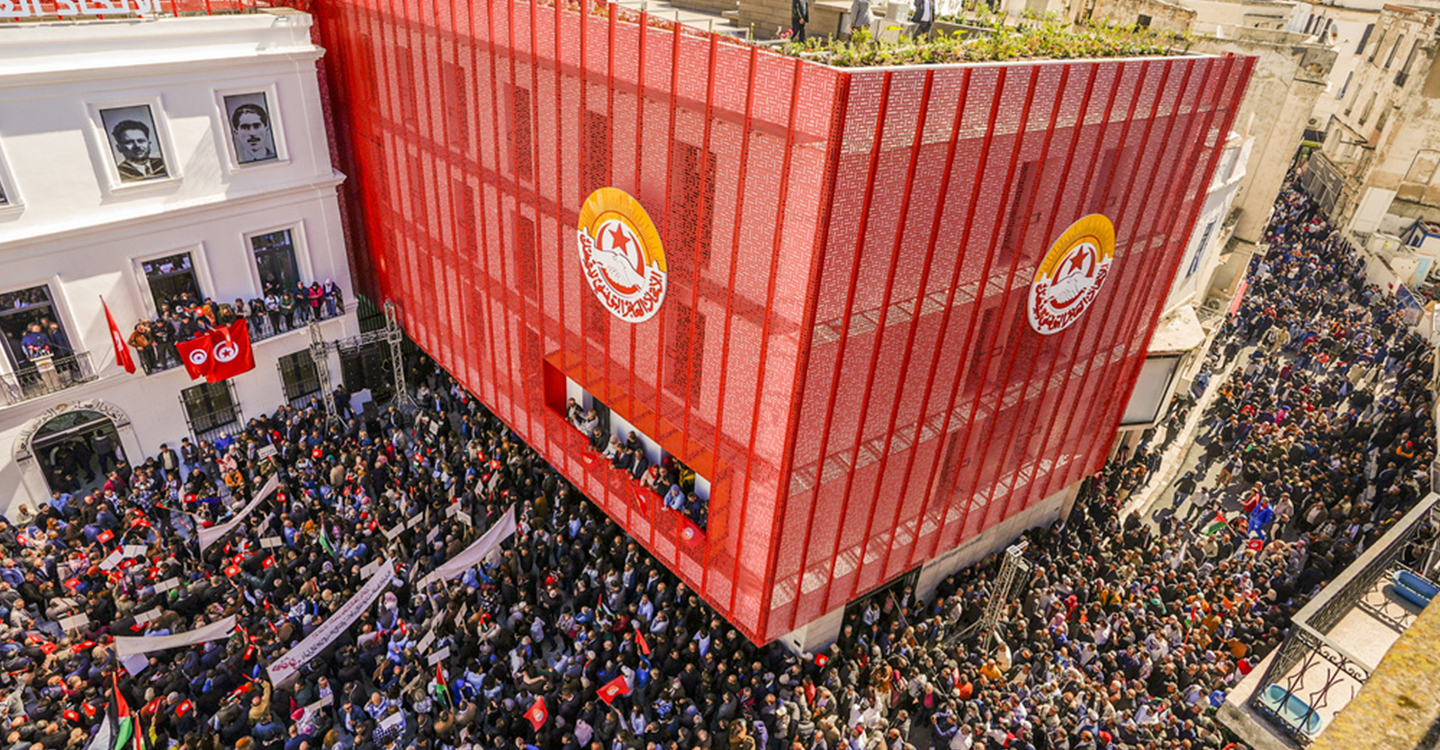
Nearly 15 years after helping to dismantle authoritarianism in Tunisia, the country's most powerful labor confederation — the General Union of Tunisian Workers (Union Générale Tunisienne du Travail, UGTT) — is once again at the center of a battle over the nation’s political and economic future. Following a series of attacks on its headquarters, staged by alleged supporters of President Kais Saied, the UGTT mobilized thousands of its members on 21 August 2025 to protest what its leaders described as “an attack on peaceful civil society organizations” and trade union rights.1Chaab news, (in Arabic) “UGTT secretary-general Noureddine Taboubi's speech at the national workers' rally on Thursday”, 21 August 2025, available at https://echaabnews.tn/ar/article/34603/
However, while the Union has faced authoritarian governments before, what distinguishes the current conflict is not Saied’s heavy-handed tactics, but the UGTT’s diminished ability to counter them. Historically, the Union has weathered state repression thanks to its unique organizational structure, consisting of a geographically dispersed network of local unions, a tradition of internal contestation and democratic practices that anchored its legitimacy, and deep ties to its grassroots. Today, however, internal divisions raise questions about whether the UGTT can still marshal the discipline and solidarity that enabled it to confront state power in the past. Indeed, growing factionalism and a fraying democratic culture have raised doubts about the leadership’s legitimacy and made the Union more vulnerable than at any point in its modern history.
This paper traces the origins of the current confrontation, placing it within the broader context of Tunisian labor activism, and assessing whether the UGTT can still serve as an effective check on the consolidation of Saied’s authoritarian rule. It argues that unless the Union confronts the deep divisions within its own ranks — from escalating infighting to the erosion of its once-robust internal democracy — it will struggle to rally the unified resistance necessary to halt Saied’s tightening grip on power.
From Optimism to Hostility: The UGTT’s Tumultuous Relationship with Kais Saied
To understand the current standoff between President Kais Saied and the UGTT, it is important to return to 2019, when Saied was first elected to office. As a relative political outsider and former professor of constitutional law,4Notably, in 2013 Kais Saied was one of the lawyers that aided the UGTT in drafting its proposed amendments for the country’s 2014 constitutional charter.
However, the Union’s cautious optimism that Saied would use his power to rein in corruption and stabilize Tunisia’s fragile democracy soon gave way to disillusionment as signs of the country’s authoritarian drift became clear. Rumors that the president had negotiated an austerity plan with the International Monetary Fund quickly sparked a strong backlash from the UGTT, which staged a nationwide strike on 16 June 2022 to protest the proposed subsidy cuts and wage freezes. Shortly thereafter, Saied unveiled a new constitution that confirmed his critics’ worst fears: rather than restoring democratic order, he sought to entrench a one-man rule. Drafted without consultation with key stakeholders,8While the UGTT was invited to engage in a “national dialogue” regarding the referendum in May 2022, the Union rejected this offer over a perception that the process “ignore[d] influential political actors” and determined roles unilaterally. Rather than engaging the democratically elected parliament in the drafting process, Saied appointed a loyalist law professor to head a body charged with re-writing the 2014 Constitution, which the UGTT had a critical role in drafting. Yosra Ouanes, “Tunisie: le décret relatif au référendum sur une nouvelle Constitution ‘ne nous engage pas’, dit la centrale syndicale,” Agence Andalou 25 May 2022; “Tunisia union to boycott President Saied’s national dialogue,” Al-Jazeera 23 May 2022, https://www.aljazeera.com/news/2022/5/23/tunisia-union-calls-for-strike-rejects-president-dialogue-move
For the UGTT, which built its post-2011 reputation on defending democratic compromise, the reforms represented a betrayal of the hard-won victories it had achieved in the aftermath of the Tunisian revolution. Although the UGTT leadership refrained from formally instructing its members to boycott the referendum so as not to fracture its politically heterogeneous base, it later condemned the regime’s direction, denouncing its authoritarian maneuvers. As UGTT Secretary-General Noureddine Taboubi commented in December 2022: “[The UGTT] no longer accept[s] the current path because of its ambiguity and individual rule, and the unpleasant surprises it hides for the fate of the country and democracy.”9“Tunisia trade union ‘no longer accepts’ the president’s agenda,” Al-Jazeera, 3 December 2022, https://www.aljazeera.com/news/2022/12/3/tunisia-trade-union-no-longer-accepts-presidents-agenda
In the years since the adoption of the new constitution, the UGTT’s relationship with the Saied regime has oscillated between uneasy restraint and open confrontation. At times, the Union has perceived Saied as a tactical ally — particularly in his clashes with Ennahdha, a longstanding rival of the UGTT. Yet, these brief convergences have been overshadowed by rising hostility, as the Union has also spearheaded some of the largest demonstrations against Saied’s tightening grip on power, including a 3,000-person protest in 2023 over the arrest of 20 opposition figures. Saied, for his part, has responded with an escalating crackdown designed to discredit and isolate the Union. Over the past two years, his government has invoked cybercrime laws to prosecute journalists and human rights activists,10“Tunisia: Cybercrime decree used against critics,” Human Rights Watch, 7 November 2023, https://www.hrw.org/news/2023/12/19/tunisia-cybercrime-decree-used-against-critics
At the same time, Saied has systematically excluded the Union from key economic decisions, seeking to erode the influence of what was once the country’s foremost social partner. This exclusion aligns seamlessly with the broader logic of his populist project: to cast himself as the sole defender of an imperiled nation while marginalizing any institution capable of mounting resistance. The tripartite negotiations, which, for decades, formed the backbone of Tunisia’s social contract — linking the state, employers, and labor — have repeatedly been suspended, fueling frustration across both the public and private sectors. Moreover, the unilateral adoption of policies typically negotiated with the Union’s input, such as adjustments to the Guaranteed Interprofessional Minimum Wage (SMIG)13These changes, which went into effect on 1 January 2025, raised the guaranteed minimum wage by 7.5% for professions in the agricultural and non-agricultural sectors. “The new minimum wage in Tunisia: what changes for salaries in the private and public sectors,” La Presse, 26 January 2025, https://www.lapresse.tn/2025/01/26/le-nouveau-smig-en-tunisie-ce-qui-change-pour-les-salaires-dans-les-secteurs-prive-et-public/
A Legacy of Defiance: The UGTT’s History of Labor Opposition
This confrontation marks a dangerous return to earlier periods of Tunisian history when authoritarian leaders sought to break or tame the UGTT. Since its founding in 1946, the Union has been more than a labor confederation — it has functioned as a political actor in its own right, operating as a hybrid of a workers’ organization and an opposition movement.15Yousfi, Hèla. Trade Unions and Arab Revolutions : The Tunisian Case of UGTT. Routledge, 2019.
This delicate balance between accommodation and resistance persisted under Ben Ali. At the top of the Union, elements of the executive bureau were actively co-opted, frequently collaborating with the regime to demobilize militant federations or to sideline leftist organizers. Yet, this co-optation never fully penetrated the UGTT’s regional and sectoral structures, where grassroots activists preserved the Union’s capacity for resistance.18Yousfi, Hèla. Trade Unions and Arab Revolutions : The Tunisian Case of UGTT. Routledge, 2019.
This hybrid posture — simultaneously embedded in and resistant to the authoritarian state — became decisive for the UGTT’s fortunes in 2011. When anti-regime protests erupted in Sidi Bouzid in 2010, the UGTT’s regional and sectoral branches deployed their organizational infrastructure to transform local unrest into a revolutionary uprising. While the executive bureau engaged in formal negotiations with the regime, union militants and regional leaders expanded the protest movement to major urban centers and held a series of rolling strikes against the regime.20Anderson, Ashley. 2025. Labor Unions and Democratic Unrest in North Africa: Protest and Resistance in Tunisia and Morocco, Cambridge University Press; Beinin, Joel. 2015. Workers and Thieves: Labor Movements and Popular Uprisings in Tunisia and Egypt, Stanford University Press ; Yousfi, Hela. 2015. L’UGTT, Une Passion Tunisienne : Enquête Sur Les Syndicalistes En Révolution, 2011-2014. Med Ali Édition.
Across these episodes of mobilization, the UGTT’s nationalist credentials and organizational cohesion were central to its ability to successfully oppose authoritarian rule. Before the Union’s 1978 strike against the Bourguiba regime, Secretary-General Habib Achour revitalized the UGTT’s internal bureaucracy, expanding opportunities for rank-and-file participation and presiding over the first union congress free from government intervention since independence.22Kraïem, Mustapha. 2011. Etat et société dans la Tunisie Bourguibienne. La Maghrébine pour l'Impression et la Publication du Livre.
Challenges to Continued Opposition
Today, however, the UGTT’s capacity for effective political resistance has been constrained by its internal struggles. Within the Union, traditionally militant federations (i.e., the education, health, and banking sectors) coexist alongside a small pro-Saied contingent and an apolitical wing that prefers to avoid political opposition in favor of a greater focus on economic concerns. These divisions complicate collective action, forcing the leadership to balance the preservation of political influence with the need to maintain internal unity.25Bishara, Dina, and Sharan Grewal. “Political, Not Partisan: The Tunisian General Labor Union under Democracy”, Comparative Politics, 54, no. 3 (2022) 453–475.
Meanwhile, the UGTT’s own democratic credentials have foundered, giving unexpected resonance to many of Saied’s vitriolic critiques. For example, the repeal of existing term limits on executives at the Union's 2021 Sousse Congress has triggered accusations of creeping centralization under Secretary-General Noureddine Taboubi, with some members accusing Taboubi of trying to "monopolize the [UGTT]’s leadership.”27Anonymous trade unionist quoted in Ben Rajeb, Mohamed. “The decline of Tunisia's most powerful trade union.” Qantara, 7 April 2025.
Figure 1: Trust in selected Tunisian institutions, 2024 (Arab Barometer)
Importantly, in a political environment marked by disillusionment and economic despair, this narrative has found fertile terrain. Public confidence in civil society organizations across Tunisia remains low. As data from the Arab Barometer shows (Figure 1), strong majorities view organized groups — including parties, NGOs, and unions — as less trustworthy than key pillars of the Saied regime (i.e., the president, police, and army). In his recent attacks against the UGTT, Saied has leveraged this sentiment to accuse the Union’s leadership of “squandering taxpayer money” with repeated strikes and to justify government investigations into its financing.29Official Facebook page of the Tunisian Presidency, https://www.facebook.com/Presidence.tn/
Finally, compounding the Union’s troubles has been the rise of rival labor organizations since the 2011 revolution, most notably the Union of Tunisian Workers (UTT, Union des Travailleurs Tunisiens). Led by former UGTT Secretary-General Ismail Sahbani, the UTT has faced its own accusations of corruption,31Notably, Ismail Sahbani was a former UGTT official who was tried and sentenced to a year in prison on charges of corruption during the Ben Ali regime.
Conclusion
Ultimately, whether the UGTT can overcome its current challenges and prevail in its confrontation against Kais Saied hinges on two key factors: its ability to restore its internal democracy and its capacity to reconnect with ordinary Tunisians. The Union’s historical advantages remain significant. Its legacy continues to command legitimacy — the UGTT is woven into Tunisia’s national history of independence and democracy in ways that no other actor can attempt to replicate. It also remains the only institution capable of forcing the Saied administration to yield, as demonstrated by the recent transportation strike that brought thousands into the streets and shuttered large portions of the economy. On the international stage, the UGTT continues to benefit from extensive networks that can amplify pressure on the government and complicate Saied’s image abroad.
Yet the obstacles the UGTT faces are profound. The institutional landscape that once allowed it to peacefully mediate political crises — as it did in 2014 — has all but disappeared. Kais Saied has dismantled most independent checks on his power, the parliament is weak, and the opposition is hopelessly fragmented. Meanwhile, soaring inflation, persistent unemployment, and effective repression campaigns have drained public energy for protest, even among the Union’s most loyal supporters. In such conditions of widespread apathy and economic hardship, sustained collective mobilization is increasingly difficult to achieve.
In the long arc of Tunisia’s modern history, the UGTT has faced down autocrats before — and won. It survived Bourguiba’s paternalism, withstood Ben Ali’s repression, and steered the country through a revolutionary transition that many feared would implode. Today’s confrontation thus carries a familiar ring: once again, a would-be strongman is attempting to consolidate power by attacking the UGTT. But, unlike his predecessors, Saied wields a potent new weapon — popular frustration. He has convinced many Tunisians that the country’s institutions have failed them, and that centralized rule offers the only cure for dysfunction. According to the latest results from the Arab Barometer, 77% of Tunisians continue to have quite a lot or a great deal of trust in Saied, while concerns about the same issues that brought him to power —persistent unemployment, high cost of living, and political instability — remain at an all-time high.33Arab Barometer, Wave VII, Tunisia, https://www.arabbarometer.org/media-news/arab-barometer-reveal-findings-from-major-tunisia-survey/
Left unchallenged, that narrative could render the UGTT’s resistance impotent. Still, Tunisia’s history offers an important antidote. When the country’s rulers sought to erode the UGTT’s legitimacy, the Union has often responded with renewed vigor and solidarity. If the UGTT’s leaders can successfully reenergize its base and frame its struggle not merely as a fight for wages but as a defense of Tunisia’s democratic future, it may yet reclaim its historical role at the vanguard of political opposition. However, should the Union proceed on its current path of democratic decline, the country may lose its final line of defense against a dangerous return to autocratic rule.
Endnotes
The views represented in this paper are those of the author(s) and do not necessarily reflect the views of the Arab Reform Initiative, its staff, or its board.