Food Poisoning from Free Nutritious Meals Reached 20,000 Cases in 2025
The mass poisoning cases linked to Indonesia’s Free Nutritious Meals program reveal how hurried, centralized implementation and weak food-safety governance turned a welfare initiative into a public-health risk.
● Keracunan akibat Makan Bergizi Gratis (MBG) tembus 20 ribu kasus sepanjang 2025.
● Poisoning from Free Nutritious Meals (MBG) surpassed 20,000 cases over the course of 2025.
● Sekitar 11 ribu dapur MBG belum tersertifikasi dan mengabaikan standar keamanan pangan.
● Around 11,000 MBG kitchens remain uncertified and are neglecting food-safety standards.
● The situation has been worsened by the centralized and hurried implementation of MBG in pursuit of government targets.
● Situasi ini diperparah oleh pelaksanaan MBG yang terpusat dan tergesa-gesa demi kejar target pemerintah.
Poisoning from Free Nutritious Meals (MBG) surpassed 20,000 cases over the course of 2025. Even into early 2026, poisoning cases continued to number in the thousands.
Keracunan akibat Makan Bergizi Gratis (MBG) tembus 20 ribu kasus sepanjang 2025. Bahkan hingga awal 2026, kasus keracunan masih terus tembus angka ribuan.
Our analysis, using report data from health facilities in Indonesia, found 177 extraordinary events (KLB) caused by MBG-related poisoning in 127 regencies/cities and 33 provinces over the past year.
Analisis kami menggunakan data laporan fasilitas kesehatan di Indonesia menemukan ada 177 kejadian luar biasa (KLB) akibat keracunan MBG di 127 kabupaten/kota dan 33 provinsi sepanjang tahun lalu.
From our data analysis and interviews, it emerged that the principal cause of the mass poisonings was the weak application of food-safety standards, the result of MBG’s centralized and rushed implementation.
Dari hasil analisis data dan wawancara yang kami lakukan, terungkap bahwa faktor utama penyebab keracunan massal adalah lemahnya penerapan standar keamanan pangan akibat pelaksanaan MBG yang terpusat dan tergesa-gesa.
Weak Food-Safety StandardsStandar keamanan pangan lemah
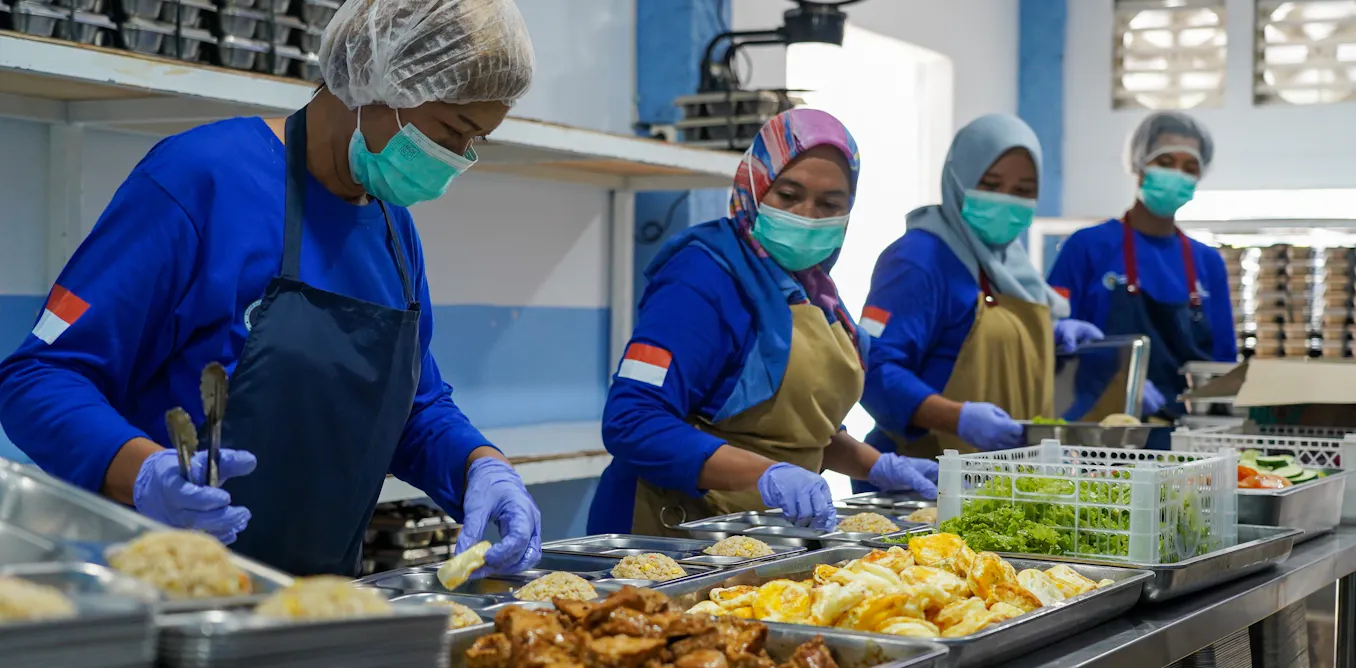
Our interviews with 162 health surveillance officers found various violations of basic food-safety principles in MBG implementation. Among them: MBG kitchen staff, known as Nutrition Fulfillment Implementation Units (SPPG), cooked without complete personal protective equipment, practiced poor handwashing, and stored raw food ingredients at improper temperatures.
Wawancara kami dengan 162 petugas surveilans (pemantauan) kesehatan menemukan berbagai pelanggaran prinsip dasar keamanan pangan dalam pelaksanaan MBG. Di antaranya, petugas dapur MBG alias Satuan Pelaksana Pemenuhan Gizi (SPPG) memasak tanpa alat pelindung diri lengkap, melakukan praktik mencuci tangan yang buruk, serta menyimpan bahan mentah makanan pada suhu yang tidak tepat.
Cooked MBG meals were also left at room temperature for seven to eight hours before being consumed. This duration far exceeds the safe four-hour food-storage limit recommended by the World Health Organization (WHO).
Makanan matang untuk MBG juga dibiarkan dalam suhu ruang selama 7–8 jam sebelum dikonsumsi. Durasi ini jauh melampaui batas aman penyimpanan makanan selama empat jam yang direkomendasikan oleh Organisasi Kesehatan Dunia (WHO).
Ideally, cooked food that is not consumed immediately should be stored in a refrigerator at a maximum temperature of 5°C (Celsius).
Idealnya, makanan yang sudah dimasak harus disimpan di lemari pendingin dengan suhu maksimal 5°C (Celcius) ketika tidak dikonsumsi secara langsung.
Storing food beyond the safe time limit increases the risk of bacterial growth, including E. coli, Salmonella, Campylobacter, and Staphylococcus. This array of dangerous bacteria was shown to have caused most MBG poisoning cases, based on laboratory testing conducted by the Ministry of Health.
Penyimpanan makanan melebihi batas waktu aman meningkatkan risiko pertumbuhan bakteri, seperti E. coli, Salmonella, Campylobacter, dan Staphylococcus. Deretan bakteri berbahaya tersebut terbukti menyebabkan sebagian besar kasus keracunan MBG berdasarkan hasil uji laboratorium yang dilakukan Kemenkes.
The cleanliness of MBG kitchens and tableware was also extremely poor. Food containers, for example, were often dried with wiping cloths; fruit was not washed by the proper method; kitchen utensils were merely wiped down without sterilization; and sanitation in the kitchen environment was poor.
Kebersihan dapur dan alat makan MBG juga sangat buruk. Contohnya, wadah makanan sering dikeringkan menggunakan kain lap, buah tidak dicuci dengan metode yang benar, peralatan dapur hanya dilap tanpa sterilisasi, serta sanitasi lingkungan dapur buruk.
Such conditions risk becoming another gateway for bacterial growth, including bacteria carried by flies.
Kondisi tersebut berisiko jadi pintu masuk lain bagi pertumbuhan bakteri, termasuk yang dibawa oleh lalat.
Apart from bacterial contamination, a minority of poisoning cases were caused by contamination with the chemical nitrite. This substance is used to control bacteria and as a food preservative, as in the case of the mass poisoning of 1,315 students in West Bandung, West Java.
Selain kontaminasi bakteri, minoritas kasus keracunan disebabkan oleh kontaminasi bahan kimia nitrit. Zat ini digunakan sebagai pengendali bakteri sekaligus pengawet makanan, misalnya, dalam kasus keracunan massal 1.315 siswa di Bandung Barat, Jawa Barat.
Tens of Thousands of MBG Kitchens UncertifiedBelasan ribu dapur MBG tak tersertifikasi
Weak early-detection and incident-response systems in the field have compounded the risk of mass poisoning from MBG. We found that this occurred because local health offices were not optimally involved in the planning, implementation, and monitoring of the project.
Lemahnya sistem deteksi dini dan respons kejadian di lapangan memperparah risiko keracunan massal akibat MBG. Kami menemukan, hal ini terjadi karena dinas kesehatan daerah tidak dilibatkan secara optimal dalam perencanaan, pelaksanaan, dan pemantauan proyek ini.
MBG implementation has so far been highly centralized. The National Nutrition Agency (BGN), formed only about four months before the program was launched, was assigned to coordinate MBG implementation nationally through the SPPG.
Pelaksanaan MBG selama ini sangat terpusat. Badan Gizi Nasional (BGN)—yang baru dibentuk sekitar empat bulan sebelum program diluncurkan—ditugaskan untuk mengoordinasikan pelaksanaan MBG secara nasional melalui SPPG.
Yet BGN only began requiring every MBG kitchen to hold a hygiene and sanitation feasibility certificate (SLHS) in September 2025, nine months after thousands of victims had already fallen ill as a result of the Free Nutritious Meals rollout.
Namun, BGN baru mewajibkan setiap dapur MBG tersebut untuk memiliki sertifikat laik higiene sanitasi (SLHS) per September 2025 alias sembilan bulan setelah ribuan korban berjatuhan akibat pelaksanaan Makan Bergizi Gratis.
Applying SLHS can guarantee the quality of food and environmental safety. However, we found that only 198 MBG kitchen units had SLHS out of a total of 11,592 units in operation. In other words, around 98 percent of MBG kitchens still lacked this certification and continued operating.
Penerapan SLHS dapat menjamin kualitas keamanan pangan dan lingkungan. Namun, kami menemukan hanya 198 unit dapur MBG yang memiliki SLHS dari total 11.592 unit yang beroperasi. Artinya, sekitar 98% dapur MBG belum mengantongi sertifikasi ini dan tetap beroperasi.
In addition to SLHS, BGN’s guidelines recommend that MBG kitchens meet the international standard for food-safety management systems, known as hazard analysis and critical control point (HACCP). Yet BGN reported that only 26 MBG kitchen units met HACCP standards.
Selain SLHS, BGN dalam pedomannya merekomendasikan dapur MBG untuk memenuhi standar internasional sistem manajemen keamanan pangan alias hazard analysis and critical control point (HACCP). Namun, BGN melaporkan hanya 26 unit dapur MBG yang memenuhi HACCP.
According to BGN, every SPPG is required to have a dedicated officer who supervises the application of daily food-safety standards, such as cooking methods and food storage.
Setiap SPPG menurut BGN, wajib memiliki petugas khusus yang mengawasi penerapan standar keamanan pangan harian, seperti cara memasak dan penyimpanan makanan.
This task appears to be placed solely on nutrition officers, of whom there is only one in each MBG kitchen. As a result, their workload is grossly unbalanced. On the other hand, nutritionists have the primary obligation of ensuring that the MBG menu meets nutritional standards every day.
Tugas ini tampaknya hanya dibebankan pada petugas gizi—yang hanya tersedia satu orang per dapur MBG. Akibatnya, beban kerja mereka sangat tidak berimbang. Karena di sisi lain, ahli gizi memiliki kewajiban utama untuk memastikan menu MBG sesuai standar gizi setiap harinya.
Rushed Production Neglects SafetyProduksi kejar tayang abaikan keamanan
Under the technical guidelines for MBG management, each MBG kitchen unit is required to produce 3,000 meal portions for 15 to 20 schools.
Berdasarkan petunjuk teknis pengelolaan MBG, tiap unit dapur MBG wajib memproduksi tiga ribu porsi makanan untuk 15–20 sekolah.
In reality, many MBG kitchens produce more than 3,500 portions per day in order to pursue the government’s target of 82.9 million beneficiaries by the end of 2025. On top of that, MBG kitchens must provide food for posyandu, or integrated health-service posts, every month.
Faktanya, banyak dapur MBG yang memproduksi lebih dari 3.500 porsi per hari demi mengejar target pemerintah 82,9 juta penerima manfaat di akhir 2025. Belum lagi, dapur MBG harus menyediakan makanan bagi posyandu tiap bulan.
Without a strict food-safety management system, this minimally evaluated race to meet production targets risks adding to the workload of MBG kitchen staff and neglecting food-safety standards. The cooking process, for instance, can continue late into the night.
Tanpa sistem manajemen keamanan pangan yang ketat, agenda kejar tayang minim evaluasi ini justru berisiko menambah beban kerja petugas dapur MBG dan mengabaikan standar kemananan pangan. Proses memasak makanan, misalnya, bisa berlangsung hingga larut malam.
Food Safety Is Not NegotiableKeamanan pangan tak bisa ditawar
To prevent food-poisoning cases, every MBG kitchen must apply HACCP and the WHO’s five keys to safer food.
Untuk menghindari kasus keracunan makanan, tiap dapur MBG wajib menerapkan HACCP dan lima kunci keamanan pangan dari WHO.
One requirement is monitoring temperature control points so that food is protected from the risk of microbial contamination. For example, if freshly cooked food is to be stored in a refrigerator, it must pass through two cooling stages to prevent bacterial growth.
Salah satunya kewajiban memantau titik kendali suhu agar makanan aman dari risiko terkontaminasi mikroba. Misalnya, jika makanan yang baru matang ingin disimpan di lemari pendingin, makanan tersebut harus melewati dua tahap pendinginan agar tidak ditumbuhi bakteri.
First, lower the temperature from 60°C to 20°C within a maximum of two hours. Second, continue cooling it to 4°C within two to four hours.
Pertama, turunkan suhu dari 60°C ke 20°C dalam waktu maksimal dua jam. Kedua, lanjutkan pendinginan hingga 4°C dalam waktu 2-4 jam.
All temperature measurements must use calibrated thermometers and be documented in a temperature logbook.
Semua pengukuran suhu harus menggunakan termometer terkalibrasi dan didokumentasikan dalam buku laporan (log) suhu.
In addition to temperature control points, raw and cooked ingredients must be strictly separated. Food that has passed the safe time limit for consumption must be discarded and must not be served.
Selain titik kendali suhu, pisahkan bahan mentah dan matang secara ketat. Makanan yang melewati batas waktu aman dikonsumsi, wajib dibuang dan tidak boleh disajikan.
It must also be ensured that every MBG kitchen worker applies hygiene standards at every stage of MBG management, from ingredient preparation through the distribution process for school students.
Pastikan pula setiap personel dapur MBG menerapkan standar higienitas di semua tahapan pengelolaan MBG, mulai dari penyiapan bahan hingga proses distribusi untuk siswa sekolah.
The application of these technical food-safety standards will not be effective without clear governance, routine supervision by local health professionals, and periodic independent audits.
Penerapan standar teknis keamanan pangan ini tidak akan efektif tanpa tata kelola yang jelas, pengawasan rutin oleh profesional kesehatan setempat, serta audit berkala yang independen.
The government also needs to invest in essential infrastructure, such as routine thermometer calibration, adequate refrigerators and freezers, sterilization equipment, access to clean water, and kitchen facilities that meet the standards for large-scale food management.
Pemerintah juga perlu berinvestasi pada penyediaan infrastruktur penting, seperti kalibrasi termometer rutin, lemari pendingin dan freezer memadai, peralatan sterilisasi, akses air bersih, serta fasilitas dapur yang memenuhi standar pengelolaan makanan skala besar.
Implementation must be carried out gradually, using food-safety rules and practices that are tightly supervised and involve multiple sectors.
Penerapannya harus dilakukan secara bertahap, menggunakan aturan dan praktik keamanan pangan yang diawasi ketat dengan melibatkan lintas sektor.
Involve health offices, especially community health centers (puskesmas), as well as schools, education offices, and the public in routine MBG oversight. This includes a school-based disease-monitoring system to accelerate the response to extraordinary events.
Libatkan dinas kesehatan (terutama puskesmas), sekolah-dinas pendidikan, dan masyarakat dalam pengawasan rutin MBG. Ini termasuk sistem pemantauan penyakit berbasis sekolah untuk mempercepat respons penanganan kejadian luar biasa.
Another important step is to conduct operational research to identify barriers to implementation, as well as a cost-benefit analysis of MBG, in order to evaluate the program’s long-term sustainability.
Hal penting lainnya, lakukan riset operasional untuk mengidentifikasi hambatan penerapan, serta analisis biaya-manfaat MBG, guna mengevaluasi keberlanjutan program dalam jangka panjang.