Election-Fraud Theory Occupies a “Loose Platform”
The essay traces how Threads, with its loose, horizontal architecture and Instagram-fed reach, became a staging ground where Korea’s Olympic Park protest against alleged election fraud organized itself, amplified conspiracies, and consumed its own fractures.
It must have been around last summer that I installed the app called Threads. It was entirely because of Instagram. Instagram had cunningly placed posts linked to Threads among posts uploaded by my Instagram “friends.” Whenever I happened to click one of those links, a pop-up would appear telling me I had to install a new application. After this pattern repeated several times, I finally installed it. Even then, I did not use it often. Occasionally I would enter search terms related to self-improvement, and the algorithm naturally guided me toward similar posts.
‘스레드(Threads)’라는 애플리케이션을 설치한 것은 지난해 여름 즈음이었을 것이다. 순전히 인스타그램 때문이었다. 인스타그램은 스레드와 연동되는 게시글을 인스타 ‘친구’들이 올린 게시물 사이에 교묘하게 배치했다. 그 링크를 어쩌다 한 번씩 클릭하면 애플리케이션을 새로 설치해야 한다는 팝업창이 떴다. 이런 패턴을 몇 번이나 거듭한 끝에 결국 설치했다. 하지만 설치하고 나서도 자주 사용하지 않았다. 가끔 자기 계발과 관련된 검색어를 입력하니, 알고리즘도 자연스레 유사한 게시물로 나를 안내했다.
The Threads algorithm began to show a different face after this year’s local elections. On June 3, election day for the local elections, an unprecedented incident occurred at some polling stations: ballots ran short, and voting was temporarily suspended. People angered by the “damage to suffrage” gathered on June 5 at Olympic Park in Songpa-gu, Seoul. Around that time, posts began to appear one by one in my Threads algorithm certifying that their authors had been to the Olympic Park rally. In a video of about a minute uploaded by one user, rally participants were waving the Taegeukgi and the Stars and Stripes while chanting, “Fraudulent election, new election; hand-count same-day votes.”
스레드 알고리즘이 다른 양상을 보이기 시작한 것은 이번 지방선거 이후다. 6월3일 지방선거 본투표일 일부 투표소에서 투표용지가 부족해 투표가 일시적으로 중단되는 초유의 사태가 발생했다. ‘참정권 훼손’에 분노한 사람들이 6월5일 서울 송파구 올림픽공원으로 모여들었다. 그 무렵 내 스레드 알고리즘에 올림픽공원 집회에 다녀왔다고 인증하는 게시물이 하나둘 걸리기 시작했다. 어느 이용자가 올린 1분 남짓 영상에서 집회 참가자들은 태극기와 성조기를 흔들며 “부정선거 재선거, 당일투표 수개표”라는 구호를 외치고 있었다.
On the afternoon of June 15, I met three men and women in their twenties who had stayed at Olympic Park before moving to the front of the Blue House, where they were calling for a “new election.” When I asked at Olympic Park what social media they used, one woman answered specifically, “Mostly Threads.” In mid-June, I created a new account and set “fraudulent election” and “Olympic Park” as topics of interest. An entirely different world opened up. After only a few searches, the Threads home screen was plastered with allegations of election fraud.
6월15일 오후, 올림픽공원에 머물다 청와대 앞으로 자리를 옮겨 ‘재선거’를 외치는 20대 남녀 세 명을 만났다. 올림픽공원에서 어떤 소셜미디어를 사용하는지 물으니, 한 여성이 “주로 스레드를 쓴다”라고 콕 집어 대답했다. 6월 중순, 새로운 계정을 만들어 ‘부정선거’ ‘올림픽공원’을 관심 주제로 설정해봤다. 전혀 다른 세상이 펼쳐졌다. 몇 번의 검색만으로 스레드의 메인 화면은 부정선거 의혹으로 도배됐다.
Threads is a text-centered social media platform launched by Meta in July 2023. It contrasts with its “sister” platform Instagram, which is based on photographs and videos. Threads can be linked to an Instagram account. The low threshold for Instagram users to sign up played a decisive role in Threads’ early growth. According to the data analytics solution Wiseapp Retail, Instagram’s average monthly number of users in Korea from January to April this year was 28.08 million. Threads, which steadily moved up in weight class over the same period, had an average monthly user count of 7.29 million, fewer than X, formerly Twitter, at 7.95 million, but similar to Facebook at 7.47 million.
스레드는 2023년 7월 메타가 출시한 텍스트 중심 소셜미디어 플랫폼이다. ‘자매’ 플랫폼 인스타그램이 사진·동영상을 기반으로 한 것과 대비된다. 스레드는 인스타그램과 계정을 연동할 수 있다. 인스타그램 이용자들에게 가입 문턱이 낮다는 특징은 스레드 초기 성장에 결정적 구실을 했다. 데이터 분석 솔루션 와이즈앱·리테일에 따르면 올해 1~4월 인스타그램의 국내 월평균 사용자 수는 2808만명이었다. 같은 기간 꾸준히 체급을 올린 스레드의 월평균 사용자 수는 729만명으로, 엑스(X·옛 트위터, 795만명)보다 적으나 페이스북(Facebook·747만명)과 비슷했다.
Because it is text-centered social media, the user experience resembles X. On the home screen, one can scroll endlessly downward to check new posts, “like” a post and leave a comment, or “repost” or share it. Posts can be written within a limit of 500 characters. Apart from the hashtag function, when uploading a post one can set a single “topic”; if one clicks that word on a post where the topic is displayed, the screen moves to a page searching that word. The structure makes it possible to find and read posts that have set the same word as their topic more quickly.
텍스트 중심 소셜미디어이다 보니, 이용 경험은 X와 유사하다. 홈 화면에서 끊임없이 스크롤을 내려 새로운 게시물을 확인할 수 있으며, 게시물에 ‘좋아요’를 누르고 댓글을 달거나, 게시물을 ‘리포스트(재게시)’ 또는 공유할 수 있다. 게시글은 500자 이내로 작성 가능하다. 해시태그 기능과 별개로 게시글을 올릴 때 ‘주제’를 하나 설정할 수 있는데, ‘주제’가 표시된 게시물에서 해당 단어를 클릭하면 화면은 그 단어를 검색한 페이지로 넘어간다. 같은 단어를 주제로 설정한 글을 더 빠르게 찾아 읽을 수 있는 구조다.
Until now, YouTube has often been singled out as the main stage on which political suspicions or public opinion take shape. Around the time the ballot shortage occurred in the June 3 local elections and people began gathering at Olympic Park, YouTube was once again the platform with the strongest influence. YouTubers who gained strength during the martial-law emergency still hold the microphone, with relatively solid subscriber bases. A representative example is the channel Goh Seong-guk TV, with 1.34 million subscribers, which this time uploaded videos of visits to Olympic Park, delivering hot dogs and sorting trash for recycling. The channel Lee Bong-kyu TV, whose subscribers approach one million, also rode this current by editing and uploading videos of Olympic Park participants. Instagram, with its large number of users, was also heated. According to Sometrend, a social media analysis tool, mentions of “fraudulent election” on Instagram, meaning the number of posts containing the analyzed term, soared from 44 on June 2 to 608 on June 5. Mentions of “Olympic Park,” which before the local elections had remained at about 100 a day, rose to 698 on June 7.
그동안 정치적 의혹이나 여론이 형성되는 주무대로 흔히 유튜브를 지목했다. 6월3일 지방선거에서 투표용지 부족 사태가 발생하고, 사람들이 올림픽공원에 모이기 시작할 무렵에도 유튜브는 역시나 가장 강력한 영향력을 지닌 플랫폼이었다. 비상계엄 국면에서 득세한 유튜버들은 지금까지도 비교적 탄탄한 구독층을 보유하며 마이크를 쥐고 있다. 대표적으로 구독자 134만명을 보유한 채널 ‘고성국TV’는 이번에 올림픽공원에 방문해 핫도그를 배달하고, 쓰레기를 분리수거하는 영상을 올렸다. 채널 ‘이봉규TV’도 구독자가 100만명에 육박하는데, 올림픽공원 참가자 영상을 편집해 올리며 이 흐름에 편승했다. 이용자 수가 많은 인스타그램 역시 뜨거웠다. 소셜미디어 분석 도구인 썸트렌드에 따르면, 인스타그램 내 ‘부정선거’ 언급량(분석 단어가 포함된 게시글 수)은 6월2일 44건에서 6월5일 608건으로 폭증했다. 지방선거 전에는 하루 100여 건에 머물던 ‘올림픽공원’ 언급량도 6월7일에는 698건으로 늘었다.
That Olympic Park and election fraud emerged as hot keywords on Threads, which is linked to Instagram, is to some extent a natural result. But the way Olympic Park rally participants used Threads differed somewhat from X or YouTube, which were used mainly to “certify” participation in the rally. From the early days of the Olympic Park rally, Threads became a platform for recruiting volunteers. When someone doing volunteer work posted a volunteer recruitment notice on Threads, someone else who saw it volunteered. On June 14, too, a volunteer recruitment post went up on Threads. It said volunteers were being recruited by dividing tasks among a “recycling team” to organize trash, a “safety support team” to maintain order, a “runner team” to deliver donated food to each gate, and a “gate support team” to assist gates that were short-handed. The post, which surpassed 5,000 views, drew a string of comments saying people would come to help. Recruitment posts uploaded on other dates also received comments such as “I’ll go if I have time” and “What kind of work would I be doing?”
인스타그램과 연동된 스레드에서 올림픽공원과 부정선거가 뜨거운 키워드로 떠오른 현상은 어느 정도 당연한 결과다. 하지만 올림픽공원 집회 참가자들의 스레드 이용 방식은 집회 참여를 ‘인증’하는 데 주로 사용된 X나 유튜브와는 조금 달랐다. 올림픽공원 집회 초기부터 스레드는 자원봉사자를 모집하는 플랫폼이 됐다. 자원봉사를 하던 누군가가 스레드에 봉사자 모집글을 올리면, 이를 본 다른 누군가가 지원했다. 6월14일에도 자원봉사자 모집글이 스레드에 올라왔다. 쓰레기를 정리하는 ‘분리수거팀’, 질서 유지를 관리하는 ‘안전지원팀’, 지원받은 음식을 각 게이트에 배달하는 ‘러너팀’, 인원이 부족한 게이트를 지원하는 ‘게이트지원팀’을 나눠 자원봉사자를 모집한다는 내용이었다. 조회수가 5000회를 넘긴 이 글에는 ‘도우러 가겠다’는 댓글이 줄을 이었다. 또 다른 날짜에 올라온 모집글에도 “시간 되면 가겠다” “어떤 일을 하게 되냐”라는 댓글이 달렸다.
Election-fraud theory occupies a “loose platform.”‘느슨한 플랫폼’ 점거한 부정선거론
Why Threads? The banner the Olympic Park rally participants have most stubbornly raised has been “voluntary participation with no affiliation.” In the early days, the Olympic Park rally even set rules for itself. Posters were put up around Olympic Park saying, “Shout only for a new election and against the infringement of suffrage; wave only the Taegeukgi,” and asking people to refrain from election-fraud slogans and the Stars and Stripes. After the weekend, the mainstream shifted to the “American flag” forces, and the slogans changed along with it to “Fraudulent election, new election; hand-count same-day votes,” but the atmosphere still emphasized the “purity” of individuals participating freely. Threads is free from the framing of “YouTuber merchants aiming for Super Chat donations.” There is no small handful of channels monopolizing the algorithm. There is the protective screen of anonymity, and anyone can exchange conversation without much burden through short texts. Jung Min-cheol, vice chair of the Democratic Party of Korea’s policy committee, operator of the social media channel “Jung Min-cheol’s Is This Real?” and author of The 1020 Far Right Is Coming, put it this way: “Before that, Threads was not a platform with a clear political tendency. Perhaps they needed a platform of their own that no one had monopolized?” The features of Threads, resembling a loose and horizontal square, may have touched on what the Olympic Park rally participants wanted to pursue.
왜 스레드일까. 그동안 올림픽공원 집회 참가자들이 가장 완강하게 내세운 기치는 “소속이 없는, 자발적인 참여”였다. 집회 초기, 올림픽공원 집회는 스스로 규칙을 규정하기도 했다. ‘재선거와 참정권 침해만 외칠 것, 태극기만 흔들 것’이라며, 부정선거 구호와 성조기를 자제해달라는 내용이 담긴 대자보가 올림픽공원 곳곳에 붙어 있었다. 주말을 넘기면서 대세는 ‘성조기’ 세력으로 넘어가고, 구호도 덩달아 “부정선거 재선거, 당일투표 수개표”로 바뀌었지만, 개인이 자유롭게 참여했다는 ‘순수성’을 강조하는 분위기는 여전했다. 스레드는 ‘슈퍼챗 후원을 노리는 유튜버 장사꾼’이라는 프레이밍에서 자유롭다. 알고리즘을 독점하는 소수의 채널도 없다. 익명이라는 보호막이 있고, 짧은 텍스트로 누구나 부담 없이 대화를 주고받을 수 있다. ‘정민철의 이거 진짜예요?’라는 이름의 SNS 채널 운영자이자 책 〈1020 극우가 온다〉 저자인 정민철 더불어민주당 정책위원회 부의장(25)은 이렇게 말했다. “스레드는 그전까지 정치 성향이 분명한 플랫폼이 아니었다. 아무도 독점하지 않은 그들만의 플랫폼이 필요하지 않았을까?” 느슨하고 수평적인 광장을 닮은 스레드의 특징이, 올림픽공원 집회 참가자들이 추구하고 싶었던 바와 맞닿았을 수 있다.
Even at Olympic Park, where the slogans have changed from the early rallies that cried only for a “new election,” not a few people in their twenties and thirties are still coming. At 7 p.m. on Wednesday, July 1, a weekday, the Taegeukgi and the Stars and Stripes were fluttering at Olympic Park. Between 10,000 and nearly 12,000 people were gathered there as a floating population, according to Seoul real-time city data. By age group, those in their thirties or younger accounted for about 40 percent. Waving the two flags from side to side, they shouted the slogan “Fraudulent election, new election.”
‘재선거’만 외치던 초창기 집회와는 구호가 달라진 올림픽공원에도, 여전히 적지 않은 2030이 찾아오고 있다. 평일인 7월1일 수요일 오후 7시 올림픽공원에는 태극기와 성조기가 나부끼고 있었다. 올림픽공원에 1만명에서 1만2000명 가까운 유동 인구가 모였다(서울 실시간 도시데이터 기준). 연령대별로 보면 30대 이하가 약 40%를 차지했다. 이들은 두 국기를 좌우로 흔들며 “부정선거 재선거”라는 구호를 외쳤다.
What worldview are the Olympic Park rally participants sharing on Threads? I looked at whether the election-fraud conspiracy theory was gaining a response there. Even before the local elections, there had been some posts introducing “evidence of election fraud,” but they were not numerous. They were mostly uploaded by users highly involved in politics. I visited the personal page of one Threads user who, in October 2025, had posted that “bundles of new bills” had been found in the 2022 Gyeonggi-do superintendent of education election. The user, whose nickname was “National Team ○○○,” identified himself in his profile as a supreme council member of Freedom and Innovation. To another user’s post saying she “wanted to enlighten her husband,” he recommended System War Master Plan, a book explaining the December 3 emergency martial law as a “system war”; and he responded “Destroy communism!” to a certification post about holding a rally condemning election fraud at Hwajeong Station in Goyang, Gyeonggi-do.
올림픽공원 집회 참가자들은 스레드에서 어떤 세계관을 공유하고 있을까. 스레드에서 부정선거 음모론이 호응을 얻고 있는지 살펴봤다. 지방선거 이전부터 ‘부정선거 증거’를 소개하는 게시물은 일부 있었지만, 그 수가 많지는 않았다. 주로 정치 고관여층 이용자들이 올렸다. 2022년 경기도교육감 선거에 ‘신권 다발’이 발견됐다는 내용의 게시물을 2025년 10월에 올린 한 스레드 이용자의 개인 페이지에 들어가봤다. 닉네임 ‘국대○○○’인 이용자는 프로필 소개란에 자신을 ‘자유와혁신 최고위원’이라고 밝히고 있었다. 그는 ‘남편을 계몽하고 싶다’는 다른 이용자의 게시물에 12·3 비상계엄이 ‘체제 전쟁’이라고 설명하는 책 〈체제전쟁 마스터플랜〉을 추천하는가 하면, 경기 고양시 화정역에서 부정선거 규탄 집회를 열었다는 인증글에 “멸공!”이라고 호응했다.
Through the local elections, posts explaining the election-fraud conspiracy theory more kindly seemed to increase. On June 21 and 22, one user repeatedly posted “evidence of election fraud” under the topic “Jamsil democratization movement.” The user shared AI-made explanatory materials, claiming that the National Election Commission had improperly written numbers by hand on “unnumbered paper” before distributing it, or that in Excel data released by the commission the number of ballots did not match the number of voters. As the election-fraud theory spread, posts to the effect that Yoon Suk Yeol had been right also received attention. Election fraud was one of the justifications Yoon Suk Yeol gave for declaring the December 3 emergency martial law. When one Threads user wrote, “Inside the Republic of Korea, we are fighting anti-state forces, communism. Trump can side with Korea only if he knows Korea is firmly pro-American and anti-China. The president who can make that possible is Yoon Suk Yeol,” responses followed: “That is neatly organized,” and “President Yoon Suk Yeol must be released now.”
지방선거를 거치면서 부정선거 음모론을 더욱 친절하게 설명하는 게시글이 늘어난 것으로 보였다. 한 이용자는 6월21일과 22일 이틀 동안 ‘잠실 민주화운동’이라는 주제를 달아 ‘부정선거 증거’를 여러 번 게시했다. 선관위가 ‘무번호지’에 수기로 번호를 적어서 배부한 게 잘못됐다거나, 선관위가 공개한 엑셀 자료에서 투표용지와 투표자 수가 맞지 않았다며 AI로 만든 설명 자료를 함께 공유했다. 부정선거론이 퍼지면서 윤석열이 옳았다는 취지의 게시물도 관심을 받았다. 부정선거는 윤석열이 12·3 비상계엄을 선포한 명분 중 하나였다. 한 스레드 이용자가 “대한민국 내부에서는 반국가 세력(공산주의)과 싸우고 있다. 한국이 확실한 친미 반중 상태임을 알아야 트럼프가 한국 편을 들 수 있다. 이게 가능한 대통령은 윤석열이다”라는 내용의 글을 올리자 “정리가 깔끔하다” “윤석열 대통령님이 지금 석방되어야 한다”라는 호응이 이어졌다.
Rumors even more absurd than the election-fraud theory were also made and spread on Threads. The first was the “Eye of Providence.” On June 10, a Threads user uploaded a photograph of a container installed in front of the Olympic Park Gymnastics Arena and posted that the eye-shaped image drawn on top of the container “seems to be the Eye of Providence.” The Eye of Providence, a design in which an eye is inserted at the center of an equilateral triangle, is a symbol of the “Illuminati,” said to be a secret organization manipulating world power from behind the scenes. The post was shared roughly 1,000 times and reposted more than 700 times. Posts saying “I saw the Eye of Providence too” followed one after another. The image identified as the “Eye of Providence” was an advertisement for a pharmaceutical company’s eye-nutrition supplement.
부정선거론보다 황당한 괴담들이 스레드에서 만들어지고 퍼지기도 했다. 처음은 ‘전시안’이었다. 6월10일 한 스레드 이용자가 올림픽공원 체조경기장 앞에 설치된 컨테이너 사진을 올리면서, 컨테이너 위에 그려진 눈 모양 그림을 두고 “전시안인 것 같다”라는 내용의 게시물을 올렸다. 정삼각형 중앙에 눈이 삽입된 형태의 도안을 의미하는 전시안은 세계 권력을 뒤에서 조종하는 비밀조직이라고 이야기되는 ‘일루미나티’의 상징물이다. 해당 게시물은 1000여 차례 공유되고 700번 넘게 리포스트됐다. 자신도 전시안을 목격했다는 게시물이 줄줄이 올라왔다. ‘전시안’이라 지목된 해당 그림은 제약회사의 눈 영양제 광고였다.
The rumor that began with the “Eye of Providence” did not end as a one-off. At last a new conspiracy theory appeared: that a “human sacrifice,” a ritual offering people as victims, was being carried out inside the Handball Gymnasium. This followed a June 11 post saying “there is a burning smell inside the stadium” and the sharing on Threads of a short video showing an underground entrance near gates 1-3 of the Handball Gymnasium being welded from the inside. Combined with the “Eye of Providence” rumor raised the day before, all manner of grotesque interpretations appeared. “When riot police suppression begins, won’t people be crushed to death if they are pushed into a dead end, a stairway with the exit blocked?” “They are trying to induce a crushing death and offer a human sacrifice.” As the welding video was rapidly shared, it planted an unfounded anxiety that “a major disaster could happen.” The fear created by rumor eventually entered reality. On the night of June 17, the thirteenth day of the rally, a man in his thirties caused a disturbance in front of gates 1-3 of the Handball Gymnasium. Repeating the words “They are killing people in there,” he injured himself with a weapon before being arrested by police.
‘전시안’에서 시작된 괴담은 일회성으로 끝나지 않았다. 급기야 핸드볼경기장 내부에서 사람을 제물로 바치는 의식인 ‘인신 제사’가 이루어지고 있다는 새로운 음모론이 등장했다. 6월11일 ‘경기장 안에서 탄내가 난다’라는 게시글과 핸드볼경기장 1-3번 게이트 인근 지하 출입구를 내부에서 용접하는 짧은 영상이 스레드에 공유되면서다. 전날 제기된 ‘전시안’ 괴담까지 더해지면서 각종 기괴한 해석들이 등장했다. “경찰기동대 진압이 시작될 때 막다른 길(출입구가 막힌 계단)에서 사람들이 밀리면 압사당하는 것 아니냐” “압사를 유발해 인신 제사를 드리려는 것이다.” 해당 용접 영상은 빠르게 공유되면서 “큰 참사가 생길 수 있다”라는 근거 없는 불안을 심었다. 괴담이 만들어낸 공포는 결국 현실로 이어졌다. 집회 13일째 되던 6월17일 밤, 한 30대 남성이 핸드볼경기장 1-3번 게이트 앞에서 소란을 피웠다. 이 남성은 “저 안에서 사람을 죽이고 있다”라는 말을 반복하며 흉기로 자해하다 경찰에 체포됐다.
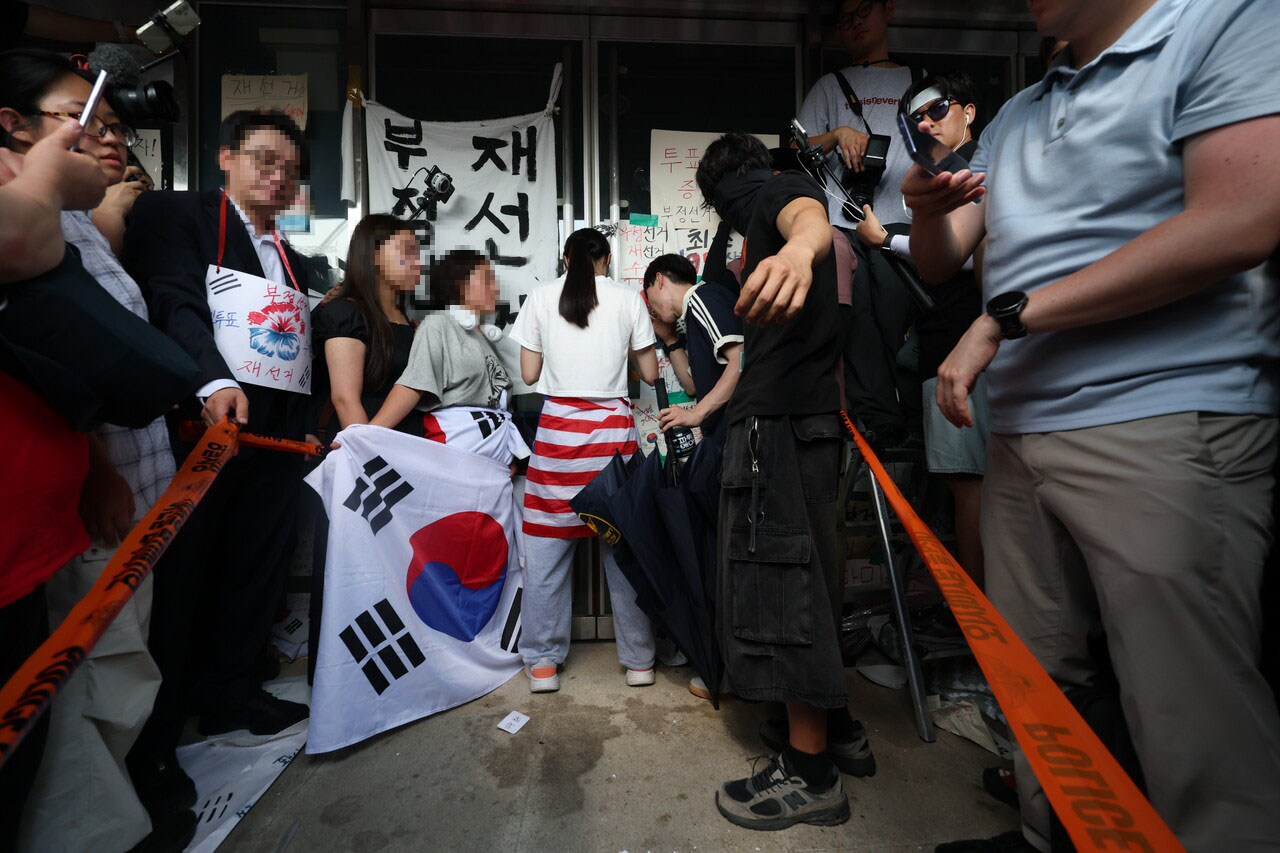
“Hero tales” were also produced through Threads. On June 16, after People Power Party lawmakers negotiated with some rally participants, it was decided that employees of sports organizations would be allowed to enter. The employees tried to go in through gate 2-1, but failed when a young woman with the Stars and Stripes wrapped around her waist blocked them. Threads users at the Olympic Park rally called this woman “Oldark,” a portmanteau of “Olympic Park” and “Joan of Arc.” An AI-composited image putting armor on the woman’s face was also shared on Threads.
‘영웅담’도 스레드를 거치며 생산됐다. 6월16일 국민의힘 의원들이 집회 참가자 일부와 협상한 끝에 체육단체 직원들의 출입을 허용하기로 했다. 직원들은 2-1번 게이트로 진입하려고 했지만, 성조기를 허리에 두른 한 젊은 여성이 막아서면서 무산됐다. 올림픽공원 집회의 스레드 이용자들은 문을 막아선 이 여성을 ‘올림픽공원’과 ‘잔다르크’를 합성해 ‘올다르크’라 불렀다. 이 여성의 얼굴에 갑옷을 입힌 AI 합성 사진도 스레드에 공유됐다.
While rumors and hero tales were being cultivated side by side, the loose freedom of the “square” returned as poison. The old conflict became visible between the group that had led the early rally and insisted that only “new election” should be shouted, and supporters of Freedom and Innovation who shouted “fraudulent election” and “Korea-U.S. joint investigation.” The conflict that erupted on June 28 in front of gate 2-3 of the Handball Gymnasium was broadcast on Threads in its entirety, deepening the rift further.
괴담과 영웅담이 나란히 배양되는 동안, ‘광장’의 느슨한 자유로움은 독이 되어 돌아왔다. 초반 집회를 주도했던 ‘재선거’만을 외쳐야 한다는 무리와 ‘부정선거’와 ‘한·미 공조수사’를 외치는 자유와혁신 지지 세력 간의 해묵은 갈등이 가시화했다. 6월28일 핸드볼경기장 2-3번 게이트 앞에서 폭발한 갈등은 스레드에 고스란히 중계되면서 골이 더욱 깊어졌다.
Jeon Han-gil is a “provocateur”; fatigue is “because of orders.”전한길은 ‘프락치’, 피로감은 ‘지령 탓’
On the night of June 28, when several young male participants tried to cover with Taegeukgi flags the placards already posted on the outer wall about “fraudulent election,” “same-day voting,” and the Association of World Election Bodies, A-WEB, which has been identified as a “force behind election fraud,” they clashed roughly with those who opposed them. A video was shared on Threads showing a young man who called for a new election shoving and knocking down a middle-aged man who believed a Korea-U.S. joint investigation was necessary. Some Threads users claimed those men had deliberately tried to cover the words “fraudulent election,” calling them a “youth group acting under orders from the People Power Party” and “provocateurs.” Mocking claims that “they came from Cambodia, the scam compounds,” based on tattoos on the young man’s body in the video, came to dominate the feed.
6월28일 밤 젊은 남성 참가자 몇몇이 기존 외벽에 붙어 있던 ‘부정선거’ ‘당일투표’ 그리고 ‘부정선거의 배후 세력’이라 지목받는 ‘세계선거기관협의회(A-WEB)’ 관련 손팻말을 태극기로 가리려고 하자, 이를 반대하는 세력과 거칠게 부딪쳤다. 재선거를 주장하는 젊은 남성이 한·미 공조수사가 필요하다고 보는 중년 남성을 밀쳐 넘어뜨리는 영상이 스레드에 공유되었다. 몇몇 스레드 이용자는 해당 남성들이 ‘부정선거’ 단어를 의도적으로 가리려 한 것이라며, “국민의힘 지령을 받은 청년 단체” “프락치”라고 주장했다. 영상 속 청년의 신체에 새겨진 문신을 두고 “저들은 캄보디아(스캠 단지)에서 왔다”라는 조롱 섞인 주장이 피드를 장악했다.
The arrows were also aimed at Jeon Han-gil, a former lecturer who had tried to mediate the situation on-site. Jeon is a figure who has vigorously pushed the election-fraud conspiracy theory since immediately after the December 3 emergency martial law. Yet when he took an attitude that seemed to represent the young men, “Threads opinion” turned cold. Fierce denunciations poured out: “Return to private life,” “So you were an Enchufado, someone connected to power.” The jeering even led to a “Jeon Han-gil provocateur controversy.”
화살은 현장에서 상황을 중재하려던 전직 강사 전한길씨에게도 향했다. 전씨는 12·3 비상계엄 직후부터 부정선거 음모론을 세차게 주장해온 인물이다. 그러나 그가 젊은 남성들을 대변하는 듯한 태도를 취하자 ‘스레드 여론’은 싸늘하게 뒤집혔다. “자연인으로 돌아가라” “엔추파도스(Enchufados·권력과 연결된 사람)였구나”라는 맹비난이 쏟아졌다. 야유는 ‘전한길 프락치 논란’으로까지 이어졌다.
As the conflict intensified, many of those who had insisted on shouting only “new election” left Olympic Park. The three young people who moved the rally site to the front of the Blue House as early as June 15 explained, “It is true Olympic Park has become a symbolic space, but we wondered whether an effective voice would be delivered, so we came here.” Kwon, a man in his twenties, said, “I think there should be a new election, but I don’t think a Korea-U.S. joint international investigation is right. Since it happened in our country, our country should resolve it.” Even so, when asked, “Are you trying to draw a line between yourselves and those who claim election fraud?” all three were cautious about answering and kept their words spare.
갈등이 심해지면서 ‘재선거’만 외쳐야 한다고 주장하던 이들 중 상당수는 올림픽공원을 떠났다. 6월15일 일찌감치 청와대로 집회 자리를 옮긴 청년 세 명은 “올림픽공원이 상징적인 공간이 된 것은 맞지만, 실효성 있는 목소리가 전달될지 의문이라 (청와대 앞으로) 왔다”라고 설명했다. 20대 권 아무개씨는 “재선거를 해야 한다고 생각하지만 한·미 공조 국제수사는 아닌 거 같다. 우리나라에서 일어난 일이니 우리나라가 해결해야 한다”라는 의견을 표했다. 그러면서도 “부정선거를 주장하는 사람들과 선을 그으려는 것인가”라는 질문에는 세 명 모두 답하기 조심스럽다며 말을 아꼈다.
On the afternoon of June 27, near Hongik University Station in Mapo-gu, Seoul, a youth group called “BOSS Hongdae” continued a rally with a single-digit number of participants. They used only the new-election slogan and the Taegeukgi. They explained that if one brought up the phrase election fraud, the path to sympathy regardless of political tendency would be blocked. This looked less like a break with the election-fraud conspiracy theory than a strategic judgment, but in Olympic Park, which even they had left, there remained only a deadlock with no exit.
6월27일 오후 서울 마포구 홍대입구역 인근에서 ‘BOSS 홍대’라는 청년 단체가 한 자릿수 인원으로 집회를 이어갔다. 이들은 재선거 구호와 태극기만을 사용했다. 부정선거라는 단어를 꺼내면 정치 성향에 관계없이 공감할 수 있는 길이 막히기 때문이라고 이들은 설명했다. 부정선거 음모론과의 절연이라기보다는 전략적 판단에 가까워 보이지만, 이들마저 떠나버린 올림픽공원에는 출구 없는 교착만이 남았다.
At 11 a.m. on July 1, I opened Threads once more. The “Jeon Han-gil provocateur” controversy, which had kept the algorithm hot until the day before, had already subsided somewhat. When I refreshed the home screen, the algorithm, as if it had been waiting, lined up new posts. One post, uploaded about an hour earlier by a user who had set a Taegeukgi as the profile picture, caught my eye. It was a post taking aim at some users who had complained of fatigue as the rally dragged on.
7월1일 오전 11시, 스레드를 다시 한번 열었다. 전날까지도 알고리즘을 뜨겁게 달군 ‘전한길 프락치’ 논란은 그새 한풀 꺾여 있었다. 메인 화면을 새로고침 하니 알고리즘이 기다렸다는 듯이 새로운 게시물을 나열했다. 태극기로 프로필 사진을 설정한 한 이용자가 약 한 시간 전에 올린 글이 눈에 들어왔다. 집회가 오랜 시간 이어지면서 피로감을 호소한 일부 이용자를 저격하는 글이었다.
“It seems orders have come down! ‘I worked hard at Olgong, the Olympic Park rally, and did everything I had to do’; ‘There are too many people stirring up strange discord’; ‘So I’m tired, Olgong is over’ — it seems like a strategy to sap our strength with this repertoire. You can filter out posts like that.” This new “rumor” received 5,600 likes in six hours and was reposted by more than 700 people.
“지령 내려온 듯합니다! ‘나는 올공(올림픽공원 집회) 열심히 했고 할 것 다 했다’ ‘이상한 분란 일으키는 사람이 너무 많다’ ‘그래서 지쳤다 올공은 끝났다’ 이 레퍼토리로 힘 빠지게 하려는 전략 같습니다. 저런 글은 거르시면 됩니다.” 이 새로운 ‘괴담’은 6시간 만에 5600명이 ‘좋아요’를 누르고, 700여 명이 리포스트했다.
On the afternoon of July 2, the National Assembly’s special committee for a parliamentary investigation, which is looking into the ballot shortage in the local elections, entered the Handball Gymnasium with police cooperation. It was the twenty-seventh day since the Olympic Park rally began. But it was unable to carry out the ballot boxes. About 380 ballot boxes from across Songpa-gu, along with ballots and other materials, are still being stored inside, without having been removed.
7월2일 오후, 지방선거 투표용지 부족 사태를 살피고 있는 국회 국정조사특별위원회(국조특위)가 경찰의 협조로 핸드볼경기장에 진입했다. 올림픽공원 집회가 시작된 지 27일 만이다. 그러나 투표함을 반출하지는 못했다. 송파구 전역의 투표함 약 380개와 투표지 등이 반출되지 못한 채 여전히 그 안에 보관돼 있다.
- Half of men in their twenties answered that it was a “deliberately fraudulent election” [Public Opinion Survey on Voter Perceptions After the June 3 Local Elections] In the June 3 local elections, the National Election Commission caused an unexpected uproar. At 26 polling stations nationwide, voting was briefly suspended and then resumed because ballots ran short. The place where voting was suspended the longest was...
- 20대 남성의 절반이 ‘고의적 부정선거’라고 답했다 [6·3 지선 이후 유권자 인식 여론조사] 6·3 지방선거에서 선거관리위원회는 뜻밖의 파문을 일으켰다. 투표용지가 부족해 투표가 잠시 중단됐다가 재개되는 일이 전국 26개 투표소에서 발생했다. 투표가 가장 오래 중단된 곳은...
- In June 2026, Korea’s young right experienced a sense of political efficacy. At 3:30 p.m. on Sunday, June 7, I got off at exit 3 of Olympic Park Station on Seoul Subway Line 5. I saw a vendor selling the Taegeukgi and the Stars and Stripes together. Up to this point, it was the usual scene of a “rally condemning election fraud”...
- 2026년 6월, 한국의 젊은 우파들이 정치적 효능감을 경험했다 6월7일 일요일 오후 3시30분, 서울 지하철 5호선 올림픽공원역 3번 출구에 내렸다. 태극기와 성조기를 함께 파는 상인이 보였다. 여기까지는 여느 ‘부정선거 규탄 집회’ 풍경과 ...
- There were holes at every stage: how should the National Election Commission be rebuilt? The Election Commission’s mismanagement produced a calamity. Digging into it revealed that there were more polling stations with “ballot shortages” than the initial count had shown. According to the findings announced by the National Election Commission on June 8, the ninth nationwide simultaneous local...
- 모든 단계에서 구멍이 있었다, 선관위를 어떻게 고쳐 쓸까? 선거관리위원회의 관리 부실이 참극을 낳았다. 파헤쳐보니 ‘용지 부족’ 투표소가 초기 집계보다 많았다. 중앙선거관리위원회(중앙선관위)가 6월8일 발표한 조사 결과, 제9회 전국동시지...
- The election-fraud conspiracy theory has weakened and become isolated [Public Opinion Survey on Voter Perceptions After the June 3 Presidential Election] Through Yoon Suk Yeol’s removal and the June 3 presidential election, fractures appeared among election-fraud conspiracy theorists. At the same time, the firm judgment of a majority of the public toward their election-fraud conspiracy theory was also confirmed. SisaIN, after Yoon Suk Yeol’s removal...
- 부정선거 음모론, 약해지고 고립됐다 [6·3 대선 이후 유권자 인식 여론조사] 윤석열 파면과 6·3 대선을 거치며 부정선거 음모론자 사이에 균열이 발생했다. 동시에 이들의 부정선거 음모론에 대한 국민 다수의 단호한 평가도 확인됐다.〈시사IN〉은 윤석열 파면 ...
- Interview with the head of the National Election Commission’s response team for election-fraud suspicions: “There is no election fraud.” As Yoon Suk Yeol was impeached on April 4 and an early presidential election was confirmed, the National Election Commission established an “election-fraud suspicion” response unit to monitor suspicions of election fraud spreading on YouTube and social media and rapidly prepare response materials...
- 선관위 부정선거 의혹 대응반장 인터뷰 “부정선거는 없다” 4월4일 윤석열이 탄핵되어 조기 대선이 확정됨에 따라 중앙선거관리위원회(선관위)는 유튜브·SNS에 확산되는 부정선거 의혹을 모니터링하고 신속하게 대응 자료를 작성하는 ‘부정선거 의...
- Why do we go to vote? [Kim Young-min’s Resolution to Serialize] We go to vote because we dislike hereditary succession. However much we may have lost our edge, we cannot choose a hereditary monarchy, can we? Even from a capable person, an incompetent child can be born. To entrust ourselves to an accident such as hereditary succession...
- 우리는 왜 투표하러 가는가 [김영민의 연재할 결심] 우리는 세습이 싫어서 투표하러 간다. 아무리 총기를 잃었기로서니 세습하는 군주정을 택할 수는 없지 않은가. 유능한 사람으로부터도 무능한 자식이 태어나는 법. 세습 같은 우연에 맡기...
- “Men in their twenties are not far-right; they have been ‘anti-Democratic-Party-ized.’” This article was not originally planned. SisaIN, together with the polling firm Hankook Research, planned a large-scale web survey to examine voters’ perceptions after the June 3 local elections. Last year, on June 4...
- “이대남은 극우가 아니라 ‘반민주당화’된 것이다” 본래 이 기사는 예정에 없던 것이었다. 〈시사IN〉은 여론조사 전문업체 한국리서치와 함께 6·3 지방선거 이후 유권자의 인식을 알아보는 대규모 웹조사를 기획했다. 지난해 6월4일 ...
- What if your neighbor is “far-right”? [A Reporter’s Recommended Book] He is certainly a good person. Diligent and cheerful. As an instructor, he keeps appropriate boundaries with me, his student, and teaches with passion. Thanks to him, I learn a great deal. That very person, however, about the Korean national football team’s World Cup group of 32...
- 당신의 이웃이 ‘극우’라면? [기자의 추천 책] 그는 분명 좋은 사람이다. 성실하고 유쾌하다. 강사인 그는 학생인 나와 적절한 선을 지키며 열정적으로 수업한다. 덕분에 많이 배운다. 그런 그가 한국 축구 국가대표팀의 월드컵 32...