From “a Drop in a Great River” to the Challenge of Removing 880 Tons of Debris at TEPCO’s Fukushima Daiichi Nuclear Power Station: Inside Unit 5, Built to the Same Design as Unit 2
TEPCO’s first retrieval of a mere 0.7 grams of fuel debris from Fukushima Daiichi’s Unit 2 marks only the smallest beginning of a technically unprecedented, decades-long effort to remove an estimated 880 tons of material.
From “a Drop in a Great River” to the Challenge of Removing 880 Tons of Debris: TEPCO’s Fukushima Daiichi Nuclear Power Station: Reporting from Inside Unit 5, Built to the Same Design as Unit 2. Society; Economy and Business; Weather and Disasters - English - Japanese - Simplified Chinese - Traditional Chinese - French - Spanish - Arabic - Russian.
「大河の一滴」から880トンのデブリ取り出しに挑む―東電福島第1原発 : 2号機と同型の5号機内部を取材 社会 経済・ビジネス 気象・災害- English - 日本語 - 简体字 - 繁體字 - Français - Español - العربية - Русский
In November 2024, Tokyo Electric Power Company succeeded for the first time in experimentally retrieving roughly 0.7 grams of fuel debris from Unit 2. The work had originally been planned for 2021, but the development of the equipment and preparatory operations took time, delaying the effort by three years.
東京電力は2024年11月、2号機から約0.7グラムの燃料デブリの試験的取り出しに初めて成功した。当初は、21年に実施する計画だったが、装置開発や準備作業などに時間を要し、3年遅れた。
How, exactly, did they manage to remove some 0.7 grams of debris?
いったいどのようにして約0.7グラムのデブリを取り出したのか。
I went inside Unit 5, whose structure is almost identical to that of Unit 2. At the time of the earthquake disaster, Unit 5 was shut down for periodic inspection and therefore escaped serious damage. In the effort to remove debris from Unit 2, Unit 5 has served as a full-scale simulation facility, useful for studying entry routes for work robots and for developing equipment.
2号機とほぼ同じ構造を持つ5号機の内部を取材した。震災当時、5号機は定期点検中で運転を停止していたため、深刻な被害を免れている。2号機からのデブリの取り出しにあたっては、5号機が作業用ロボットの進入経路を検討したり、装置を開発したりするための実寸大のシミュレーション設備として役立っている。
Directly Beneath the Pressure Vessel圧力容器の真下へ
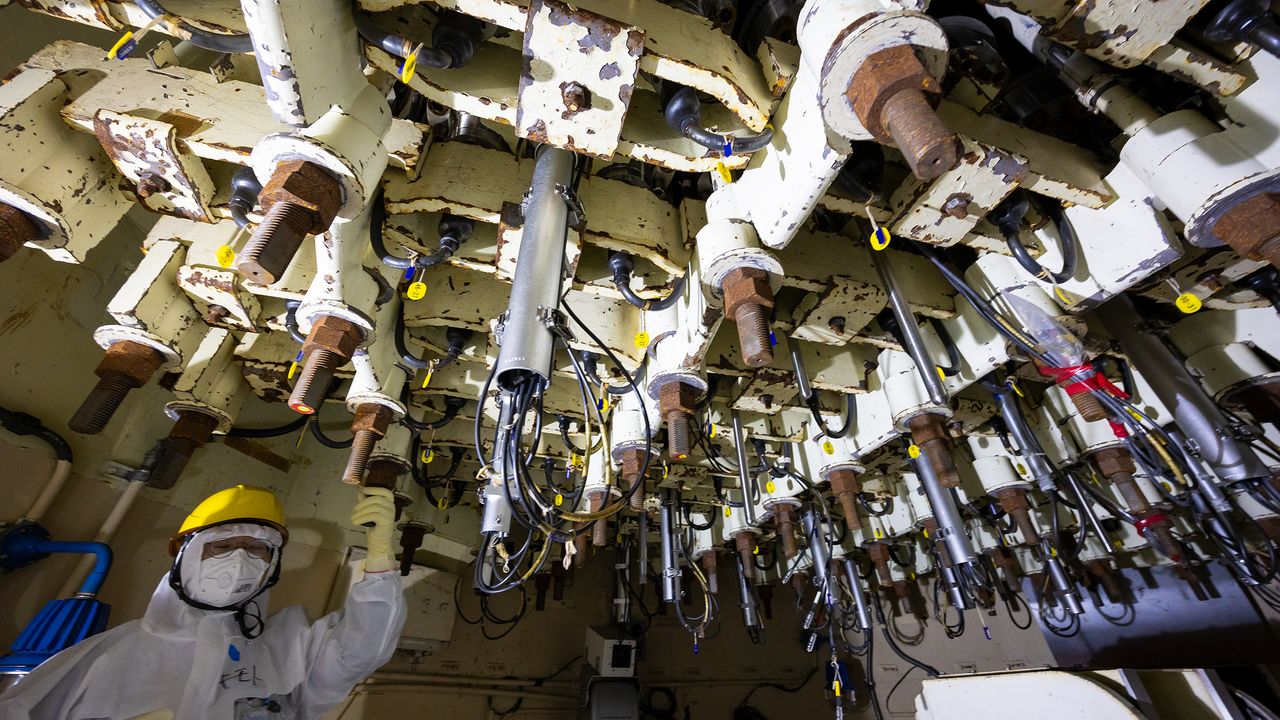
In the space directly beneath the reactor pressure vessel of Unit 5, a dense array of devices, including drive mechanisms for the control rods used to regulate the reactor’s output, hung down like icicles. A penetration hole known as the “X-6 penetration,” formerly used when replacing this equipment, became the entry point for approaching the fuel debris that had melted and fallen below.
5号機の原子炉圧力容器の真下にあたる場所には、原子炉の出力をコントロールするための制御棒の駆動装置などさまざまな装置が氷柱(つらら)のようにぎっしりとぶら下がっていた。この装置を交換するために使われていた「X6ペネトレーション」と呼ばれる貫通孔が、溶け落ちた燃料デブリにアプローチするための入り口となった。
The 0.7 Grams Collected as if Lowering a Fishing Line釣り糸を垂らすようにして採取した0.7グラム
The X-6 penetration has an inner diameter of 55 centimeters. A guide pipe was installed there, and a device was pushed into the containment vessel as though extending a fishing rod. Through a gap in the grating, the iron lattice cover, a claw-like tool at the tip was lowered straight down, and a tiny handful of debris accumulated at the bottom of the containment vessel was collected. That was the roughly 0.7 grams.
X6ペネトレーションの内径は55センチ。ここにガイドパイプを設置し、釣り竿を長く延ばすように格納容器内に装置を押し込み、グレーチング(鉄製の格子状のふた)のすき間からツメのような先端治具をまっすぐに下に垂らし、格納容器の底部にたまたったデブリをほんのひとつかみ採取した。それが約0.7グラム。
Of course, it is impossible to enter the interior of the accident-stricken Unit 2, so the work was conducted remotely, on the basis of accumulated preliminary surveys and while checking camera images. In Unit 5, when one looks beneath the grating, devices for replacing the control-rod drive mechanisms and other internal equipment can be seen. In Unit 2, however, the fuel is believed to have melted down while engulfing such internal mechanisms, accumulating at the bottom of the containment vessel; the difficulty of removing it is immeasurable.
もちろん事故を起こした2号機の内部には入ることができないので、事前調査の積み重ねと、カメラの映像を確認しながらの遠隔操作だ。5号機では、グレーチングの下をのぞくと、制御棒駆動機構を取り換えるための装置などが見えるが、2号機はこうした内部機構を巻き込みながら燃料が溶け落ちて格納容器底部にたまっているとみられ、取り出しの難度は計り知れない。
A Drop in a Great River大河の一滴
Akira Ono, chief decommissioning officer of TEPCO’s Fukushima Daiichi Decontamination and Decommissioning Engineering Company, described the experimental retrieval in the autumn of 2024 as “a drop in a great river.”
東京電力福島第1廃炉推進カンパニーの小野明代表は、2024年秋の試験的取り出しを「大河の一滴」と表現した。
“At first it may truly be only a single drop, but I think what matters is to make it steadily larger. To that end, we want to make full use of every piece of knowledge we can gain.” The company is also aiming to begin surveys using a robotic arm.
「初めは本当に一滴かもしれませんが、どんどん大きくしていくのが大事だと思っている。そのために得られる知見は全部生かしていきたい」 ロボットアームを使った調査にも着手目目指す
This spring, TEPCO will attempt a second experimental retrieval from Unit 2. The company says it is moving ahead with improvements, including a redesign of the tip section, in order to mitigate the weakness of the fishing-rod-style device, whose end is not stable.
東電ではこの春、2回目の試験的取り出しに挑戦する。先端が安定しない釣り竿式装置の弱点を軽減するため、先端部分の設計見直しも含めた改善を進めているという。
In last year’s experimental retrieval, it was discovered at the last moment that the pipes used to push the retrieval device into the containment vessel had been connected in the wrong order. Then, just before the device was to grasp the fuel debris, another problem arose: the camera attached to the device’s tip stopped transmitting images.
昨年の試験的取り出しでは、直前になって取り出し装置を格納容器内に押し込むパイプの接続順が間違っていたことが発覚。さらに、燃料デブリをつかむ直前になって、装置先端に取り付けているカメラが映らなくなるトラブルもあった。
“The work of connecting the pipes in sequence is itself extremely simple, so we had thought there was no safety problem. But because it is an area with high radiation levels, workers must be in full protective gear, including full-face masks, and must finish the task quickly while it is hard to move. There were also problems with voices not carrying well and communication being difficult,” Ono recalls. Ahead of the second experimental retrieval, TEPCO will proceed with still greater caution, including checks of workers’ movements.
「パイプを順番に接続する作業そのものは極めてシンプルなものなので、安全上の問題はないと考えていた。しかし、放射線量が高いエリアのため、防護服に全面マスクの完全装備で、身動きしづらい中で短時間で作業を終えなければならない。声が通りにくくコミュニケーションが取りづらいという問題もあった」と振り返る。2回目の試験的取り出しに向けては、作業員の動作確認など、一段と慎重に取り組む。
In addition, during fiscal 2025 the company plans to begin surveys using a robotic arm. Compared with the fishing-rod-style device, which is like lowering a line straight down through gaps in the grating, the robotic arm has a far wider range of motion. Because it can measure radiation levels and capture images at various points on the bottom of the containment vessel, TEPCO expects it will sharply increase the amount of information that can be gathered toward full-scale debris retrieval.
さらに、25年度中には、ロボットアームを使った調査にも着手する方針だ。グレーチングのすき間から真下に糸を垂らすような釣り竿式の装置に比べると、ロボットアームは可動範囲が広い。格納容器の底部のさまざまな地点で放射線量を測ったり、映像を撮影したりできるため、本格的なデブリ取り出しに向けて収集できる情報が格段に増えることが期待できるという。
Fuel debris in Units 1 through 3 is estimated to amount to 880 tons. Recovering all of it on the road to decommissioning will be a long undertaking, and in the course of that process the work will likely be beset by “unexpected” troubles.
燃料デブリは1~3号機に880トンあると推計される。廃炉に向けて全量を回収するのは長い道のりで、その過程では、「想定外」のトラブルに見舞われることもあるだろう。
Ono says, “Until now, there were areas where we left human resource development to the partner companies responsible for decommissioning work. But this is a difficult site, an unprecedented work environment where the skills and knowledge required keep changing. TEPCO, too, must become integrally involved in developing personnel and improving skills.”
小野代表は「これまで、人材育成は廃炉作業を受け持つ協力企業まかせのところがあった。しかし、先例のない作業環境で、要求される技能・知識がどんどん変わってくる難しい現場。東電も一体となって人材育成、技能向上に関与していかなければならない」と話す。
“Decommissioning will require many years, and local people need to be involved. We want to create conditions in which decommissioning can proceed sustainably while bringing local companies into the effort,” he says.
「長い年月を要する廃炉には、地元の皆さんに関わってもらう必要がある。地元企業を巻き込みながら、サステナブルに廃炉を進めていく状況を作っていきたい」という。
Reporting and text: Naoshige Kaida (Nippon.com Editorial Department). Reporting and photography: Yukinori Hashino (Nippon.com Editorial Department).取材・文 : 貝田尚重(ニッポンドットコム編集部) 取材・撮影 : 土師野幸徳(ニッポンドットコム編集部)
Banner photo: Inside the primary containment vessel of Unit 5 at the Fukushima Daiichi Nuclear Power Station. Its basic structure is the same as that of the accident-stricken Units 1 through 3, and it is being used as a full-scale simulation facility for advancing decommissioning work.
バナー写真 : 福島第1原発5号機の原子炉格納容器の内部。事故を起こした1~3号機と基本的な構造が同じで、廃炉作業を進める上での実物大シミュレーション施設として活用されている