Hinomaru: The Symbolism and History of Japan’s National Flag
Japan’s hinomaru, long treated as the de facto emblem of the nation, carries ancient solar symbolism, modern legal ambiguity, and the unresolved weight of wartime memory.
Hinomaru: The Symbolism and History of Japan’s National Flag
Hinomaru: The Symbolism and History of Japan’s National Flag History Culture- English - 日本語 - 简体字 - 繁體字 - Français - Español - العربية - Русский Tracing the Origins
Japan’s national flag, a red disk set against a white field, is commonly known as the hinomaru, literally the “circle of the sun.” Its origins lie in ancient sun worship. In Japanese legend, Amaterasu, the sun goddess, is said to be the ancestor of Japan’s emperors. Japan is linked to the sun in another sense as well: situated to the east of China, it has long referred to itself as the “land of the rising sun.” The country’s name is written 日本, or Nihon, with 日 meaning “sun,” binding the motif closely to national identity.
Japan’s national flag, a red circle against a white background is commonly known as the hinomaru (literally, the “circle of the sun”). Its origins are rooted in ancient sun worship. In Japanese legends, Amaterasu, the goddess of the sun, is said to be the ancestor of Japan’s emperors. Japan has a further connection with the sun as, due to being located east of China, the Japanese have a history of referring to their own country as the “land of the rising sun.” Japan is written as 日本 (Nihon) in Japanese, with 日 meaning “sun,” so it ties in closely with the country’s identity.
According to the writer Imoto Shuji, the earliest known example of a flag depicting the sun appeared at a New Year’s ceremony in 701, during the reign of Emperor Monmu. It did not, however, feature a red disk.
According to the author Imoto Shuji, the earliest known example of a flag depicting the sun appeared at a New Year’s ceremony in 701 during the reign of Emperor Monmu. However, it did not feature a red circle.
Flags bearing a red disk on a white ground are thought to have first appeared during the Genpei War of 1180-85. Another theory holds that the design came into use during the Mongol invasions of Japan in the thirteenth century, though there is no clear evidence for this. In June 1999, the Japanese government acknowledged in a written response that although “historically there are records showing use even before the Edo period [1603-1868],” the flag’s “origins are not fully known.”
It is thought that flags with a red circle on a white background first appeared during the Genpei War (1180–85). Another possible theory is that flags with this design started being used during the thirteenth century Mongolian invasions of Japan, but there is no clear evidence for this. In June 1999, the Japanese government acknowledged in a written response that while “historically there are records showing use even before the Edo period [1603–1868]”, the flag’s “origins are not fully known.”
It was not until the nineteenth century, with the arrival of one foreign ship after another, that the hinomaru acquired official status.
It was not until the nineteenth century, with the arrival of a succession of foreign ships, that the hinomaru took on official status.
In August 1854, the shogunate designated the hinomaru as Japan’s official national maritime flag, or ensign, in order to distinguish Japanese ships from foreign vessels. Then, in January 1855, the Japanese warship Shoheimaru, presented to the shogunate by the Satsuma domain, now Kagoshima Prefecture, entered Tokyo Bay flying the hinomaru at its stern. This is said to have been the first actual use of the flag as a maritime ensign.
In August 1854, the shogunate declared the hinomaru as the official national maritime flag (ensign) of Japan to distinguish it from foreign vessels. Then, in January 1855, the Japanese warship Shōheimaru, presented to the shogunate by the Satsuma domain (now Kagoshima Prefecture), entered Tokyo Bay flying the hinomaru at its stern. This is said to be the first time that the flag was actually used as a maritime ensign.
After the fall of the shogunate and the Meiji Restoration of 1868, the new Meiji government issued a Council of State proclamation in February 1870, granting the hinomaru its first official recognition. That recognition, however, applied only to its use as a national flag for Japanese merchant ships, not as a symbol of the country as a whole.
Following the fall of the shogunate and the 1868 Meiji Restoration, in February 1870 the new Meiji government issued a Council of State proclamation, giving the hinomaru its first official recognition. However, this recognition was only as a national flag for Japanese merchant ships, rather than as a symbol for the country as a whole.
Even so, from that time onward, the hinomaru was treated as Japan’s de facto flag. Eventually, 129 years after the Council of State proclamation, it received full legal recognition with the enactment of the Act on National Flag and Anthem in August 1999. Thus the hinomaru has been Japan’s official national flag for less than thirty years.
Even so, since that time, the hinomaru has been treated as the de facto flag of Japan. Eventually, 129 years after the Council of State proclamation, it gained full legal recognition with the enactment of the Act on the National Flag and Anthem in August 1999. Thus, the hinomaru has only been Japan’s official national flag for less than thirty years.
Associations with WarWar Associations
One reason for the long delay in legalizing the flag’s status was the persistence of public sentiment associating it with the militarism of the prewar and wartime years. The fact that the Allied occupation authorities restricted use of the hinomaru immediately after World War II reinforced that perception.
One reason for the delay in legalizing the status of the flag was the lingering public sentiment that associated it with the militarism of the prewar and war years. The fact that use of the hinomaru had been restricted by the Allied forces directly after World War II strengthened this perception.
In a 1964 government poll conducted in the year of the Tokyo Olympics, respondents were asked what came to mind when they thought of the hinomaru. Twenty-two percent said it made them think of the war.
When a government poll held in 1964, the year of the Tokyo Olympics, asked people what came to mind regarding the hinomaru, 22% responded that it made them think of the war.
From the 1950s, the Ministry of Education began encouraging schools to raise the national flag and sing the national anthem, and from the 1980s this guidance was enforced more strictly. As the number of teachers and staff refusing to comply increased, disputes arose across Japan.
From the 1950s, the ministry of education started promoting the raising of the national flag and singing the national anthem at schools, and from the 1980s this guidance was more strictly enforced. This led to issues across Japan as the number of faculty staff refusing to follow those guidelines rose.
A tragic incident occurred in February 1999 involving the principal of Hiroshima Prefectural Sera High School. Caught between the demands of the Board of Education and those of his staff, he took his own life the day before the school’s graduation ceremony. This became the direct trigger for the enactment of the Act on National Flag and Anthem by the cabinet of Obuchi Keizo in 1999.
A tragic incident occurred in February 1999 involving the principal of Hiroshima Prefectural Sera High School. Caught between the demands of the Board of Education and his staff members, he committed suicide the day before the school’s graduation ceremony. This directly triggered the enactment of the Act on the National Flag and Anthem by Obuchi Keizō’s cabinet in 1999.
Red, But What Red?
Red, But What Red?
Article 1 of the law states simply that “the national flag shall be the nisshoki,” using the official term for the hinomaru. The law also specifies that the red disk is to be placed at the center and have a diameter equal to three-fifths of the flag’s height. As for the disk’s color, it is given only as “red,” with no further detail on the precise shade.
Article 1 of the law states simply that “The national flag is the nisshōki”—using the official term for the hinomaru. The law also specifies that the red circle should be at the center with a diameter three-fifths of the height of the flag. The color of the circle is only given as “red,” with no details given on the exact shade.
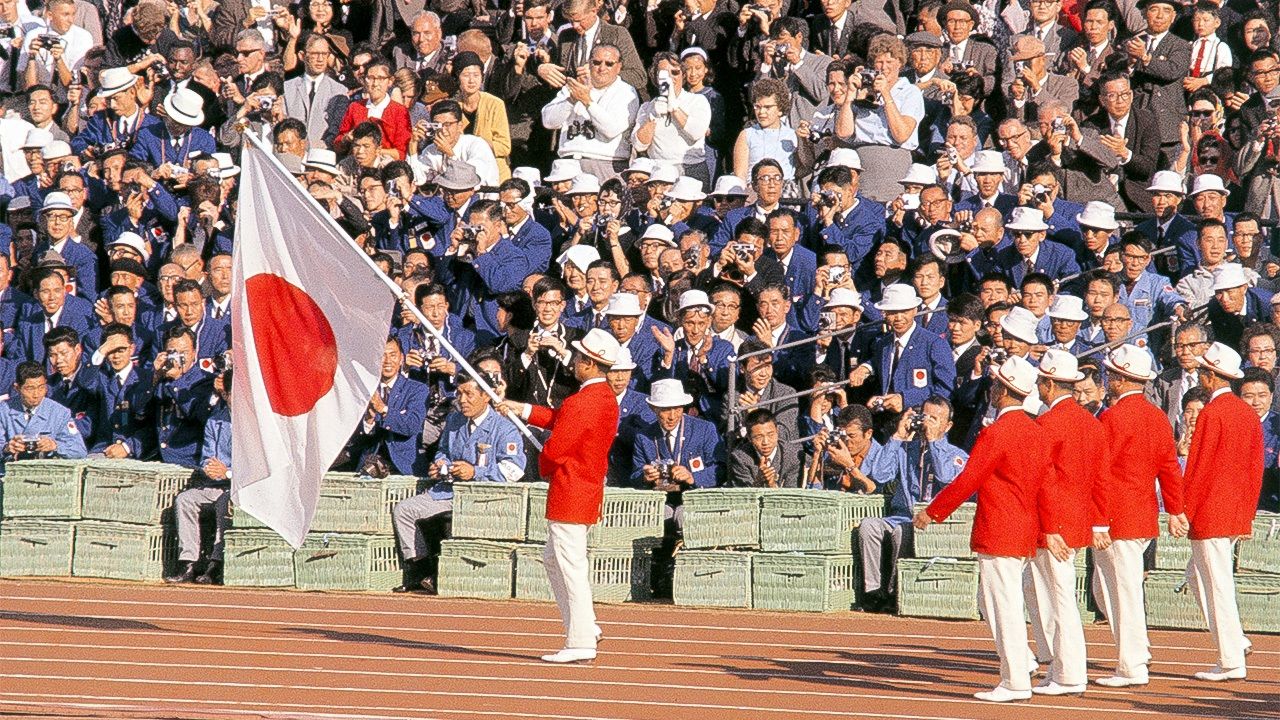
In an interview with the Sasakawa Sports Foundation, Fukiura Tadamasa, a flag expert responsible for producing the national flags of participating countries at the 1964 Tokyo Olympics, recalled the difficulties he faced at the time.
In a Sasakawa Sports Foundation interview, Fukiura Tadamasa, a flag expert responsible for making the national flags for the participating countries at the 1964 Tokyo Olympics, recalled the difficulties he experienced at the time.
“The hardest part was deciding on the ‘red’ of the hinomaru,” he explained. “So, with the help of the Japan Color Research Institute and Shiseido’s research laboratory, we collected 500 flags from ordinary households.” After analyzing them, “we calculated the most common shade and selected that as the ‘red’ of the hinomaru.”
“What was most difficult was deciding the ‘red’ for the hinomaru,” he explained. “So, with the help of Japan Color Research Institute and the Shiseidō research laboratory, we collected 500 flags from ordinary households.” After they were analyzed, “we calculated the most common shade and chose that as the ’red’ of the hinomaru.”
Its origins may remain uncertain, but stories surrounding the hinomaru are without number.
Its origins may not be clear, but there are countless stories concerning the hinomaru.