Cement’s Stubborn Emissions
A quarter of industrial carbon emissions sits in a material that every housing boom and infrastructure plan still depends on.
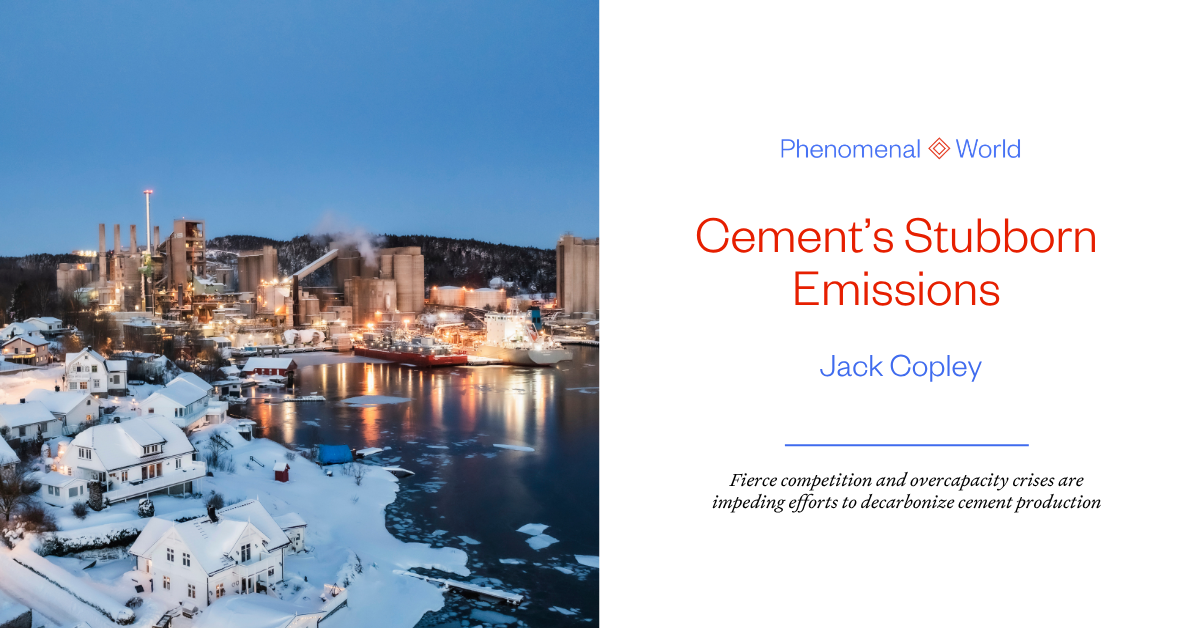
Fierce competition and overcapacity crises are impeding efforts to decarbonize cement production
Cement production is responsible for around a quarter of global industrial carbon emissions. The sector releases approximately one billion more tons of carbon dioxide every year than the entirety of the continent of Africa does across all its industries combined. These colossal numbers are in large part due to cement’s carbon intensity: almost a ton of carbon is emitted per ton of cement produced. Another reason is its ubiquity. Concrete, which consists of cement and aggregates such as sand and gravel, is the most consumed substance on Earth after water. Used widely in the construction of modern buildings, highways, bridges, dams, and ports, it is the physical substance of economic development.
Decarbonizing a production process that has been likened to “putting a mountain through a sieve” is, unsurprisingly, extremely difficult. Fossil fuels power the quarrying and crushing of raw materials like limestone; the heating of these materials into clinker, the grey nodules that are cement’s primary component; and the milling and transport of the cement mix. This results in only half of the industry’s carbon emissions: the rest comes from a carbon dioxide–producing chemical reaction known as calcination that takes place during the production of clinker. This problem is impervious to the heavy artillery of decarbonization, namely falling green electricity prices.
There are several levers that the cement industry can pull to reduce emissions, including increasing energy efficiency, introducing fuel substitution, partially replacing clinker with low-carbon supplementary cementitious materials (SCMs), and creating new binders that don’t contain clinker.1Another decarbonization lever is the transformation of building practices such that less cement is consumed. This is extremely important but cannot be enacted directly by the cement sector itself. Each strategy is important but limited. For example, many plants are already highly efficient, restricting the scope for further improvements, and a number of SCMs such as blast furnace slag will become scarce as steel decarbonization phases out blast furnaces. Because of these obstacles, the industry consensus is that carbon capture will be the most important decarbonization strategy: it will mop up the roughly 40 percent of emissions that are projected to remain after everything else has been tried.2 The (<)a href='https://gccassociation.org/concretefuture/carbon-capture-utilisation-and-storage/'(>)Global Cement and Concrete Association(<)/a(>) expects 36 percent of emissions reductions to come from carbon capture; the (<)a href='https://www.cementeurope.eu/media/t0qh4vti/cembureau-position-paper-sustainable-carbon-cycles-2021-09-27.pdf'(>)European cement lobby(<)/a(>) has a higher estimate of 42 percent. Carbon capture technology, too, is deeply problematic, not least because of the infrastructural hurdles to its rollout.
But as serious as these technical challenges are, they alone cannot explain the abysmal pace of cement decarbonization. While existing strategies are imperfect, they can make a major dent in emissions. The problem is that their adoption has been glacially slow. For all the sustainability reports and net zero roadmaps, the sector has only further carbonized since the Paris Climate Conference: both absolute carbon emissions and carbon intensity are higher than in 2015.
What accounts for the green transition’s failure to launch in the cement industry? The answer lies not only in the sector’s unique chemistry, but in its uniquely crisis-prone political economy. Fierce competition and overcapacity crises have long depressed profitability in this industry, and are now impeding firms’ ability to shoulder the enormous costs required to decarbonize production. This is clearest in China, where most cement is manufactured and where overcapacity woes are greatest. But versions of this dilemma manifest across a host of regional cement markets.
Historically, such drags on profitability have been overcome by restructuring processes that cull excess capacity and thereby cull sections of the labor force, creating space for new investment. Today, a “green” restructuring process is emerging, facilitated by state “derisking” measures (to borrow the term popularized by the economist Daniela Gabor), which guide private capital towards developmental or industrial policy objectives by shifting risk from the private to public sphere. These measures have, in some places, incentivized modest investment in cement decarbonization—but this has been accompanied by plant closures and redundancies, announced in the name of both financial and environmental imperatives. A similar pattern is emerging across a range of heavy industries. The danger is that a “derisked” decarbonization, which leaves investment decisions under the control of corporations, will become a byword for deindustrialization, with adverse consequences for climate politics.
Restrain competition or be ruined
Portland cement is the name of the concoction that today binds 98 percent of the world’s concrete. Invented by the English bricklayer Joseph Aspdin in the 1820s, cement production was a primitive business in its early years. Laborers dredged England’s Thames and Medway rivers by hand for mud and chalk, which were then processed and burned in small bottle kilns. The resulting clinker was ground to powder between millstones, as in traditional flour mills.
This process was transformed by the late-nineteenth-century invention of the rotary kiln. The enormous cylinder—Thomas Edison patented a kiln in 1909 that was 150 feet long—was positioned at a slight incline, like the axle of a giant vehicle fitted askew. Materials were fed into the top end to be blasted into clinker by the white-hot combustion of pulverized coal at the bottom. This augured a productivity revolution. The output of a cement plant increased from around fifty to one or two thousand barrels per day, and mechanization consequently accelerated the quarrying of raw materials and the processing of the growing throughput. Production rose, prices fell, and Portland cement became more and more integral to the built environment, from prestigious public buildings to the slums of reinforced concrete that sprung up in the crevices and extremities of cities.
There was a human cost to these changes in the pace and scale of cement production. By the early twentieth century, it was among the most accident-prone industries. One of the bloodiest US industrial disasters took place at the Lehigh Portland Cement Company’s works in Pennsylvania in 1942 when thirty-one workers were “blown to bits” by a quarry explosion, leaving their remains “scattered over the landscape,” as The New York Times reported. Children at the local school were hurled from their chairs and covered in broken glass. Similar incidents litter the historical record. Dust engulfed fenceline communities, diminishing lung function and contaminating local soil and vegetation. In 1962, testimony from two women in Kent, England, was read out in Parliament: “The cement dust comes over in billowing grey clouds, descends like a fog, coating pavements and cars and smothering gardens and fields.” Lehigh Valley residents spoke simply of “the breeze.”3 Such historical testimonies echo through contemporary China. Villagers in Jiangsu Province have (<)a href='http://www.china.org.cn/environment/2013-04/27/content_28677632_2.htm'(>)complained(<)/a(>) that they “dare not open their windows or dry clothing outdoors” because of local cement factories. The dust even gums up romantic relations: “Girls from other villages are always reluctant to marry a guy living here.”
The transformation of cement-making into a mass production industry also created another problem: the threat of ruinous imbalances between production and consumption. Cement involves massive fixed investments, requiring high rates of capacity utilization for firms to achieve profitability. While this is typical of heavy industries such as steel, the cement industry is unique in that demand relies almost exclusively on construction—a sector marked by boom-and-bust dynamics. A further difference is cement’s high bulk-to-value ratio and perishability, which means that it is not generally transported more than two to three hundred miles. Because of this, regional cement oligopolies largely depend upon demand from nearby construction projects.
Cement is therefore characterized by enormous production capacities and volatile, geographically uneven demand. As competition drives the expansion of cement capacity and production beyond what local construction markets can absorb, the lines of regional market segmentation blur. Facing insufficient demand, firms seek to penetrate their rivals’ markets, often accepting lower prices in return for higher sales. Catastrophic retaliation ensues, manifested in overproduction, low capacity utilization, falling prices, and waning profitability. Competition “breeds a thunderstorm,” one cement executive put it. “And then it gradually slips into a category five hurricane.”4See Truman Bewley, (<)em(>)Price Setting(<)/em(>) (Polity, 2025).
Even in such conditions, firms are often wary of shutting plants and abandoning sunk investments. After all, those that retain their production lines benefit from an increase in prices once other producers exit the market. But the situation is sometimes bad enough that it becomes necessary to purge significant capacity. During the profit crisis that stretched from the late 1960s through the 1980s, many US cement firms shut down operations and fled the business, shifting into carpet manufacturing, ski resorts, even winemaking. As the Lehigh Cement Company claimed in 1968, foreshadowing the neoliberal period, “we are not manufacturers of cement . . . but managers of assets.” Workers bore the brunt of this: the combined effect of the restructuring and technological upgrading of the US cement industry in this era was a 37 percent fall in production employment between 1980 and 1988.
Cement capitalists have long sought to suspend these dynamics, often by colluding with one another to limit competition. The president of the US firm Riverside Cement commented in 1934: “ours is an industry that . . . must systematically restrain competition or be ruined.” Collusive strategies have ranged from the mundane, such as the now-outlawed “basing points system” in the US and UK, whereby cement prices were set by producers according to an agreed-upon formula, to the remarkably bold: during the height of the Syrian Civil War, the French cement giant Lafarge paid millions of dollars to ISIS and the al-Nusrah Front to protect operations at one of their Syrian plants, and entered into a revenue-sharing agreement with ISIS in exchange for the group’s help in gaining an edge over local competitors selling imported Turkish cement by imposing taxes on them or by banning their activities outright.5Lafarge drivers carried travel documents bearing the black flag of ISIS that stated: “In the name of Allah the Merciful, the mujahedeen are asked to let this vehicle transporting cement from the Lafarge plant pass through checkpoints, following an agreement with the company.” (In 2026, a French court made history by sentencing the former CEO of Lafarge to six years in prison for financing terrorism.) Unsurprisingly, the industry has been repeatedly targeted by antitrust authorities, such that the pressures of competition have not been nullified.
Small profits, big emissions
In the twenty-first century, cement has remained a business marked by high capital costs, fragile demand, and the tendency for competition to drive capacity beyond what markets can stomach. These crisis-ridden accumulation dynamics are jeopardizing the industry’s green transition.
China, which produces half of the world’s cement, typifies this dilemma. From the 1990s to the 2010s, as colossal cities and urban villages rose from the earth, bound together by mega-infrastructure projects, China devoured cement at an unprecedented scale. Between 2011 and 2013, the country used more concrete than the US did in the entire twentieth century. Demand peaked during these years, as waves of urbanization and industrialization crested, and then entered a secular decline. This left chronic cement overcapacity. The Communist Party has since battled to shut down excess production lines, while major firms like Anhui Conch try to restrict “rate race competition” through consolidation. Neither have yet succeeded: capacity utilization stands at around 50 percent in an industry made up of roughly 3,000 companies, depressing prices and profit rates. The “current market price of cement hardly covers production costs,” a recent study of the Chinese cement sector argued. Because of these profit pressures, “some producers are reluctant to apply the rapidly accessible measures of decarbonization” like clinker reduction—let alone absorb massive carbon capture costs. A further complication is the large investments that firms have already sunk into older assets. Cement plants have operational lifetimes of around forty years, and around 90 percent of plants in the country were built within the last twenty or so years. Firms are wary of transforming, let alone scrapping, such facilities before they can be fully exploited.
Chinese overcapacity troubles are notorious, but not unique. In Vietnam—the world’s third largest cement producer—and in Thailand, Bangladesh, Indonesia, and parts of the Middle East and Latin America, capacity buildouts have also run up against stalling demand. Similar dynamics have afflicted producers in mature economies as well. “The reality is that there is over a billion tons of excess cement production capacity in the world,” stated the founder of the World Cement Association in 2024. Things are better or worse in different countries, but global capacity utilization stands at around 65 percent—a rate that is incompatible with sustained profitability.
In Europe, fitting a cement plant with carbon capture technology may cost between €200–500 million—higher, in some cases, than the original investment cost of the plant itself. More money will be required for things like fuel switching. This spike in costs is unlikely to be compensated with sufficiently high prices: research suggests that buyers are only willing to pay a 10 percent premium for green cement, while the actual green premium stands at more than 100 percent. This makes it very difficult to make a business case for decarbonizing, and without a business case, nothing happens. “If you want [the] cement industry to decarbonize, the cement company has to make money out of it,” a director of a major cement association told me. “People don’t like it, but that’s the reality.” The industry’s unprofitability poses a “huge problem” for decarbonization, another senior industry figure I spoke to said. “I mean, how are you going to get somebody to lend you money for the investments required if you aren’t making any money in your core business?”
The need to secure financing has long shaped the industry’s priorities. Prior to the 2008 financial crisis, Western multinationals launched a wave of acquisitions to take advantage of buoyant cement demand. This demand evaporated when the crash hit and construction sectors slumped. The Mexican giant Cemex, for example, had in 2006 announced its 100 percent debt-financed purchase of the Australian cement firm Rinker and now faced potential ruin. With structural overcapacity, low profitability, and high debt-to-earnings ratios, cement multinationals embarked upon a long campaign of disinvestment and deleveraging. It took more than a decade and a half for credit ratings agencies to finally promote Cemex from junk to investment grade.
Consequently, at just the moment that global pressure for climate action was building, the cement majors were becoming increasingly conscious of financial market scrutiny when weighing up investments. As a 2014 study put it, “gearing, debt reduction and the financial rating are absolute top priorities” for the multinationals. With “such a short-term focused financial appraisal applied even to investments in long-lasting assets,” other objectives like cutting emissions “play only a secondary role in the investment decisions.” This management principle has endured. To reward its investors, the German major Heidelberg Materials announced a €1.2 billion share buyback scheme in 2024—triple the cost of its one operational carbon capture plant. In China, too, credit conditions are tough: green cement plants have even lower profitability than their carbon-intensive rivals and take eight to ten years to repay their loans.
As a result, most decarbonization progress has been the result of government intervention: foremost, European efforts to derisk green cement investments. EU policies such as Horizon Europe and the Innovation Fund, as well as grants provided by national governments, have incentivized some firms to undertake significant decarbonization spending. These green investments were also made possible by the unique business conditions that pertain in Europe. Similar to other regions, European firms have faced huge excess capacity since 2008, yet they have enjoyed healthy profitability in recent years. This is because producers took advantage of the post-pandemic inflation to raise their prices, which have remained high even after energy costs subsided in 2023. But the EU’s Emissions Trading System has aided this price buoyancy by functioning as an informal production quota: if firms limit their output to what is covered by their emissions allowances (which are free for industrial producers, though they are now being gradually phased out), they avoid paying the full carbon price. This has kept a lid on European production volumes and countered the profit-eroding tendencies of overcapacity. This combination of public support and stable earnings has meant that Europe is now the site of more than half of the world’s planned carbon capture cement projects.
However, even in Europe, where the impacts of overcapacity have been mitigated, the enormous costs of cement decarbonization and lack of a green premium have still put a ceiling on climate progress: only one green cement plant is operating, and few others have reached a final investment decision. With Biden’s Inflation Reduction Act, the US looked poised to overtake Europe in terms of derisking strategy. Trump put paid to this: $3.7 billion in carbon capture grants were withdrawn in 2025, killing off a host of green cement projects. With much of the construction industry destabilized by tariffs and relentless immigration raids that terrorize and disappear its workforce, the hope is now said to lie in demand from AI. Hyperscalers like Amazon, Meta, and Microsoft have struck supply deals with low-carbon cement firms, putting a green gloss on the ecocidal data center buildout.
In China, government support for cement decarbonization has been more limited. The Chinese state has issued various mandates for the industry’s output and efficiency, and cement was recently integrated into a national emissions trading scheme, but there has been little direct state financing for cement decarbonization. The results speak for themselves: according to the Global CCS Institute, there are three carbon capture cement plants in China that together sequester only 0.03 percent of the country’s gargantuan cement emissions. According to some sources, the carbon dioxide captured from the largest project is used for “enhanced oil recovery,” meaning it is injected deep into oil reservoirs to flush out dregs of fuel.
In many countries, then, decarbonization efforts have been forced to navigate the industry’s acute crisis tendencies, with varying degrees of success. The situation is different in India and parts of Africa. There, such tendencies have been overwhelmed, or perhaps temporarily postponed, by breakneck urbanization and infrastructure development. Producers find themselves in the position of their Chinese counterparts two decades earlier, scrambling to throw up plants and capture a share of booming demand. Flush with cash, Indian cement oligopolies are making significant investments in decarbonization. This includes improvements in energy efficiency, the growing use of renewable power, and the launch of several carbon capture pilot projects.
Yet any resulting fall in carbon intensity will have to overcome rising cement output—a battle of rate versus mass. This reveals a broader predicament. In many countries where cement demand has moderated, overcapacity appears as a barrier to decarbonization because of its negative impact on profitability. But in parts of the developing world, where profit margins are fat and capacity is chasing demand skyward, growing cement production may simply outpace decarbonization efforts. Given their expansion plans, India’s producers don’t expect to reach net zero until 2070, compared to 2050 for European firms. By 2070, a recent study indicates, more than 600 million Indians may be exposed to “unprecedented heat.”
Visions of transition
Even Europe’s greatest success story, Heidelberg Materials’ Brevik facility, which opened in Norway last year, points to the complexities of decarbonization. The world’s largest green cement works, the facility is said to capture about 400,000 tons of carbon dioxide annually—currently 50 percent of the plant’s total emissions. It was made possible by state subsidies that covered more than 80 percent of the required investment. The carbon sequestered from the plant is injected into a geological formation thousands of feet under the Norwegian Sea by Northern Lights—a joint venture of the oil companies Shell, Total, and Equinor. Public funds took care of 80 percent of the costs of this project. For industry players, this shows the transformative potential of derisking. If such state support measures are ambitious enough, advocates claim, green animal spirits can be summoned even in particularly crisis-prone sectors like cement.
But in 2024, with construction nearly complete, Heidelberg made another, quieter announcement: it was shutting down production at plants in Germany, France, and Spain, citing weak demand in addition to climate goals. It is likely that many more closures will follow in the coming years, across Europe and the wider world. Experts predict that global cement demand will fall 22 percent by 2050, dragged down by Chinese decline and mature market stagnation. This will—alongside rising carbon prices and growing green cement production that will further expand supply—place great pressure on firms to shutter excess capacity. The European Commission explicitly welcomes this: capacity reductions will cut emissions and create a less glutted cement market. The World Cement Association concurs: “To remain both profitable and environmentally responsible, the cement industry must aim to reduce capacity by 50 percent . . . within the next decade.” For every Brevik that is built, many more plants must go to the wall.
On its own, a rash of cement plant closures wouldn’t have disastrous effects on employment, though it would cause local pain. But the same profound crisis tendencies are present in other heavy industries such as steel, aluminum, petrochemicals, and ammonia, which emit catastrophic volumes of carbon dioxide and employ millions of people worldwide. The automobile industry faces similar dynamics. Firms in these sectors also appear to be using the climate agenda as cover to abandon excess capacity. The German steelmaker Thyssenkrupp, for example, won billions of euros in subsidies to build a single green steel works, aspects of which it later backtracked on, while shutting down production lines elsewhere and cutting 11,000 jobs. Tata Steel is following the same playbook in the UK—£500 million received in grants, one green furnace built, four brown furnaces snuffed out, 2,800 workers sacked—as is the chemical giant Ineos.
The question, then, is not if derisking can unlock green investment in these industries. It is possible financially, at least in many rich countries. But such a derisking strategy will be extremely difficult to sustain politically if it entails throwing heaps of public money at multinational corporations as they eliminate jobs and accelerate deindustrialization. By leaving investment decisions in the hands of capitalists, the derisking state may simply extend the harms caused by decades of industrial restructuring. The far right is already seizing on this situation to advance its “culture war against climate action,” Rebekah Diski argues, as it claims to protect workers from being “sacrificed on the altar of net zero.”
Yet some workers have sought to resist allowing their predicament to be instrumentalized in this way. When Heidelberg announced the closure of their clinker plant, the workers of Cementos Rezola in the Basque Country launched an indefinite strike and a campaign to build public support for their struggle. They belonged to ELA and LAB, two militant trade unions that have begun to articulate their own vision of climate strategy—one that isn’t predicated on the destitution of their members.
More than a “just transition,” LAB speaks of an “ecosocialist transition program,” consisting of “public control of strategic sectors, democratic planning of the economy, and the decommodification of essential areas of daily life.” While cognizant that climate rhetoric is often a pretext for corporate restructuring, the union cautions against dismissing the urgency of decarbonization. Faced with threats of closure, it calls for fully paid reductions in working time for affected employees and for the repurposing of carbon-intensive plants so that they might serve social and environmental needs. In the case of cement, this could mean retrofitting factories to produce more environmentally sustainable materials. It so happens that calcined clay—a low-carbon binder—can be made in repurposed rotary kilns. The point is to “repoliticize the productive sphere,” LAB argues, and to force “a dispute about property” itself.