Where Ukraine Strikes Russia: The Geography, Logic, and Priorities of Its Attacks
Ukraine’s strikes inside Russia have evolved from isolated blows against military and energy targets into a systematic campaign aimed at constricting the infrastructure that sustains Russia’s war economy.
ArticlesСтатті
Where Ukraine Strikes Russia: The Geography, Logic, and Priorities of Its Attacks
Куди б’є Україна по Росії: географія, логіка та пріоритети ударів
Sleepless nights and the groans of Russians along the lines of “But what did we ever do to deserve this?!” are becoming routine in many regions of the Russian Federation. Strikes on Russian oil terminals point to a new phase in the campaign: systematic pressure on export infrastructure. Key ports on the Baltic and Black seas have come under fire, and their synchronized disruption creates a bottleneck effect for the entire supply system. In the end, this is no longer simply about damaging individual facilities, but about deliberately limiting Russia’s ability to export oil and therefore to obtain the resources it needs to wage war.
Безсонні ночі й стогін росіян на кшталт «а нас-то за что?!» стають для багатьох регіонів РФ системою. Удари по нафтових терміналах РФ свідчать про перехід до нової фази кампанії — системного впливу на експортну інфраструктуру. Під прицілом опинилися ключові порти на Балтиці та Чорному морі, і їх синхронне ураження створює ефект «вузького горла» для всієї системи постачань. У підсумку йдеться вже не просто про пошкодження окремих об’єктів, а про цілеспрямоване обмеження здатності Росії експортувати нафту, а отже, й отримувати ресурси для ведення війни.
Narrated with the help of AI in the voice of Valeria PavlenkoОзвучено за допомогою ШІ голосом Валерії Павленко
We downloaded and analyzed posts from the Russian Telegram channel Radar po vsey Rossii (@radarrussiia), which issues air-raid alerts, to see how the war is returning to the territory of the aggressor. Russia has no official centralized resource for announcing air alerts, so the true numbers and duration of threats may be even higher; even so, these data clearly show that quiet nights are a thing of the past for many Russians.
Ми вивантажили й проаналізували повідомлення з російського телеграм-каналу «Радар по всей России» (@radarrussiia), який сповіщає про повітряні тривоги, щоб побачити, як війна повертається на територію агресора. Офіційного централізованого ресурсу для оголошення повітряних тривог у Росії немає, тому справжні цифри й тривалість загроз можуть бути ще більшими, проте навіть ці дані чітко демонструють: спокійні ночі для багатьох росіян залишилися в минулому.
It can be said that, thanks to the work of Ukraine’s defense industry and help from partners, 2025-2026 have turned strikes on Russia’s energy and oil sector into a systematic campaign with a clear geography and an equally clear logic. The main axes of strikes are the border regions, the central part of the Russian Federation, and the deep rear, with its critical and industrial infrastructure.
Можна сказати, що завдяки роботі української оборонки і допомозі партнерів 2025–2026 роки перетворили удари по енергетиці та нафтовій галузі Росії на системну кампанію, яка має чітку географію і не менш чітку логіку. Основні напрямки ударів — прикордонні області, центральна частина РФ, а також глибокий тил із критичною та промисловою інфраструктурою.
Russia Does Not SleepРосія не спить
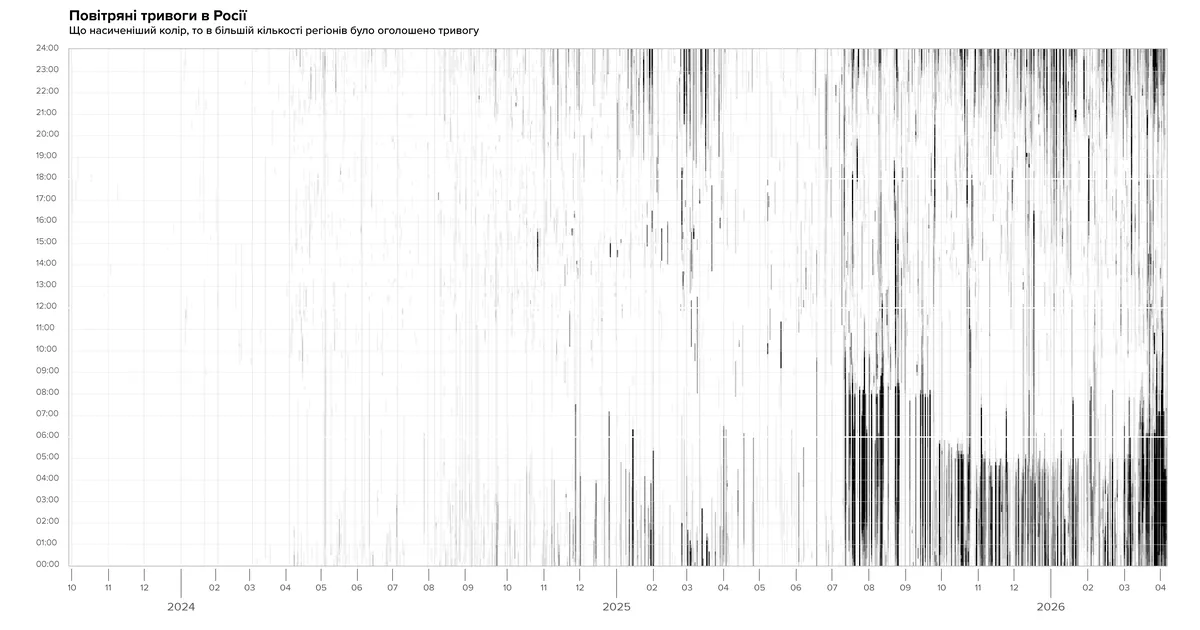
There are not merely more alerts; the attacks are designed to exhaust. Danger is usually announced closer to midnight and lasts until five or six in the morning. Whereas in the autumn of 2023 alerts lasted an average of 40 minutes, now, in 2026, they last three or four hours a day.
Тривог не просто побільшало — атаки працюють на виснаження. Небезпеку переважно оголошують ближче до опівночі, й триває вона до 5-ї чи 6-ї години ранку. Якщо восени 2023 року тривоги в середньому тривали 40 хвилин, то тепер, у 2026-му, три-чотири години на добу.
Air-raid alerts in RussiaПовітряні тривоги в Росії
The more saturated the color, the more regions in which an air-raid alert was declared
Що насиченіший колір, то в більшій кількості областей було оголошено повітряну тривогу
The attacks themselves have also increased. In the spring of 2026, the number of reports of drone attacks rose sharply and may reach 150 in a single day.
Побільшало й самих атак. Навесні 2026 року кількість повідомлень про дронові атаки різко зросла і може сягати 150 за добу.
Number of air-raid alert reports by type of threatКількість повідомлень про повітряні тривоги за типами загроз
Monthly dynamics of attack warnings in Russian regions
Динаміка попереджень про атаки в російських регіонах за місяцями
Missile attacks, by contrast, have noticeably declined since the start of 2025, shortly after Donald Trump’s inauguration. Interestingly, at the same time Russia increased the number of strikes against Ukraine; read more about this in our article here.
Натомість ракетних атак відчутно поменшало після початку 2025 року — невдовзі після інавгурації Дональда Трампа. Цікаво, що в цей час Росія збільшила кількість ударів по Україні (докладніше про це читайте в нашій статті тут).
Number of attack reportsКількість повідомлень про атаки
Average number of UAV and missile warnings (seven-day moving average) UAVs Missiles
Середня кількість попереджень про БпЛА і ракети (семиденне ковзне середнє) БпЛА Ракети
Alerts are most often declared in Volgograd, Kaluga, and Saratov oblasts. There they last, on average, more than four hours. In Moscow Oblast, for example, the average duration of alerts is more than two hours.
Найчастіше тривоги оголошують у Волгоградській, Калузькій і Саратовській областях. Там вони в середньому тривають понад чотири години. Наприклад, у Московській області середня тривалість тривог — понад дві години.
The Borderlands: A Zone of Tactical EffectПрикордоння: зона тактичного впливу
Ukrainian drones operate most intensively against the regions that directly border Ukraine: Belgorod, Kursk, and Bryansk oblasts. Recently, Voronezh and Rostov oblasts have been added to this list, as has Krasnodar Krai: drone launchers operate from there, airfields hosting enemy aviation are located there, and oil depots and ammunition warehouses are concentrated there.
Найінтенсивніше українські дрони працюють по областях, які безпосередньо межують з Україною: Бєлгородській, Курській та Брянській. Останнім часом до них додалися Воронезька та Ростовська області, а також Краснодарський край (звідти працюють пускові установки дронів, там розміщені аеродроми, де базується авіація противника, і зосереджені нафтобази й склади БК).
This is fairly obvious: minimum distance means maximum frequency, and less time to intercept our means of attack, whether missiles or drones. Here we strike regularly, and this affects the aggressor’s tactical and, in part, operational capabilities. Targets include ammunition depots, air-defense positions, logistics hubs, and facilities that support troop groupings near the front. In essence, this is the transfer of combat operations deep into Russian territory and, one might say, the expansion of the kill zone.
Це досить очевидно: мінімальна відстань — максимальна частота, менше часу на перехоплення наших засобів ураження — ракет і дронів. Тут ми б’ємо регулярно, і це впливає на тактичні й частково оперативні спроможності агресора. Цілями стають склади боєприпасів, позиції протиповітряної оборони, логістичні вузли та об’єкти, які забезпечують угруповання військ біля фронту. По суті, це перенесення бойових дій у глиб російської території і, можна сказати, розширення кілзони.
Average duration of air-raid alerts by region 15 regions with the longest alerts Central Russia: A Demonstration of Vulnerability
Середня тривалість повітряних тривог за регіонами 15 регіонів із найдовшими тривогами Центр Росії: демонстрація уразливості
The second important axis of strikes is the central regions, in particular Moscow and Moscow Oblast. Kaluga, Tula, Tver, and Smolensk oblasts also come under attack.
Другий важливий напрям ударів — центральні регіони, зокрема Москва та Московська область. Також під ударами опиняються Калузька, Тульська, Тверська та Смоленська області.
If earlier attacks on the Russian capital were more symbolic in nature, something like the strikes on Berlin in the summer of 1941, lately they have become regular. The aim is not so much the physical destruction of facilities as the creation of systemic pressure, including disruption of airport operations with endless “carpet” alerts, when no aircraft flies anywhere, which translates into losses in the millions, an overload on forces, and the expenditure of air-defense ammunition.
Якщо раніше атаки на столицю РФ мали радше символічний характер, щось схоже на удари по Берліну влітку 1941 року, то останнім часом вони стали регулярними. Мета — не так фізично знищити об’єкти, як створити системний тиск, зокрема порушити роботу аеропортів із нескінченними «коврами», коли жоден літак нікуди не летить, що виливається в мільйонні збитки, перевантаження сил і витрати боєприпасів ППО.
Another very important factor is the psychological effect on what adequate people call brains. Russians see that even the most protected areas are vulnerable.
Також дуже важливий фактор — психологічний вплив на те, що в адекватних людей зветься мізками. Росіяни бачать, що навіть найбільш захищені райони є уразливими.
The Deep Rear: Strikes on the EconomyГлибокий тил: удари по економіці
A separate and strategically most important axis is strikes on industrial regions deep inside Russia. This means Ryazan, Nizhny Novgorod, Samara, Saratov, and Volgograd oblasts, as well as Tatarstan.
Окремий і стратегічно найважливіший напрям — удари по промислових регіонах у глибині Росії. Йдеться про Рязанську, Нижньогородську, Самарську, Саратовську та Волгоградську області, а також Татарстан.
These regions contain key oil refineries, chemical plants, and energy facilities. Strikes against them have a long-term purpose: reducing the production of fuel, raw materials for gunpowder and gunpowder itself, and explosives; complicating logistics; and creating economic pressure on the Russian Federation’s war machine and on the economy as a whole.
Саме в цих регіонах містяться ключові нафтопереробні заводи, хімічні підприємства та об’єкти енергетики. Удари по них мають довгострокову мету. Це зменшення виробництва пального, сировини для пороху і власне самого пороху, вибухівки, ускладнення логістики й створення економічного тиску на військову машину РФ та економіку загалом.
It should be noted, however, that the Russians restore oil refineries fairly quickly and are building protective elements around them. For that reason, reports of refineries being hit have recently disappeared from the news.
Хоча зазначимо, що росіяни відновлюють нафтопереробні заводи досить швидко й споруджують на них захисні елементи. Тому останнім часом із новин зникли повідомлення про ураження НПЗ.
It is telling that many such facilities are attacked not once or twice, but repeatedly. This testifies to the systematic nature and priority of this direction, as well as to the Russians’ inability to protect them.
Характерно, що багато таких об’єктів атакується не раз і не два. Це свідчить про системність і пріоритетність цього напрямку, а також про неспроможність росіян їх захистити.
Limiting ExportsОбмеження експорту
Another axis of strikes deserves separate attention, one that is gradually leading to critical consequences. These are strikes on oil terminals, which affect the export capacity of Russian oil.
Окремо варто виділити ще один напрямок ударів, який поступово призводить до критичних наслідків. Це удари по нафтових терміналах, що впливає на експортні можливості російської нафти.
In addition to the refineries themselves, important elements of oil transport and export infrastructure have come under Ukrainian drone attack: oil depots, transshipment hubs, pumping stations, and facilities connected to trunk oil pipelines. Even if damage to such nodes does not paralyze the system completely, the strikes significantly reduce throughput and force export flows to be redistributed.
Окрім самих НПЗ під українськими дроновими ударами опинилися важливі елементи інфраструктури транспортування й експорту нафти: нафтобази, перевалочні вузли, насосні станції та об’єкти, пов’язані з магістральними нафтопроводами. Навіть якщо пошкодження таких вузлів не паралізують систему повністю, удари суттєво зменшують пропускну спроможність і змушують перерозподіляти експортні потоки.
This has several consequences: stable exports through ports become more difficult, the costs of logistics and restoration rise, delays emerge in the supply of crude and petroleum products, and the overall efficiency of the energy sector declines.
Це має кілька наслідків: ускладнюється стабільний експорт через порти, зростають витрати на логістику та відновлення, виникають затримки в постачанні сировини та нафтопродуктів, знижується загальна ефективність енергетичного сектору.
As a result, even without the complete destruction of major facilities, a systemic effect is achieved: a partial restriction of export potential, which directly affects the Russian Federation’s foreign-currency revenues.
У результаті навіть без повного знищення великих об’єктів досягається системний ефект — часткове обмеження експортного потенціалу, що безпосередньо впливає на валютні надходження РФ.
The South and the Caucasus: Infrastructure and PortsПівдень і Кавказ: інфраструктура і порти
Less intensive but regular strikes are also recorded in the southern regions, in particular Krasnodar Krai, Astrakhan Oblast, and the North Caucasus. The focus here is on oil depots, transport infrastructure, and facilities connected with resource exports. Military facilities, including airfields, also sometimes become targets.
Менш інтенсивні, але регулярні удари фіксуються також у південних регіонах, зокрема в Краснодарському краї, Астраханській області, на Північному Кавказі. Тут у фокусі нафтобази, транспортна інфраструктура та об’єкти, пов’язані з експортом ресурсів. Подеколи мішенями стають і військові об’єкти, зокрема аеродроми.
Long-Range Strikes: The Effect of ReachДалекі удари: ефект досяжності
From time to time, Ukrainian drones reach far more distant regions as well, from Leningrad Oblast to areas near the Caspian Sea. Such attacks occur less often, but they have an important effect.
Періодично українські дрони досягають і значно віддаленіших регіонів — від Ленінградської області до районів поблизу Каспійського моря. Такі атаки трапляються рідше, але мають важливий ефект.
They demonstrate range and the ability to hit facilities at great depth. Often these are unique or especially important targets: major oil and gas facilities or enterprises of the military-industrial complex.
Йдеться про демонстрацію дальності й здатності уражати об’єкти на великій глибині. Часто це унікальні або особливо важливі цілі — великі нафтогазові об’єкти чи підприємства військово-промислового комплексу.
The Logic of the CampaignЛогіка кампанії
Despite the broad geography, the strikes are not chaotic. A clear structure of priorities can be traced:
Попри широку географію, удари не хаотичні. Простежується чітка структура пріоритетів:
the borderlands, to influence the course of combat operations;
прикордоння — для впливу на хід бойових дій;
fuel and energy infrastructure, for economic attrition;
паливно-енергетична інфраструктура — для економічного виснаження;
export logistics, to reduce foreign-currency revenues;
логістика експорту — для зменшення валютних надходжень;
military facilities, such as airfields and air defense, to reduce combat capabilities;
військові об’єкти (аеродроми, ППО) — для зменшення бойових можливостей;
Moscow, as a political and psychological target.
Москва — як політична та психологічна ціль.
Strikes on Russian Oil Terminals: UAVs Are Hitting Exports, Not Merely Facilities
Удари по нафтових терміналах РФ: БпЛА б’ють по експорту, а не лише по об’єктах
Recent strikes by Ukrainian drones on Russian territory reveal a fundamentally new logic in the campaign. Whereas earlier the blows fell mainly on military targets or border infrastructure, oil terminals and other key nodes through which the aggressor earns money by exporting energy resources are now at the center of attention.
Нещодавні удари українських безпілотників по території Росії показують принципово нову логіку кампанії. Якщо раніше били переважно по військових цілях або прикордонній інфраструктурі, то нині в центрі уваги нафтові термінали та інші ключові вузли, на яких агресор заробляє, експортуючи енергоносії.
This is a series of coordinated strikes on several critically important ports, above all on the Baltic and Black seas.
Йдеться про серію скоординованих ударів по кількох критично важливих портах, передусім на Балтиці та Чорному морі.
The Baltic axis has become one of the main ones. In late March and early April, drones repeatedly attacked the port of Ust-Luga, one of Russia’s largest oil hubs. The strikes were accompanied by fires on terminal grounds, damage to storage tanks, and damage to transshipment infrastructure. At the same time, another key Baltic port, Primorsk, through which crude oil is exported, also came under attack.
Балтійський напрям став одним із основних. Наприкінці березня і на початку квітня безпілотники не раз атакували порт Усть-Луга — один із найбільших нафтових хабів Росії. Удари супроводжувалися пожежами на території терміналів, пошкодженням резервуарів та інфраструктури перевалки. Паралельно під атаки потрапив ще один ключовий балтійський порт — Приморськ, через який іде експорт сирої нафти.
The consequences of such strikes extend far beyond local damage. Even the partial disabling of storage tanks or loading nodes immediately reduces shipment volumes. Delays arise, routes change, restrictions accumulate, and overall exports fall as a result. In effect, it is enough to hit several key points for the entire system to begin functioning worse.
Наслідки таких ударів виходять далеко за межі локальних пошкоджень. Навіть часткове виведення з ладу резервуарів або наливних вузлів одразу зменшує обсяги відвантаження. Виникають затримки, змінюються маршрути, накопичуються обмеження, у результаті падає загальний експорт. Фактично достатньо уразити кілька ключових точок, щоб уся система почала працювати гірше.
Thus, after a strike on the Black Sea export axis, the Russians encountered quite a few problems. In early April, our UAVs once again attacked the Sheskharis oil terminal in Novorossiysk. This is one of Russia’s key ports on the Black Sea, and it is there that the remnants of the Black Sea Fleet, which fled the “city of Russian glory,” Sevastopol, are hiding. Damage to berth infrastructure, disruptions in the operation of pumping systems, and fires led to temporary restrictions on the terminal’s functioning. Given its role in exports, even short-term disruptions immediately affect overall supply volumes.
Так, після удару по чорноморському напрямку експорту в росіян виникло чимало проблем. На початку квітня наші БпЛА вкотре атакували нафтовий термінал «Шесхарис» у Новоросійську. Це один із ключових портів Росії на Чорному морі, саме там ховаються залишки ЧФ, які втекли з «города русской славы» Севастополя. Пошкодження причальної інфраструктури, перебої в роботі систем перекачування та пожежі призвели до тимчасових обмежень у функціонуванні терміналу. А з огляду на його роль в експорті навіть короткострокові збої одразу позначаються на загальних обсягах поставок.
What matters is not only where the strikes are delivered, but also how they are combined. The Baltic and Black Sea axes came under attack at the same time; attacks on Ust-Luga, Primorsk, and Novorossiysk occurred almost synchronously, creating a synergistic pressure effect on the entire export system. This sharply narrowed the room for maneuver.
Важливо не лише те, куди саме завдаються удари, а й те, як вони поєднуються. Балтійський і чорноморський напрямки опинилися під ударом одночасно, атаки на Усть-Лугу, Приморськ і Новоросійськ відбувалися майже синхронно, що створило ефект синергетичного тиску на всю експортну систему. І це різко звузило можливості для маневру.
As a result, the problem is no longer individual damaged facilities, but the reduced throughput of the entire system.
У результаті проблема вже не в окремих пошкоджених об’єктах, а в зменшенні пропускної спроможності всієї системи.
Average duration of air-raid alerts by monthСередня тривалість повітряних тривог за місяцями
This is precisely the main change in the tactics of drone strikes: they are directed less and less at “spectacular” destruction and more and more at creating systemic economic pressure. Oil terminals are, in this sense, an ideal target, because they combine logistics, exports, and financial revenues. Unlike oil refineries or fields, maritime terminals have a critical feature: they are the end point of the entire system. It is here that oil is transformed from a resource into money.
Саме в цьому й полягає головна зміна тактики дронових ударів — вони дедалі менше спрямовані на «ефектні» знищення й дедалі більше на створення системного економічного тиску. Нафтові термінали в цьому сенсі ідеальна ціль, бо поєднують у собі логістику, експорт і фінансові надходження. На відміну від нафтопереробних заводів чи родовищ морські термінали мають критичну особливість — вони є кінцевою точкою всієї системи. Саме тут нафта перетворюється з ресурсу на гроші.
If a plant can be partly bypassed and flows redirected, the situation with ports is far more complicated: there are few of them, each has its own specialization and throughput capacity, and each is unique.
Якщо завод можна частково обійти, а потоки переспрямувати, то з портами ситуація значно складніша: їх мало, кожен має свою спеціалізацію та пропускну спроможність, кожен із них унікальний.
This means that even local damage creates an effect that is difficult to compensate for. Other ports are quickly overloaded, logistics become more complicated, and as a result export schedules begin to slip, while shadow tankers are increasingly intercepted by allies. The characteristic feature of the latest attacks is not the complete destruction of facilities. It is enough to disable one or two tanks, start a fire, damage a pumping station or the power-supply system, and the terminal is already operating in a restricted mode or stops for a time. It is precisely this “economy of the strike” that makes the campaign effective: relatively small means achieve a disproportionately large result.
Це означає, що навіть локальне пошкодження створює ефект, який складно компенсувати. Інші порти швидко перевантажуються, логістика ускладнюється, внаслідок чого експортні графіки «пливуть», а тіньові танкери дедалі частіше перехоплюють союзники. Характерна риса останніх атак — це не повне руйнування об’єктів. Достатньо вивести з ладу один-два резервуари, створити пожежу, пошкодити насосну станцію або систему електроживлення — і термінал уже працює в обмеженому режимі або зупиняється на певний час. Саме ця «економіка удару» робить кампанію ефективною: відносно невеликими засобами досягається непропорційно великий результат.