Who really was Mackenzie King, the maker of modern Canada?
Canada’s moderation looks less like temperament and more like an engineered governing method.
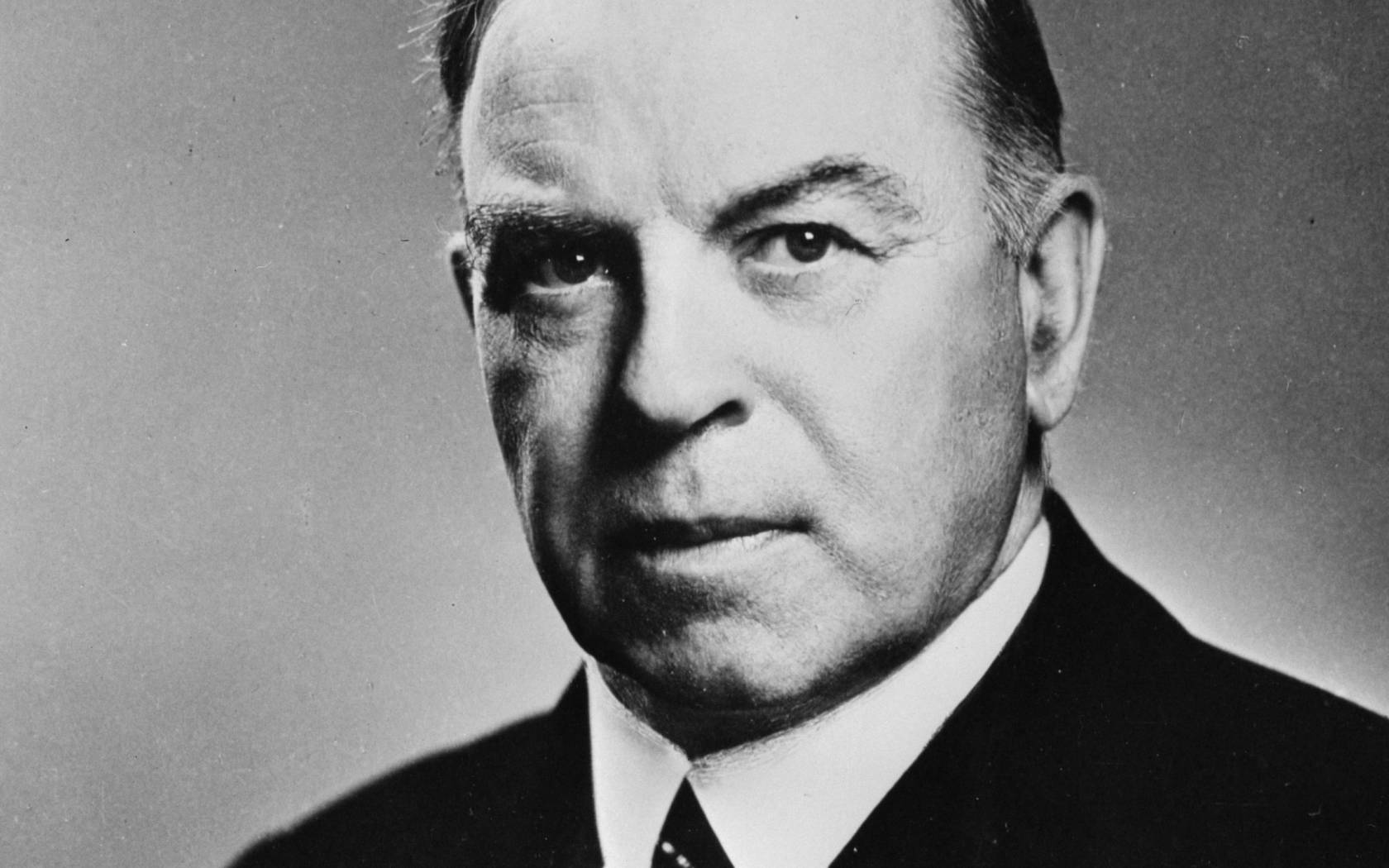
A new collection of essays revisits the life of a séance-holding Presbyterian bachelor whom historians routinely rank as Canada's greatest prime minister, yet one largely ignored by his countrymen.
The Enduring Riddle of Mackenzie King, edited by Patrice Dutil, UBC Press, $49.85
The 150th anniversary of William Lyon Mackenzie King’s birth was marked in 2024. ‘Mackenzie who?’ will probably be the response of most readers. Canada’s prime minister during the Second World War, King has seen his star wane in recent years. As Patrice Dutil, the editor of this collection of essays on King’s life and legacy, writes: ‘Unless they carry $50 bills… Canadians have no idea of what he even looked like. His name is never invoked, anywhere.’
Dutil does not mention that, the day before his sesquicentennial, it was announced that King would be bumped from appearing on Canadian currency. When King’s grave was vandalised in 2021, a scholar told CBC that ‘[it] surprised me that anyone in the public would care enough to vandalise his monument right now’.
Yet King has a strong claim to be the only Canadian politician of truly world-historical importance. From the French surrender in June 1940 to Operation Barbarossa a year later, King was the ranking Allied leader in the war in Europe, behind only Churchill. For the first – and perhaps the only – time in its national history, what Canada did mattered a great deal to the fate of the world. And King was the man who decided what Canada would do next. The country ended the war with the world’s third-largest navy and fourth-largest air force, a mini-Sparta created under the watch of a man who had been one of the last true believers in appeasement.
Then there is his extraordinary political longevity. By the time he resigned office in 1948, he had been prime minister for 21 years, a British Empire record that was later surpassed by Godfrey Huggins of Rhodesia, whose electorate, at its peak, numbered a mere 66,000 souls. King kept the Tories out of power for a generation, and Canada’s founding party has still not really recovered. If today’s 18-year-old Liberal Party staffers unironically boast of working for ‘Canada’s natural governing party’, it is thanks in no small part to him.
But who was King, the Presbyterian bachelor whom historians routinely rank as Canada’s greatest prime minister, yet who is ignored both by his countrymen and even by his own Liberal Party? The Enduring Riddle of Mackenzie King does not provide a key to the riddle, but it is as good a time as any to assess the man whom few loved, but who shaped Canada into the country it is today, for better or for worse.
If most Canadians know anything about King, it is as ‘Weird Willie’, a man who sought counsel from his dead mother, his dead dogs (all named Pat), the dead President Roosevelt, and the even more dead Leonardo da Vinci, a man who consulted Ouija boards and mediums, and whose virginity was the result either of repressed mommy-desire or of homosexuality.
In the book’s epilogue, the distinguished Canadian historian J.L. Granatstein blames his mentor, C.P. Stacey, for this situation. The Canadian Army’s official historian, Colonel Stacey, loathed King, like almost all army men. The reason, which Granatstein tersely describes as ‘his handling of manpower during the [Second World] war’, was King’s refusal to send home-defence conscripts to reinforce the all-volunteer First Canadian Army, which, having landed on Juno Beach, was bleeding out in vicious fighting across France, the Netherlands, and finally Germany.
King eventually sent the conscripts, but not before becoming convinced that the generals were mounting a coup (the coup, such as it was, amounted to a few senior generals considering submitting their resignations). The First Canadian Army was saved, the war was won, but officers like Stacey never forgave what they saw as Mackenzie King’s betrayal of Canada’s servicemen.
In the 1970s, King’s diary, which he kept for 57 years (the typed transcript runs to some 50,000 pages), was opened up to researchers. By then retired, Stacey saw his chance for revenge. His 1976 book, A Very Double Life: The Private World of Mackenzie King, painted King as a mentally disturbed man who spoke to the dead, read tea leaves and shaving cream, and, in the Gladstonian manner, tried to rescue prostitutes by having sex with them, among other things. All of it was backed by chapter and verse from the King diary, which his executors had refused to burn despite his instructions (they did burn most of his séance documentation). King’s public image never recovered.
In The Enduring Riddle of Mackenzie King, several of the book’s contributors try to defend King against accusations of eccentricity, although it is a shame that Anton Wagner, the author of two volumes on Mackenzie King and spiritualism (in which he argues, against Stacey, Granatstein, and pretty much everyone else, that King’s belief in communication with the dead did influence his political life) wrote on Mackenzie King and cultural policy instead.
The most spirited defence of King’s extramural interests comes from Granatstein, whose work on King as a war leader was instrumental in the rehabilitation of his reputation – at least among historians. But its effectiveness can be judged from the fact that one line of argument consists in claiming that repeated diary references to ‘wasting’ his time in night-time walks were not admissions of the use of prostitutes, but merely voyeurism. Is it really better for King’s reputation that he should only be a pervert and not a john? Granatstein is a great historian, but there are feats of argument that even he cannot pull off.
There is relatively little in this volume about King’s foreign policy and conduct of the war because, as Dutil puts it, ‘there is already an immense library available on these topics’. One exception is a chapter by Robert Bothwell on King and America, a subject which is now of more than historical interest. For it was under King that joint continental defence, embodied in the recently suspended Permanent Joint Board on Defence, was accepted by Canada and the US.
King had many American connections – his mother was born in New York, where her father, William Lyon Mackenzie, was seeking American support for the invasion of Upper Canada and the overthrow of its government. King himself had a doctorate from Harvard University and mixed with the likes of John D. Rockefeller. This, as well as his perceived Anglophobia, meant that King was often accused of being ‘the American’, a label which even now has the potential to destroy political careers.
Unsurprisingly, a generation of conservative Canadian historians (back when such people existed) accused King of selling out Canada to America, or of destroying the country to serve a continental Mammon. By way of contrast, Bothwell argues that King managed the relationship pragmatically, walking a line between the Britain to which Canada was loyal and the America that lived next door. As another Harvard man is now in charge of Canada, it might be worthwhile to revisit some of those points.
Like every other western country, Canada has had its share of ‘historical reckoning’ with the fact that people who lived in the past had ideas which are not shared by people today. The Enduring Riddle is not an exception. There are chapters about King and the First Nations, King and the Asians, and King and the Jews. Astonishingly, King’s own views towards these groups were exactly the views you would ascribe to a Gladstonian Liberal WASP of Mackenzie King’s vintage.
More interesting is a chapter about King and the Germans. The aptly named John English reminds us that Mackenzie King was born in Berlin, Ontario (now Kitchener, for obvious reasons), a city that, in those days, was three-quarters German. King, a great lover of German culture, occasionally delivered campaign addresses in German. In the 1911 election, King campaigned against the Conservatives by arguing that their plan to subsidise the Royal Navy was tantamount to sending ‘money to build warships to fight Germany’, prompting his successful German Canadian opponent to ask whether ‘he thinks we are subjects of King George or subjects of the Emperor of Germany’.
When he met Adolf Hitler in 1937 (‘Hitler… will rank some day with Joan of Arc among the deliverers of his people’, he wrote in his diaries), King showed the German chancellor pictures of his birthplace in Berlin, Ontario, no doubt to Hitler’s puzzlement. When Justin Trudeau undertook his wardrobe tour of India, he was simply engaged in a great Canadian political tradition of ethnic politics.
What does all this amount to? Raymond B. Blake argues that King was really a radical, while Stephen Azzi and Norman Hillmer argue that King was an incrementalist. The latter is the mainstream view, and a side-by-side reading of the two essays, which cannot both be correct, reveals why. King was an old-fashioned Liberal who believed in the improvement of the lot of the masses (though he didn’t go out of his way to consort with them), but radical he was not, even if he made the occasional fiery speech.
The bigger problem for King’s reputation is that he is simply not very likeable. ‘I clearly admired King’s political skills, but could never like him as a man. Indeed, he was unlikeable, petty, and fussy about money despite his wealth… he had no charisma, ran his small staff ragged, and was devious and quite willing to blame others for his own failures.’ This comes from Granatstein, who otherwise thinks that King was a really great prime minister. With defenders like this, who needs critics?
There is also the problem that King elevated the avoidance of making tough decisions to an art form. His most famous statement, ‘conscription if necessary, but not necessarily conscription’, is enough to make one weep. One who did was F.R. Scott, whose poem on King is quoted in Christopher Dummitt’s chapter on the posthumous reception of Mackenzie King:
We had no shape Because he never took sides, And no sides
Because he never allowed them to take shape […] Let us raise up a temple To the cult of mediocrity Do nothing by halves Which can be done by quarters.
Dummitt observes that generations of Canadians refashioned King to fit the stories they wanted to tell about their country. The task is made easier by the fact that King ‘was so keen to defy generalization. His skill was to intuit what a majority of the public wanted, and then give it to them – even if this meant changing what he had said the day before, or doing one thing and saying another’.
So King was the great statesman when he died not long after the Second World War, the pervert in the 1970s when Pierre Trudeau slept around, and the white villain when identity politics first became mainstream. The problem, and Dummitt does not say it, is that the Canada of 2026 doesn’t have a sense of its history any more, and Mackenzie King is not even the butt of cheap jokes because almost no one knows who he is.
Ultimately, The Enduring Riddle of Mackenzie King runs up against the limitation of all edited volumes, which is that although it can fill in the details, it cannot be a substitute for the real thing, a monograph. But there is no serious biography of King from cradle to grave. The official production stops at 1939, and no one, in these cash-strapped days when biographies of dead white males are markedly out of fashion, seems interested in writing a proper biography. Dutil and his colleagues have written a fine book, but Mackenzie King must remain a riddle for a bit longer.