Scenes from Pro-Government Gatherings in Tajrish After Dark
An after-dark walk through Tajrish reveals how a living urban square, once defined by its everyday commerce and social ease, is remade at night into a choreographed theater of revolutionary spectacle, war memory, and ideological discipline.
June 5, 202605 June 2026
Scenes from pro-government gatherings in Tajrish after dark: a note from Tehran
Scenes from pro-government gatherings in Tajrish after dark Note from Tehran
In these spring days, the shopkeepers and street vendors of Tajrish close earlier than usual. The shoppers who come for wild greens and mountain herbs vanish before sunset, leaving the streets to processions of regime supporters waving flags. This is the same Tajrish that kept its spirit even under bombardment; the same square that stayed alive through Nowruz, with vendors selling sabzeh, samanu, and haft-seen ornaments. But now the streets are covered with booths, scaffolding, war banners, and slogans of resistance.
In these spring days, the shopkeepers and street traders in Tajrish wrap up earlier than usual. The shoppers who come looking for wild herbs and mountain vegetables disappear before sunset, leaving the streets to the flag-waving processions of regime supporters. This is the same Tajrish that kept its spirit even during bombings. The same square that stayed alive through Nowruz with its vendors selling sabzeh, samanu, and haft-seen decorations. But now the streets are covered with booths, scaffolding, war banners, and slogans about resistance.
The young hikers coming down from Darband are gone. The girls in bright summer clothes are gone too. At night, the square belongs to revolutionary men and women carrying the flags of the Islamic Republic.
The young hikers coming down from Darband are gone. The girls in colourful summer clothes are gone too. At night, the square belongs to revolutionary men and women carrying Islamic Republic flags.
******
It is past nine. Behind the broad windows of Shemiran’s oldest chelo-kebab restaurant, across from the Pasian stop, only a few customers linger over dinner. Unveiled middle-aged women and well-groomed, clean-shaven men sit at a handful of tables; most of the restaurant is empty. At the door, the doorman makes no effort to summon the steady stream of pedestrians heading north toward Sarpol. At the door, the doorman makes no effort to summon the steady stream of pedestrians heading north toward Sarpol. After so many nights, he probably knows by now that these crowds are bound elsewhere.
It's after nine. Behind the large windows of the oldest chelo kebab restaurant in Shemiran, across from the Pasian stop, only a few customers linger over dinner. Unveiled middle-aged women and neatly groomed, clean-shaven men sit at a handful of tables; most of the restaurant is empty. At the door, the doorman makes no effort to beckon the steady stream of pedestrians heading north toward Sarpol. At the door, the doorman makes no effort to beckon the steady stream of pedestrians heading north toward Sarpol. After so many nights, he probably knows by now that these crowds are headed elsewhere.
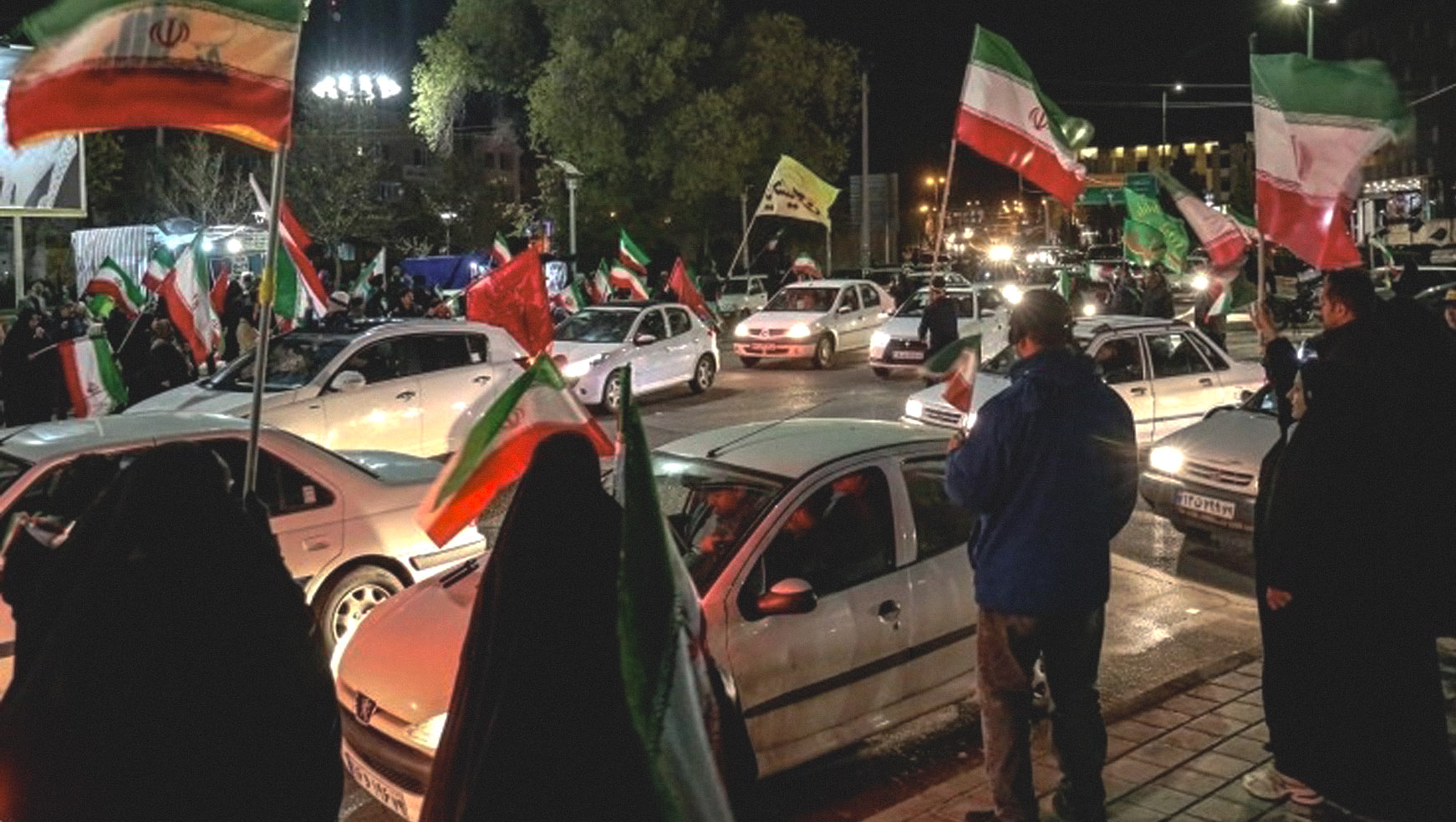
A little farther up the street, a pickup truck waits at a red light, enormous speakers stacked in its bed. Revolutionary songs pour loudly into the street. A couple of boys, perhaps ten or twelve years old, sit among the speakers, waving Hezbollah flags and Iranian flags at passing cars. The driver wears a white turban and clerical robes. Teenagers sit behind him, holding their phones sideways, perhaps playing games, perhaps filming.
A little farther up the street, a pickup truck is parked at a red light with huge speakers stacked in the back. Loud revolutionary songs blast through the street. A couple of boys, maybe ten or twelve years old, sit between the speakers waving Hezbollah flags and Iranian flags at passing cars. The driver wears a white turban and a clerical rob. Teenagers sit behind him, holding their phones sideways, maybe gaming, maybe filming.
Traffic has swallowed both the street and the sidewalks. Pedestrians squeeze through the cars.
Traffic has swallowed both the street and sidewalks. Pedestrians squeeze between cars.
In front of the truck, two women on electric motorcycles are caught in traffic. One wears a headband reading “Labbaik Ya Khamenei.” The other sits on a red motorcycle, in a black helmet adorned with tiny devil horns. Ribbons in the colors of the Iranian flag hang from her handlebars.
In front of the truck, two women on electric motorcycles wait in traffic. One wears a headband that says “Labbaik Ya Khamenei.” The other sits on a red motorcycle with a black helmet decorated with tiny devil horns. Iranian flag ribbons hang from her handlebars.
The convoy runs at least ten cars long, idling at the lights. Two girls in black chadors, riding in a white Lucano, lean out through the sunroof and wave flags, while a newly remixed revolutionary anthem booms from the speakers.
The convoy stretches at least ten cars long, idling at the traffic lights. Two girls in black chadors in a white Lucano, lean out of the sunroof, waving flags, as a newly remixed revolutionary anthem booms from the speakers.
We are armed with cries of “God is Great,”
We are armed with cries of “God is Great,”
Against the ranks of enemies we charge.
Against the ranks of enemies we charge.
We are all followers of the Leader’s path; against the ranks of enemies we charge.
We are all followers of the Leader’s path, Against the ranks of enemies we charge.
The convoy winds through Arefi-Nasab and Fallahi streets; traffic has spilled into the side alleys. A delivery rider inches forward, whistles, and gives way to a group of flag-waving girls in black chadors threading between the cars. He draws level with the white Lucano and jokes with the driver:
The convoy of cars winds through Arefi-Nasab and Fallahi streets; traffic has spilled into the side alleys. A delivery rider edges forward, whistles, and gives way to a group of flag-waving girls in black chadors weaving between the cars. He draws level with the white Lucano, and jokes with the driver:
“Who’s singing this?”
“Who’s singing this?”
The driver laughs: “Siavash Ghomayshi! No, man. It’s Haj Pouyanfar.”
The driver laughs: “Siavash Ghomayshi! No, man. It’s Haj Pouyanfar.”
The rider jokes back: “If they’re handing out dinner, maybe we should join too.”
The rider jokes back: “If they’re giving out dinner, maybe we should join too.”
The driver answers: “Come on, they say the Israelis are paying five million a night too. Join us.”
The driver answers: “Come on, they say Israelis are paying five million a night too. Join us.”
Nearby, a group of teenage skaters stand outside a café, drinking iced lattes and laughing at the whole scene.
Nearby, a group of teenage skaters stand outside a café drinking iced lattes and laughing at the whole scene.
Closer to the main square, the crowd grows more uniform. Black chadors everywhere. Strollers. Small children wearing religious headbands. The square has been divided into booths. Street vendors sell everything from glowing religious posters to colorful scarves and earrings shaped like the map of Iran.
Closer to the main square, the crowd becomes more uniform. Black chadors everywhere. Strollers. Small children with religious headbands. The square is divided into booths. Street vendors sell everything from glowing religious posters to colourful scarves and earrings shaped like the map of Iran.
People stand holding handwritten placards with long ideological messages:
People stand holding handwritten signs with long ideological messages:
“A cultural JCPOA means accepting the absence of hijab.”
“Cultural JCPOA means accepting lack of hijab.”
“We are the nation preparing the ground for the coming of the Hidden Imam.”
“We are the nation preparing the ground for the coming of the hidden Imam.”
“Do not whitewash America; it is no different from Israel, America’s dog in our region.”
“Don’t whitewash America, it's not different from Israel, which is America's dog in our region.
“We are approaching the final battle between truth and falsehood. Do not abandon the struggle, for God can easily replace any one of us if we falter.”
“We are nearing the final battle between truth and falsehood.” Don't give up the fight, for God can easily replace any of us if we falter"
Most of these slogans seem aimed less at foreign enemies than at people inside Iran.
Most of these slogans seem aimed less at foreign enemies and more at people inside Iran.
Huge billboards bearing the eyes of the children killed in the Minaab school attack rise before the plane trees. Their gaze seems fixed on the crowd flowing toward the northern end of the square. Little girls in white headscarves and young boys in school uniforms: their eyes have looked out from billboards across Tehran since the first days of the war.
Huge billboards bearing the eyes of the children killed in the Minaab school attack rise in front of the plane trees. Their gaze seems fixed on the crowd streaming toward the northern end of the square. Little girls in white headscarves and young boys in school uniforms, their eyes looking out from billboards across Tehran ever since the first days of the war.
In one corner, a painter stands before a giant canvas, painting the flag-bearing crowd as cameras record him.
In one corner, a painter stands in front of a giant canvas, painting the crowd holding flags while cameras record him.
Storm clouds gather overhead, but the rain has not yet begun.
Storm clouds gather overhead but the rain still hasn’t started.
On the northern side of the square, near the restaurants and kebab shops, a large stage has been erected beneath an enormous sign in gold calligraphy: “People’s Headquarters of Shemiran.” A singer and a religious eulogist lead the crowd through Mahmoud Karimi’s patriotic songs, while volunteers distribute free flags, tea, popcorn, and potato sandwiches. Empty paper cups litter the sidewalk.
On the northern side of the square, near the restaurants and kebab shops, a large stage has been set up beneath a huge sign, written in gold calligraphy: “People’s Headquarters of Shemiran.” A singer and a religious eulogist lead the crowd through Mahmoud Karimi’s patriotic songs while volunteers distribute free flags, tea, popcorn, and potato sandwiches. Empty paper cups litter the sidewalk.
On the sidewalk, in front of a closed Melli Shoe store, two women sit on folding chairs beside posters handwritten in red and blue marker. One reads: “Some are trying to bury our leader’s ideas before they have even buried his body. Death to traitors.” Another declares: “A cultural deal means surrendering our hijab.” A third says: “Our people changed their lifestyles to protect the country; officials refuse to change their style of governing.”
On the sidewalk, in front of a closed Melli Shoe store, two women sit on folding chairs beside posters handwritten in red and blue marker. One reads: “Some are trying to bury our leader’s ideas before they have even buried his body. Death to traitors.” Another declares: “A cultural deal means giving up our hijab.” A third says: “Our people changed their lifestyles to protect the country; officials refuse to change their style of governing.”
One woman tells the other: “The Basij kids from Niavaran handed out falafel sandwiches the other night. Tomorrow we’re bringing apples.”
One woman tells the other: “The baseej kids from Niavaran gave out falafel sandwiches the other night. Tomorrow we’re bringing apples.”
Farther off, a mobile library bus has been turned into a children’s area. Children color pictures of flags and slogans about the assassinated leader.
Farther away, a mobile library bus has been turned into a children’s area. Kids colour pictures of flags and slogans about the assassinated leader.
Another group arrives: young men and women wearing Palestinian scarves and cargo pants. One carries a Spanish flag. Two women waving Hezbollah flags tease them: “What is this, the World Cup?”
Another group arrives: young men and women wearing Palestinian scarves and cargo pants. One carries a Spanish flag. Two women waving Hezbollah flags tease them: “What is this, the World Cup?”
A booth devoted to Ferdowsi and the Shahnameh was added a few days ago. It is crowded. A sign lists the coming programs: a painting competition and Shahnameh recitations.
A booth on Ferdowsi and the Shahnameh was added a few days ago. It is crowded. A sign lists the upcoming programs: a painting competition and Shahnameh recitations.
It is well past midnight. Two weary men are dismantling the booth for the night. On a freestanding banner in front of it is a quotation from the late Leader: “I know the Shahnameh. The wisdom of Hakim Ferdowsi’s Shahnameh is not Zoroastrian wisdom; it is Quranic wisdom. Anyone who reads the Shahnameh carefully will see that Ferdowsi composed epic poetry about Iran, but from the perspective of a Muslim, and indeed a Shiite Muslim.”
It is well past midnight. Two weary men are dismantling the booth for the night. On a freestanding banner in front of the booth is a quote from the late Leader: “I know the Shahnameh. The wisdom of Hakim Ferdowsi’s Shahnameh is not Zoroastrian wisdom; it is Quranic wisdom. Anyone who reads the Shahnameh carefully will see that Ferdowsi wrote epic poetry about Iran, but from the perspective of a Muslim—and a Shiite Muslim at that.”
A couple stand in front of the booth with one child beside them and another in a stroller. The woman asks the attendant, “Did you organize the Gordafarid performance?”
A couple stand in front of the booth with a child beside them and a second in a stroller. The woman asks the attendant, “Did you organize the Gordafarid performance?”
“No,” the man replies. “That program belongs to Bagh-e Ferdows. Here we ran activities for children: naqqali performances, Shahnameh readings, and competitions.”
“No,” the man replies. “That program belongs to Bagh-e Ferdows. We ran activities here for children—naqqali performances, Shahnameh readings, and competitions.”
The husband complains: “I don’t like those programs at Bagh-e Ferdows. They’ve turned it into a carnival. One day it’s women singers, another day dancing in the name of the Shahnameh. Who are they trying to please?”
The husband complains: “I don’t like those programs at Bagh-e Ferdows. They’ve turned it into a carnival. One day it’s female singers, another day dancing in the name of the Shahnameh. Who are they trying to please?”
The attendant shrugs. “Well, clearly not you and me.”
The attendant shrugs. “Well, clearly not you and me.”
The husband pushes the stroller, paper flags hanging from its handle. The family of four walks up the hill, probably toward the Arg shopping arcade.
The husband pushes the stroller, paper flags hanging from its handle. The family of four walks up the hill, probably toward the Arg shopping arcade.
It is past midnight, but small groups still linger here and there. The rowzeh-khani has ended, and the presenter is announcing the guests scheduled for the coming nights. He tells the crowd that a famous maddah will appear and urges them to return in the nights ahead.
It is past midnight, but small groups still linger here and there. The rowzeh-khani has ended, and the presenter is announcing the guests scheduled for the coming nights. He tells the crowd that a famous maddah will be appearing and urges them to be back here in the nights ahead.
The pavement, the street, and patches of grass are strewn with small paper flags, disposable cups, bowls that once held ash, and pieces of baguette. Municipal workers in orange uniforms arrive in pickup trucks, most of them young men.
The pavement, the street, and patches of grass are littered with small paper flags, disposable cups, bowls that once held ash, and pieces of baguette bread. Municipal workers in orange uniforms pull up in pickup trucks, most of them young men.
Among the flags and the women in black chadors depicted in the oil painting, there is also an orange-clad street sweeper, but instead of a broom he carries a flag.
Among the flags and the women in black chadors portrayed in the oil painting, there is also an orange-clad street sweeper—but instead of a broom, he carries a flag.
He is holding a flag. The sweeper is perhaps the only figure in the painting who can also be seen in the square by day, alongside the rest of the city’s residents. None of the elements that have made Tajrish the pride of Tehran and Shemiran is present within the frame. The Tajrish of daylight is nowhere to be seen.
He is holding a flag. The sweeper is perhaps the only figure in the painting who can also be seen in the square by day, alongside the rest of the city's residents. None of the elements that have made Tajrish the pride of Tehran and Shemiran are present within the frame. The Tajrish of daylight is nowhere to be seen.