How art therapy helps Gaza's children process trauma
Trauma care in Gaza is not a soft cultural add-on; it is one of the few remaining systems for keeping children socially reachable.
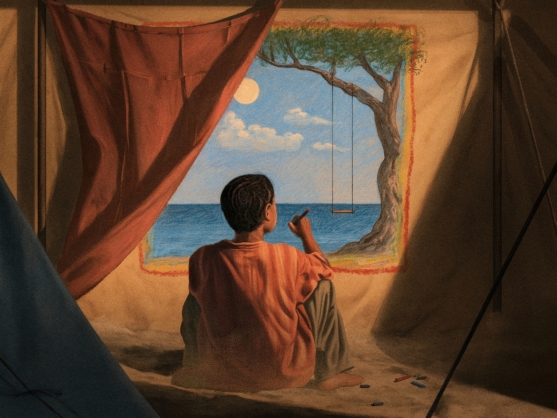
In Gaza, childhood is no longer unfolding as it once did. Something has broken in the fabric of daily life, leaving children struggling to understand a world whose pace of change has exceeded their ability to make sense of it. In temporary schools, camps, and cramped rooms, words no longer explain the world for Gaza’s children.
Into this void, artists have stepped, on a mission to help recover a lost childhood. Through drawing, movement, singing, and sound, they have begun helping traumatised Palestinian children regain the ability to express themselves. In this way, art therapy tries to give what remains of childhood a chance to breathe, perhaps through story, song, or colour.
Al Majalla met three artists from Gaza to explore their field experiences in providing psychological support and guidance to children. In their work, art and therapy intersect, as creativity becomes a tool for rebuilding the child’s inner space—however temporarily—within a reality still exposed to loss and upheaval.
Storyteller Itizaz al-Ubaid’s work seeks to loosen the direct bond between the child and the traumatic event by allowing the story to serve as a symbolic passageway. She does not begin with the war, nor does she end with it. Instead, she starts with neutral elements such as nature, colour, and imagination, to create a measure of psychological safety.
“I begin from elements that give the children a sense of warmth and imagination, until a protected imaginative space takes shape before any direct expression,” al-Ubaid explains. “The war appears in the story as one ugly image among dozens of beautiful ones, and this enables me to move the child into the safe space of art.”
In this context, children are not asked to retell their experiences directly, but gently guided towards symbolic writing through letters addressed to things that point less to war than to life. “This allows feelings to come out without a harsh reactivation of the trauma,” al-Ubaid says, adding that these children have spent three years sleeping in their shoes, because they have grown used to the possibility of sudden evacuation.
Release valve
The tools of art become a way to dismantle their fear and mistrust of the world, but for al-Ubaid, the story cannot erase the pain of reality; it is closer to an act of reordering and symbolic release, allowing the child to control how near she gets to their own experience, and how far she remains from it.
A constant concern for facilitators during this work is the fear that a child may withdraw psychologically while recounting their story. Al-Ubaid therefore walks a fine line. “The child does not readily speak about his pain. They hide it, while fear appears on their face as though the event had just happened.”