19 June 2026Focus · Latin America · South & Southeast Asia10 Items · 3 Translated · Shelf › · Archive ›
— The Dragoman's Note —
This week’s through-line is not ideology but operating capacity: who can make a society move, wait, obey, watch, buy, or defend. Finland’s apartment-block civil defense, Rio’s Terceiro Comando Puro, Noida’s police-and-employer response, and Taiwan’s drug penalties all treat the body as infrastructure to be trained, punished, or held in reserve. Culture is caught inside the same machinery: Chinese cinephiles sort state cinema from fan judgment, Fucha’s publishing circuit is disciplined across the Strait, and live stages in the dossiers do the civic work budgets and institutions refuse. Even the spectacular arenas, Mars and the 2026 World Cup, turn out to be governance fantasies: exit Earth, brand a nation, manage a border, sell a tournament. The hard question running underneath is who gets to build the routines that survive panic.
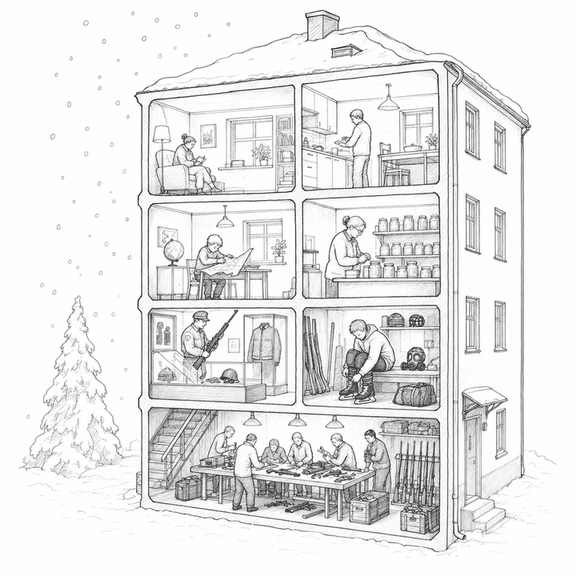
Finland’s civil defense culture shows how historical memory, everyday preparedness, and public trust turn national resilience from an abstract ideal into a shared civic practice.
Happiness Keeps Watch
Finland's civil-defense system is not a bunker fetish or wartime panic; it is a social habit built into schools, museums, apartment blocks, hobby spaces, and municipal routines. The striking number is political as much as military: in a country ranked among the world's happiest, roughly 80% say they would take up arms if the outcome of an attack were uncertain.
“Air-raid shelters are part of our lives. If children have played there since they were small, then when civil defense, drills, or a real emergency are discussed, people are probably less likely to panic.”
Why it leads: Finland has made readiness feel ordinary: a child’s playground can also be a shelter, and that quiet civic muscle is what Russia’s neighbors now have to teach the rest of Europe.
Bilingual · 5d ago · 1 min · Deep
The Brief
The Brief follows power where it becomes routine: drills, gangs, courts, cinemas, tournaments, drug schedules, publishing bans and telecom wires.
Rio's Terceiro Comando Puro is best read as an urban governance actor, not merely a gang label: territorial control, prison networks, police pressure, and rivalry with Comando Vermelho shape its power. InSight Crime's profile format usually maps leadership, revenue, geography, and state response rather than stopping at crime chronology.
By 2020, one of the gang’s leaders, Álvaro Malaquias Santa Rosa, alias “Peixão,” had begun incorporating Israeli symbolism and Pentecostal religious principles into the TCP, including the belief that faith can bring material success.
World Cup teams can be sorted by styles of winning: pressing, possession, transition, defensive compression, set-piece advantage, and star dependency. The useful payload is comparative: tactics become national systems only when player pipelines, club football, and coaching fashions line up.
En Europa, esta táctica se denomina «futbol relacional» para subrayar la importancia de la relación entre los jugadores en la construcción del juego. En Sudamérica, el cambio de paradigma teorizado por Diniz ha sido radical.
Mars colonization fantasies turn planetary crisis into an exit story for elites and engineers. Noema's likely strength is connecting space rhetoric to political imagination: the dream of escape competes with the harder task of making Earth governable.
I didn’t have the heart to compound their disappointment by revealing my own misgivings. After weeks of reading about the challenges of settling Mars, I was preoccupied with one glaring truth. Mars is an uncompromisingly hostile planet and a dreadful place to be a living organism.
Chinese film culture is approached through domestic cinephiles rather than box-office totals alone: viewing habits, taste communities, and industry data are put in the same frame. The empirical angle should help distinguish state cinema, commercial cinema, and fan judgment inside China.
नोएडा श्रमिक आंदोलन मामले में गिरफ़्तार नाबालिग जुवेनाइल होम से जमानत पर रिहा
A 16-year-old arrested after the Noida workers' protest spent about two months in jail with adults before six days in a juvenile home and release on bail. The family's allegations of assault and procedural violations turn a labor case into a test of how police, courts, and employers handle working-class dissent.
After this, having been kept in jail with adults for nearly two months, he was transferred to a juvenile home on Friday (June 12). The certificate from his ossification test, used to estimate age, had been issued on June 6; even after it established that he was a minor, he was kept in jail for six days.
Taiwan's government is moving etomidate into the most severe narcotics category, making manufacture, transport, or sale potentially punishable by death. New Bloom is likely to connect the policy to Lai's law-and-order positioning, media panic around drug driving, and Taiwan's punitive drug-law tradition.
Still, it proves all too typical that some calls were to publicly shame repeat offenders, with some cities beginning to publicize the names and photos of frequent offenders.
The 2026 World Cup is also a diplomatic arena for the United States, Mexico, Canada, FIFA, sponsors, and participating states. The useful frame is soft power through hosting, security, migration optics, and national branding rather than the tournament as pure sport.
The 2026 FIFA Men’s World Cup is now well underway, bringing 48 countries’ teams to compete in a soccer tournament co-hosted by the United States, Mexico, and Canada. With teams from every continent except Antarctica, the 2026 tournament is a truly global event.
Li Yanhe, the Gusa Publishing editor known as Fucha, has reportedly been released from imprisonment in China but blocked from returning to Taiwan. The case sits at the junction of publishing, cross-strait coercion, and the disciplining of Chinese-language cultural circuits outside the PRC.
In this sense, one notes that deprivation of political rights has been used as a pretext to prevent Taiwanese nationals from returning to Taiwan even after the end of their jail sentences. In the case of Morrison Lee, Lee was eventually allowed to leave, first traveling to Japan to lay low before returning to Taiwan.
Milei's government has cleared Telecom's purchase of Telefónica Móviles Argentina, with divestment conditions meant to contain concentration. The transaction is a privatization-era echo under new deregulatory politics: telecom infrastructure, competition rules, and foreign corporate retreat all converge.
Spanish · yesterday · Skim
Many Views
Many Views watches the same shocks change shape by language: China as rival or beneficiary, Ukraine as front line or civic infrastructure.
Many tongues on one question
China’s gains from global disorder
An Italian theoretical essay asks whether Beijing and Washington can escape the Thucydides trap at a moment of accelerating chaos; a French geopolitical read sees a sharper possibility, that China may already be the quiet winner of the war against Tehran. One treats China as half of a dangerous great-power equation, the other as the beneficiary of a regional war.
The world is at a new crossroads, with China and the United States facing the question of whether they can avoid the Thucydides trap and invent a different great-power order. Doppiozero · Italian
Four weak signals point to Beijing, not the belligerents, as the possible real winner of the war against Tehran. Le Grand Continent · French
Another question, several views
Ukraine’s war as a test of civilian infrastructure
A Russian exile reporter and a French cultural journal look past the front line to the systems that keep life going. One sees occupied Donbas as Russia’s preview of rationed fuel, timed water and hoarded food; the other sees Ukrainian cultural venues becoming shelters, resistance sites and partners for France.
Бензин по квотам, вода по часам, продукты про запас. Донбасс уже давно живет так, как Россия пока только привыкает. Рассказывает Дмитрий Дурнев
Occupied Donbas is the warning case: once war reaches refineries and utilities, ordinary life becomes a schedule of queues, limits and contingency stocks. Novaya Gazeta Europe · Russian
In Kyiv, culture is not decoration after survival; under air-raid alerts, venues double as refuges and resistance nodes while French and Ukrainian operators build a longer partnership. AOC · French
Deep Research
Deep Research follows the pipes beneath the headlines: money, fuel, corridors, reactors, bases and stages doing political work.
One fault line, many vantages
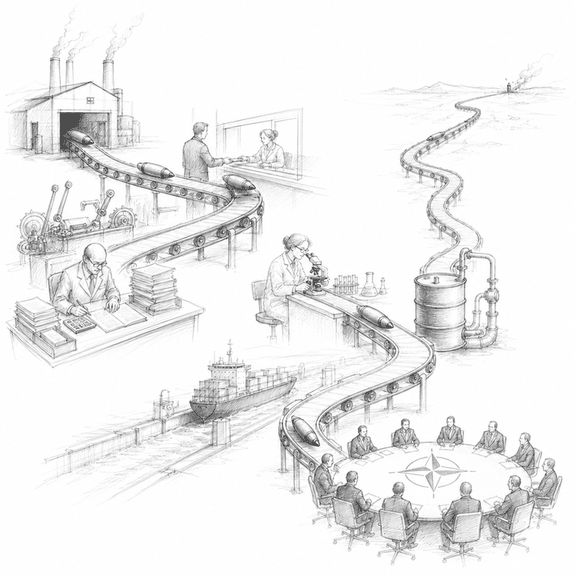
The War Machine Is a Supply Chain, Not a Mood
The Ledger Advances
The front line is only one balance sheet. Russia’s war is being financed through wages, deposits, defense orders and scientific-industrial leakage; India and Turkey read the same war through oil discounts, military dependence, chokepoints and NATO leverage.
En · Russian opposition economists, exile-facing but close to Russian statistical debates
Russia’s wartime income boom is not feeding a normal consumer recovery. High rates pull household money into deposits, banks lend to budget-backed firms, defense-linked activity keeps absorbing capital, and civilian industry gets inflation without a demand engine. Re:Russia · English
En · Indian strategic-policy establishment, New Delhi
New Delhi’s Russia line is a refinery and defense-maintenance calculation before it is a slogan about strategic autonomy. Discounted crude, settlement workarounds, and Russian-origin military platforms make U.S. secondary pressure costly enough to deepen Moscow contact rather than end it. Observer Research Foundation · English
En · Turkish foreign-policy insider view from Ankara
Ankara’s leverage comes from geography made legal: the Montreux Convention, the Bosporus, the Black Sea and NATO’s southeastern flank. Closing the Straits to warships turned Turkey from awkward ally into indispensable gatekeeper, while still leaving room to bargain with Moscow. Yetkin Report · English
En · Ukrainian/French research-security vantage from CNRS
Dubna’s Joint Institute for Nuclear Research is treated as infrastructure, not soft culture: a nominally peaceful international science hub sits inside a Russian military-industrial ecosystem, trains specialists, and keeps technology channels open. The sanctions problem is not only chips and oil tankers, but institutional prestige that lets dual-use capacity pass as collaboration. arXiv · English
One fault line, many vantages
After Deterrence: The Region Learns Exposure Management
Four views of the same shock: Gulf bases become targets, China treats Iran as a laboratory rather than a client, Berlin maps the new regional doctrine, and Moscow reads Israel’s turn from containment to serial coercion. The shared mechanism is exposure management: every actor wants leverage, fewer want to be the place where someone else’s escalation lands.
ع · Gulf security bargain from Doha and Abu Dhabi, focused on Qatar, Bahrain, Kuwait, the UAE, Oman, and Saudi Arabia.
الوجود العسكري الأمريكي في الخليج: من أداة للردع إلى مصدر للانكشاف؟
U.S. bases in the Gulf used to be an insurance policy: CENTCOM got reach, monarchies got deterrence. Iranian strikes turn that infrastructure into a liability, so Gulf hedging becomes a way to keep American protection without becoming the next launchpad or target set. Middle East Council on Global Affairs · Arabic
Tr · Turkish regional-policy view of China’s Middle East calculus, from an Al Sharq/ORSAM China specialist.
ABD ve İsrail’in İran’a Karşı Savaşında Çin’in Stratejik Hesaplaması
Beijing does not read the war as a morality play but as a stress test for energy corridors, U.S. escalation management, sanctions resilience, military technology, and Taiwan. Tehran is useful as an anti-U.S. weight, but Gulf oil, Arab capital, and Israeli-linked technology make full alignment too costly. Al Sharq Strategic Research · Turkish
De · German strategic-policy synthesis, written for Berlin’s foreign-policy establishment.
Tehran is materially weakened but harder to bypass; Israel wins time but replaces containment with a doctrine of dominance by repeated force. The strongest value is the full map: Saudi de-escalation, Lebanese sovereignty, Gulf vulnerability, Russian marginalization, Chinese restraint, and European exposure all move together. Stiftung Wissenschaft und Politik · German
Many tongues on one storm
When the Corridor Starts Governing
Ecuador is not a sudden gangster morality tale. Cocaine logistics, municipal land markets, Balkan brokers, prison command structures and hollowed-out state capacity now meet in the same places; Noboa’s war vocabulary names the violence but misses much of the machinery that keeps paying.
Es · Ground-level Ecuadorian investigation from Durán, by Plan V with Tierra de Nadie and CONNECTAS.
Durán’s cadastral offices, land registry and irregular settlements became part of the criminal infrastructure. Gangs turn untitled plots into revenue, safe houses, weapons stores and political leverage; municipal officials sit between bribery and death threats. Plan V / CONNECTAS · Spanish
Es · Ecuadorian analytical report on the European-facing cocaine chain and the state agencies usually left out of security talk.
Balkan groups are not peripheral guests in Ecuador’s cocaine economy; they use export fronts, corrupt alliances and money-laundering structures built over a decade. The useful policy implication is institutional: tax, financial-intelligence, environmental, energy and supervisory agencies belong in the anti-crime map alongside police and soldiers. Observatorio Ecuatoriano de Crimen Organizado · Spanish
En · Comparative political-science view from Galo Mayorga and Kai M. Thaler, pairing Ecuador’s security crisis with democratic backsliding.
Ecuador’s violence rose after state capacity and security institutions deteriorated; Noboa’s militarized mano dura has expanded emergency rule without solving the criminal economy. The democratic problem is practical, not ornamental: weaker courts, protest constraints and military improvisation leave the state less able to govern the networks it claims to fight. Journal of Democracy · English
What they said would happen
Fukushima Didn’t End Nuclear; It Ended the Easy Story About It
Fifteen years on, Fukushima is less a completed accident than a permanent governing arrangement: Daiichi is still a 30- to 40-year decommissioning site, Japan has moved from total shutdown toward a cautious restart politics, and the world has not abandoned nuclear so much as narrowed new-build power into China and Russia while the global share sits around 9%. ([world-nuclear.org](https://world-nuclear.org/information-library/current-and-future-generation/nuclear-power-in-the-world-today)) Scoring the 2011 forecasts: Angela Merkel’s pledge to shut Germany’s reactors within eleven years was essentially fulfilled, with a short energy-crisis extension to April 2023; Naoto Kan’s call for Japan to reduce and eventually eliminate nuclear dependence was true for the shutdown decade but has been politically reversed; the IEA warning that “second thoughts” on nuclear would raise fossil-fuel dependence and complicate climate policy was right for Japan and Germany’s first post-Fukushima years, but less decisive once renewables scaled; Exelon’s John Rowe saying the “nuclear renaissance is dead” and Schneider/Lovins/Froggatt saying Fukushima would accelerate an already visible decline were right for the US and Europe, wrong if read as a literal global death notice; George Monbiot’s March 2011 claim that Fukushima’s radiation toll would be far smaller than anti-nuclear rhetoric implied has aged better than many opponents expected, but his political inference that this would strengthen nuclear has not carried outside a few energy-security coalitions. ([theguardian.com](https://www.theguardian.com/commentisfree/2011/mar/21/pro-nuclear-japan-fukushima))
日 · Japanese environmental NGO with long Fukushima support and anti-nuclear campaign work; close to civil-society opposition rather than METI/TEPCO.
FoE’s booklet is an anti-nuclear dossier, but its value is the structure: evacuation zones, resident return, ALPS water, fuel debris, operating reactors, construction costs, uranium supply, and waste all in one visual map. It turns “Fukushima recovery” into a balance sheet of burdens shifted across time: evacuees, host towns, fishers, ratepayers, and future waste sites. FoE Japan · Japanese
日 · Local Fukushima newspaper interviewing the ministry responsible for decommissioning; the host-region questions rather than Tokyo’s energy-policy framing.
Fukushima Minpo presses the trade minister on the real unresolved pieces: repeated delays in retrieving melted fuel debris, what the final decommissioned site will look like, whether spent fuel and debris leave the prefecture, and how water-release stigma is being measured. The useful part is not the minister’s reassurance, but the local paper’s agenda: Fukushima wants end-state commitments, not another national slogan about reconstruction. Fukushima Minpo · Japanese
De · German left daily, writing from a country that actually completed the post-Fukushima exit and is now relitigating it under energy-security pressure.
A German post-exit reckoning aimed at the CDU/CSU claim that Germany took a uniquely irrational path after Fukushima. The piece puts the phaseout argument back into physical time: reactor fleets age, Flamanville took 17 years and multiplied its costs, and Germany’s unresolved high-level waste will sit in interim stores while the repository timetable slips toward mid-century or later. nd · German
A standing interest, freshly read
When the Stage Does the Work Institutions Refuse
Here, live art is not a metaphor for society; it is one of society’s working organs. The stage gives hidden labor a body, turns migration into a problem of authorship, and exposes how budgets decide which publics can exist.
Es · Buenos Aires criticism on a Mexican collective’s Central America/Nicaragua project, read from a Latin American circuit rather than the U.S. migration frame.
Central America is not scenery between Mexico and South America but a political blind spot. Lagartijas Tiradas al Sol make that blind spot unstable, following a Nicaraguan exile’s impossible burial request until documentary theatre becomes a test of impersonation, money, bureaucracy and whether humanitarian art can avoid lying. Revista Otra Parte · Spanish
De · German production-house directors speaking from inside the federal, state and municipal funding machine.
Germany’s production-house network did not merely lose a budget line; it lost the core money that lets HAU, HELLERAU and similar houses multiply grants into residencies, international co-productions and long relationships with artists in threatened contexts. “Systematisierung” and “Konsolidierung” shift money toward buildings and heritage while the live transnational ecology is asked to survive on project scraps. Nachtkritik · German
Nb · Norwegian dance criticism moving between Oslo seminar rooms, European dance history and Nordic cultural-policy warning signs.
Dance history becomes a repertoire of antifascist technique: cooperation, self-organization, alliances, refusal to become useful to authoritarian culture. The sharper tension comes when the seminar’s theory meets Nordic arts politics: Sweden’s art-freedom debate, Norway’s blurred Kulturdirektoratet/Kulturrådet split, and the withdrawn support for Hooman Sharifi’s Impure Company make “antifascism” a funding and arm’s-length problem, not only an aesthetic position. Scenekunst · NB