21 August 2026Focus · MENA · Latin America12 Items · 6 Translated · Shelf › · Archive ›
✓ done — leaves the paper tonight, click again to undo · ☆ save for later · rate a piece at the end of its reading page
— The Dragoman's Note —
This week, blocked mobility keeps turning into private risk: Egyptian families send sons onto dangerous roads, Delhi workers absorb lethal heat, and Gujarat villagers chase a promised 20 percent return because ordinary security has thinned out. The state is everywhere as allocator and bottleneck, from China’s hospital-payment rules to Egypt’s branded prescriptions to cement’s clinker problem, where technical fixes depend on procurement, standards and who pays for carbon capture. Symbols are doing harder work than decoration: the Champs-Élysées parade, Japan’s Hinomaru, Argentina’s Malvinas songs and Bad Bunny’s “we” all turn identity into a public instrument. In the dossiers, the same logic sharpens: Egypt’s post-Tahrir fortress runs on debt and migration control, Gaza scrambles old camp maps, and Congo’s coltan routes make Rubaya part of Europe’s electronics chain. Money, legitimacy and exposure are the week’s common machinery; whoever controls the route, the budget, the emblem or the supply chain controls the story people are forced to live inside.
The article argues that Egypt has not stopped irregular migration so much as displaced it westward into longer, deadlier routes through Libya, while leaving untouched the economic and social pressures that drive young people, and increasingly minors, to leave.
The Exit Road
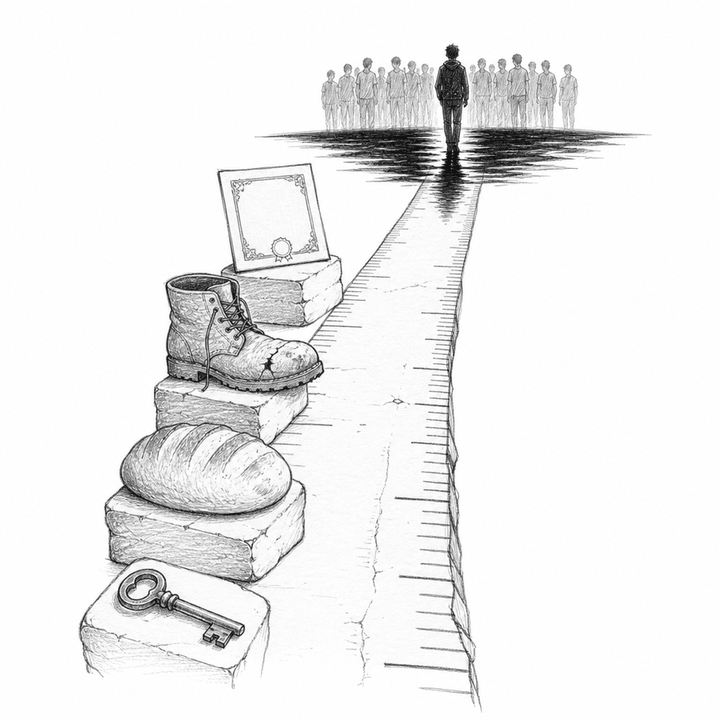
Egypt sends roughly 1.3 million young people into the labor market each year, while the economy creates too few jobs and too many of them are poor-quality work. Dangerous migration is not an aberration at the margins; it is the household-level exit route from blocked mobility, falling wages, and a state that treats youth as surplus labor.
The facts suggest that the route was not closed; it shifted westward. Instead of sailing directly from the Egyptian coast, thousands of Egyptians now cross the border into Libya first, then set out from the shores of Tobruk and its environs toward Greece and Italy. With this change, the dangers did not disappear; they multiplied.
Why it leads: Egypt did not stop the crossings; it pushed them through Libya, where a young migrant’s route to Europe now runs through militias, detention, ransom and deadlier seas.
Bilingual · yesterday · 9 min · Deep
The Brief
The Brief tracks systems that push risk downward while keeping authority upward: work, medicine, heat, flags, parades and fraud all become tests of who gets protected.
Cement emits on two fronts: the fuel burned to heat kilns and the chemical release from turning limestone into clinker. Because clinker is both cheap and structurally hard to replace, decarbonizing cement depends less on consumer choice than on standards, procurement, industrial policy, and who pays for carbon capture.
What accounts for the green transition’s failure to launch in the cement industry? The answer lies not only in the sector’s unique chemistry, but in its uniquely crisis-prone political economy.
Egypt’s prescription system trains doctors and patients to think in commercial drug names instead of active ingredients, leaving pharmacists to decode substitutions under pressure. The resulting errors are not random mistakes; they come from a pharmaceutical market where branding, scarcity, and uneven professional authority shape clinical practice.
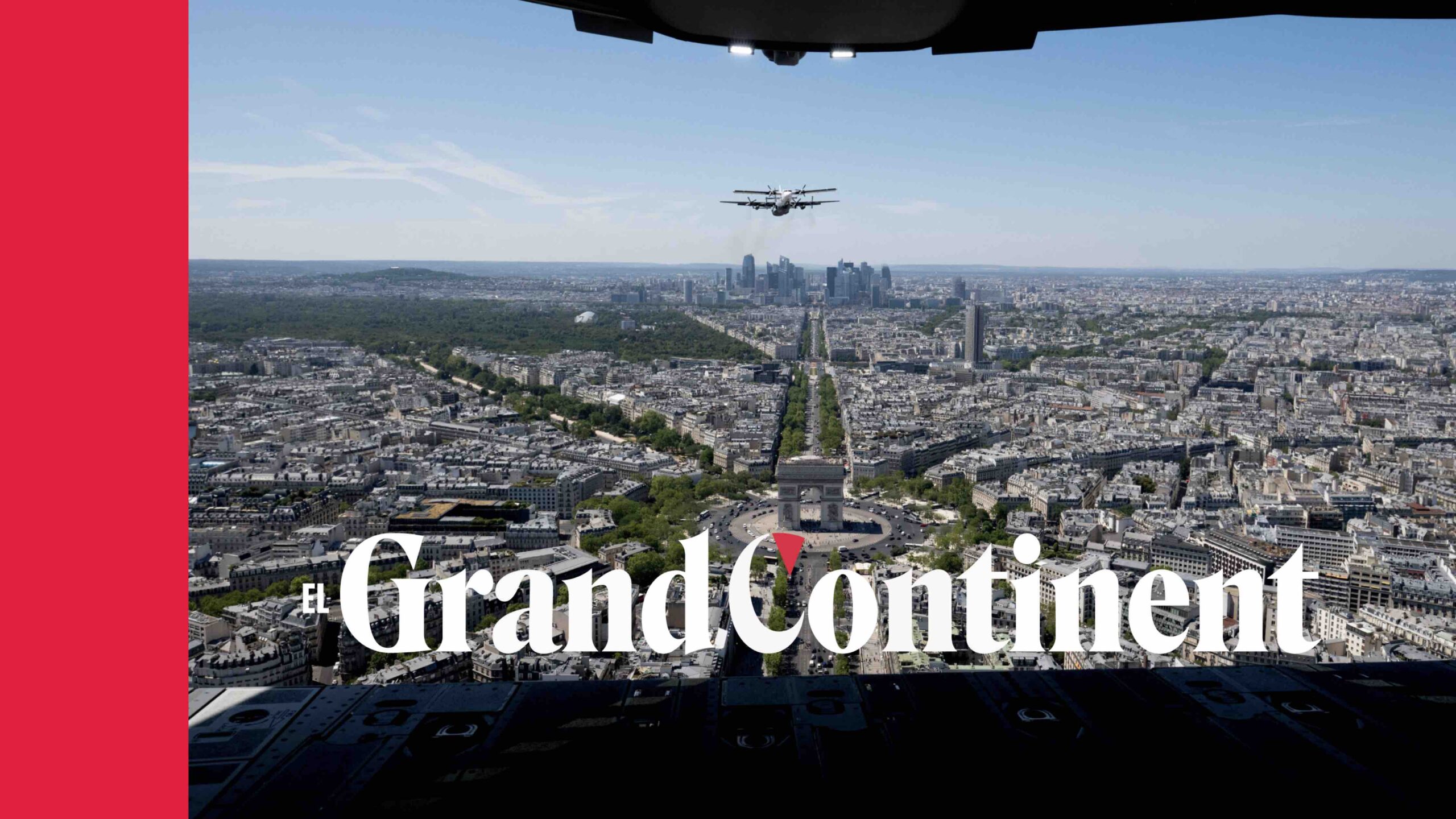
Los desfiles militares ya no son folclore nacional: de la Plaza Roja a los Campos Elíseos, funcionan como una gramática visible del nuevo orden de fuerza. Francia exhibe volumen, interoperabilidad y cultura estratégica en un momento en que Europa intenta aprender a mostrarse como actor militar, no solo como mercado regulador.
Estas imágenes esbozan los contornos de un orden internacional que ya no es el del multilateralismo nacido en 1945, ni el de la globalización optimista de la década de 2000. Los bloques imperiales se están reorganizando, la demostración de fuerza precede ahora al comunicado, y la iconografía política ha vuelto a convertirse en un arma.
मानवाधिकार आयोग से दिल्लीवासियों की अपील: अत्यधिक गर्मी को मानवाधिकार का मुद्दा घोषित किया जाए
Citizen heat registries convert lived effects into rights claims before the NHRC.
Record
What it captures
Evidence
Weekly heat registry
Health, income, sleep, dignity
Bills, medical records
Rights claim
Health, livelihood, dignity
Article 21 cases
Policy ask
Funded heat plans
Cooling, water, shade
Delhi residents and informal workers are trying to move extreme heat out of the weather column and into rights law, with heat registries documenting damage to health, livelihood and dignity. The mechanism is simple and brutal: the people least able to retreat indoors carry the highest exposure, while official relief still treats heat as an episodic hazard.
In the letter to the Commission, it is stated that official temperature data, surveys, and government reports reveal only a small part of heat’s real human impact. Those most affected are often not in a position to make their voices reach institutions. In this context, the “heat registries”
Translated from Hindi · yesterday · 4 min · Deep
中 National Healthcare Security Administration · Bilingual
China's medical-insurance payment reform is shifting hospitals away from billing each service separately toward tighter pooled-payment rules. The underlying fight is over incentives: whether hospitals make money by expanding tests, drugs and admissions, or by treating patients inside a constrained budget.
No grouping scheme can cover every case. In clinical practice, a small number of cases involve complex conditions, multidisciplinary joint diagnosis and treatment, or the use of new drugs and new technologies.
Language in Bordin's strange category is treated as material practice, not a transparent vehicle for ideas. The title's split between head and hands points to an ideological desertion: thought that has lost contact with making, labor and bodily technique.
Ma appunto, se Bordini comincia a mettere mano alle Memorie nel 1976, vuol dire che il congegno non si è mai dissolto. Parimenti, Strana categoria convoglia allo stesso tempo l’apertura alla “vita”
Bad Bunny's Super Bowl spectacle and Rajoy's political language become a test case for the unstable pronoun “we.” Mass culture, nationalism and marketable identity keep producing collective belonging, but the boundaries of that belonging are always being fought over by class, language and media power.
Napoleon III's reputation usually collapses into caricature, but his regime helped invent parts of modern mass politics, urban modernization and state-led capitalism. The revisionist payoff is that authoritarian modernization was not an accidental sideshow in nineteenth-century Europe; it was one of the routes by which modernity arrived.
Then, after living for 40 years in exile, mostly between Switzerland and London, he finally staged one of the most remarkable political comebacks in history. The nephew of Napoléon Bonaparte rode a wave of popular adulation in the aftermath of France’s 1848 revolution and it took him all the way to the summit of the French state.
Hinomaru: The Symbolism and History of Japan’s National Flag
Japan's red sun flag draws on ancient sun worship but only became the de facto national flag in the nineteenth century and a legally recognized one much later. The emblem's apparent simplicity hides a long conversion of religious symbol, imperial statecraft and postwar national identity into a single design.
Even so, from that time onward, the hinomaru was treated as Japan’s de facto flag. Eventually, 129 years after the Council of State proclamation, it received full legal recognition with the enactment of the Act on National Flag and Anthem in August 1999. Thus the hinomaru has been Japan’s official national flag for less than thirty years.
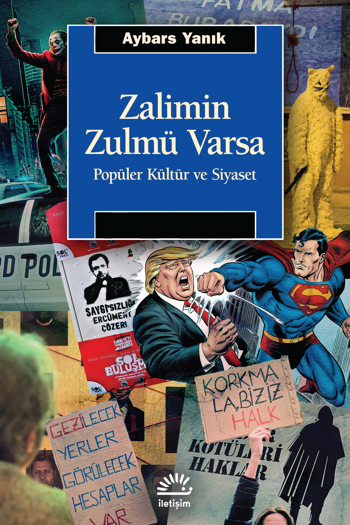
Aybars Yanık ile Söyleşi: "Zalimin Zulmü Varsa..."
Birikim interviews usually earn their space by making Turkish politics legible through ideology, class and institutional memory rather than daily outrage. The title points toward political violence and resistance, with the likely center of gravity in how domination is narrated, organized and answered.
A.Y.: Antagonistic political logic is a logic of politics that is current today and that works like clockwork. It names the logic on which today’s binaries of us/them, good people/bad people, heroes/traitors are built.
गुजरात: 35 गांवों में 400 करोड़ रुपये का कथित घोटाला, आरोपी दो भाइयों में एक भाजपा पदाधिकारी
A promised 20 percent stock-market return allegedly pulled money out of 35 Gujarat villages and into a Rs 400 crore fraud network linked to two cousins, one reportedly a local BJP office-holder. The case is less about gullibility than about political trust, informal finance and the hunger for returns where formal security is thin.
Investigators say they ran the operation much like most Ponzi schemes: money received from new investors was used to pay the promised returns to older investors, so that trust would be sustained and people would keep spreading the word to others.
Translated from Hindi · yesterday · 7 min · Deep
Many Views
Many Views turns shared symbols into contested property, from Argentina’s football memory to heat as a collective burden rather than a private discomfort.
Many tongues on one question
Argentina, football and national memory
A Spanish football-romantic, a Brazilian skeptic and a Dutch explainer meet at the same charged symbol: Argentina as a team whose World Cup drama carries Maradona, Messi, the Malvinas and regional rivalry onto the pitch. One reads the England match as historic theatre, one refuses Latin American solidarity as a duty, and one tracks why the Falklands claim keeps surfacing in the songs.
Three readings of Argentina’s symbolic weight on the pitch.
England-Argentina becomes more than a fixture: Malvinas, Maradona and Messi turn it into one of the World Cup’s most emotionally loaded encounters. Le Grand Continent (ES) · Spanish
A Brazilian can favor Latin American integration and admire Messi without cheering Argentina, because football is also made of rivalries and tensions that democracy does not erase. Outras Palavras · Portuguese
Another question, several views
Heat as a test of collective systems
A French social-policy lens and an Italian techno-ecological lens meet at the same pressure point: extreme heat is no longer a private discomfort but a stress test for public protection, energy and the machines that still depend on rivers.
France's record June 2026 heatwave exposes a class divide in adaptation: private means still decide who can stay safe, so protection has to be built collectively rather than bought individually. AOC · French
The Golfech nuclear plant's reduced output during 40-degree heat in southern France turns the climate crisis into an infrastructure problem: even advanced machines remain hostage to overheated water. Doppiozero · Italian
Deep Research
Deep Research follows the hard plumbing of power: rear areas, proxy borders, debt states, mineral routes, succession rules and cultural gatekeepers.
One fault line, many vantages
Ukraine Has Made Russia’s Rear a Front, and NATO’s Rear a Factory
Rear Lines Advance
Four different maps of the same war line up: Kyiv is attacking the Russian state through logistics, fuel, export chokepoints and attention; Moscow’s doctrinal class is normalising a world where the boundary between local war and global war dissolves; Ankara reads the same shock as a chance to move from NATO’s flank to NATO’s defense-industrial core.
Ру · Russian independent/exile analytical view, close to Russian domestic data and elite discourse.
Второй театр войны: как и почему весенняя кампания ударов по российской инфраструктуре меняет соотношение сил в противостоянии России и Украины
Cheap, scalable, longer-range Ukrainian drones are substituting for the missile arsenal Kyiv lacked, making Russian territory a second theater rather than a protected rear. The key claim is industrial and political: oil infrastructure, defense-production bottlenecks, air-defense saturation and Russian public attention now belong to the same battlefield. Re: Russia · Russian
Fr · French-European reading of a Russian doctrinal text from a Kremlin-aligned foreign-policy intellectual.
Dmitri Trenin’s doctrine treats Ukraine less as a bounded war than as one front in a permanent global contest where diplomacy, attrition, nuclear signalling, infrastructure strikes, cyberwar and social endurance all become instruments. The French commentary is useful because it does not reduce Kremlin thinking to bluster; it reconstructs the mental machinery that makes escalation and endlessness look rational inside Moscow’s strategic class. Le Grand Continent · French
Tr · Turkish strategic-autonomy view of NATO, Russia, the Black Sea and defense industry.
“Türkiye Ne NATO’nun Otomatik Aparatı Olmalı Ne de Rusya’yla Stratejik Körlük Yaşamalı”
From Ankara, the Ukraine war is also the birth of “NATO 3.0”: an alliance reorganised around ammunition, drones, air defense, critical minerals, supply chains and defense industry. Turkey’s opportunity is to become a rule-setting producer rather than a subcontractor, while preserving the Black Sea/Montreux balance and enough channels to Russia to avoid becoming merely a NATO production appendage. Fokus Plus · Turkish
One fault line, many vantages
Who Gets a Seat After the Camp Map Breaks?
A clean map of “Iran’s axis” versus “moderate states” does not survive these four readings. Tehran sees Gaza as an adaptation problem for a decentralised axis; Gulf capitals are buying room between U.S. bases, Iranian punishment capacity and Israeli escalation risk; Paris and Tel Aviv both register the same strategic trap for Israel: battlefield superiority can still leave it outside the regional order being built around it.
فا · Iranian strategic-policy view of Gaza and the axis after attrition
Hamas’s civilian retreat in Gaza is not treated as disappearance from Palestinian politics: it sheds daily governing costs while preserving social and military capacity. For Tehran, the harder calculation is whether a decentralised axis can still deter when Hezbollah, Hamas, Iraqi groups and Yemen all carry reconstruction, sanctions and domestic-political costs. Iranian Diplomacy · Persian
Fr · French/European reading of the Israeli-Saudi collision over regional order
Israel’s regional project is hierarchy through force; Saudi Arabia’s is geoeconomic maneuver, status preservation and flexible alignment. Iran’s weakening therefore does not automatically deliver an Israeli-led Middle East: Riyadh wants U.S. guarantees while widening options with the GCC, Turkey, Egypt, Pakistan, Europe and South Korea. Le Grand Continent · French
Many tongues on one storm
Congo’s Peace Deal Has to Cross Rubaya First
Washington and Doha can sign frameworks; the war’s machinery sits elsewhere: a rebel administration in the Kivus, Kinshasa’s outsourcing of counterinsurgency to Wazalendo militias, Rwandan security doctrine, and coltan routes that make Rubaya part of Europe’s electronics chain. Read together, these pieces strip away the lazy “minerals war” line without pretending minerals are incidental: territory, legitimacy, proxy warfare and supply-chain laundering are the same system.
Fr · Congo Research Group/CIC, policy-research view with Great Lakes field networks; French version of the 2026 brief.
M23 is not just a Rwandan remote-control force. Its military hierarchy, AFC political umbrella, Makenga-Ngaruye tensions, recruitment problems, refugee claims, parallel administration and long-occupation strategy create interests that Kigali can shape but not simply switch off. Center on International Cooperation / Groupe d’étude sur le Congo · French
En · Congolese research institute and Congo Research Group; close read of armed-group coalitions in North and South Kivu.
Kinshasa’s answer to M23 has been to subcontract violence: private contractors, Burundi’s army, FDLR elements and old local armed groups rebranded as Wazalendo. That buys battlefield capacity and populist legitimacy now, while creating a future debt in impunity, army integration claims and fragmented local authority. Ebuteli / Congo Research Group · English
En · Supply-chain investigation from Europe, focused on Rwanda-DRC-Luxembourg trade plumbing.
Rubaya coltan does not need a clean story to enter clean supply chains. Global Witness follows customs data, African Panther exports, Traxys purchases, Rwanda’s inflated coltan figures and weak traceability systems to show how M23-controlled ore can become a European input rather than a battlefield fact. Global Witness · English
Fr · Local incident-tracking from Kinshasa/Goma research networks; close to the Kivu battlefield rather than diplomatic choreography.
The front line looked static in February 2026, but the conflict was changing form: kamikaze drone strikes on Kisangani, FARDC drone attacks near Rubaya, M23-FDLR clashes and civilian executions around Uvira. The monthly Kivu Security Barometer keeps the peace-process story honest by showing where violence mutates after the communiqués. Ebuteli / Baromètre sécuritaire du Kivu · French
What they said would happen
Egypt After Tahrir: The Revolution That Built a Fortress
The old bargain did not return unchanged; it hardened. Egypt today is a debt-fed, security-managed republic whose ministries have moved to the desert, whose elections are negotiated among state-aligned camps, whose opposition survives as ritual or exile, and whose external patrons now pay for migration control and regional steadiness as much as for reform.
Predictions scored: SCAF’s February 2011 claim that it was not a substitute for popular legitimacy and would oversee transfer to elected civilian rule aged badly; the transfer happened briefly, then the officer-state came back through Sisi. The Muslim Brotherhood’s 2011 promise not to field a presidential candidate was plainly false, though the rival prediction that the Brotherhood was the best-organized electoral machine was true. Wael Ghonim’s “Revolution 2.0” optimism was right about mobilization and wrong about power. The 2013-14 liberal wager, stated now by Monir Fakhry Abdel Nour, that 30 June would remove the Brotherhood and then reopen civil politics was half-right: political Islam was pushed out of office, but freedom, democracy, and social justice disappeared with it. The structural pessimists did better: Gard-Murray and Bar-Yam’s 2012 warning that post-revolution states often revert to simpler autocratic forms was basically right; Lee Smith’s 2014 prediction that Sisi and the military could not solve Egypt’s economic and security problems was right on the economy and only partly right on regime stability, since the breaking point became Gulf/EU/IMF dependence rather than collapse. ([en.wikipedia.org](https://en.wikipedia.org/wiki/Supreme_Council_of_the_Armed_Forces?utm_source=openai))
ع · Egyptian legal-political essay from Al Manassa, reading the new capital through Cairo’s older geography of rule.
Sisi’s new strategic command headquarters in the desert is read as the political architecture of counterrevolution: power withdrawing from Cairo’s streets into a fortified administrative zone. The key line is Sisi’s own justification: 2011 and 30 June taught the state that courts, ministries, media, and the Defense Ministry could be surrounded by people. Al Manassa · Arabic
After the cameras left
Kazakhstan After January: Sovereignty as Procedure, Fear as Memory
January did not open Kazakhstan’s system; it taught the presidency to legalize succession before the next rupture. Russia’s war then made sovereignty concrete for ordinary Kazakhs: not a slogan, but fuel prices, oil routes, sanctions compliance, language, borders, and the uncomfortable fact that the country’s main shield is also one of its main threats.
Ру · Kazakhstani independent political reporting, with local constitutional and parliamentary experts reading the new architecture from inside Astana’s rules of power.
Tokayev’s 2026 institutional redesign turns the promise of a stronger parliament into a tighter presidential circuit: a one-chamber Kurultai, a Halk Kenesi, and a vice-president chosen from above. The aftermath of Qandy Qantar is not democratization but succession engineering: fewer elite ambiguities, more managed representation, and a legislature still unable to become a rival center of power. Vlast · Russian
Ру · PaperLab’s 2025 survey, focus groups and expert interviews; close to how Kazakh citizens connect geopolitics to prices, security and sovereignty.
Партнеры и приоритеты: что важно для казахстанцев в вопросах внешней политики
Kazakhstanis still support multi-vector policy, but no longer as a confident diplomatic formula: it reads as forced balancing by a state wedged between Russia, China and the United States. Russia’s favorability has fallen from 81% in 2020 to 53% in late 2025, yet it remains the partner many expect to help in a threat; the same neighbor is protector, market, transit route and existential danger. PaperLab · Russian
Ру · Kazakhstani survey research by PaperLab and MediaNet, fielded one year after Qandy Qantar in Kazakh and Russian.
Восприятие Январских событий в казахстанском обществе
The official coup-and-terror narrative never settled the social meaning of January. PaperLab’s survey records the unresolved civic wound: skepticism toward closed investigations, uncertainty over responsibility, and a public memory split between protest, elite conflict, state violence and fear of recurrence. PaperLab / MediaNet · Russian
Ру · Kazakh business-economic press, through a local economist and former investment official thinking in trade routes, banks, sanctions and oil logistics.
Почему Казахстан выиграл от союза с Россией в ЕАЭС, рассказал экономист
The Russia squeeze did not simply push Kazakhstan westward; it made dependence profitable and dangerous at once. Rakhim Oshakbayev’s point is blunt: sanctions created re-export booms for parts of the region, while Kazakhstan’s oil, food imports, banking risk and transit routes remain so tied to Russia that the EAEU functions less as an engine than as a shock absorber. Kursiv · Russian
A standing interest, freshly read
Who Owns Arab Culture When the Old Centers No Longer Hold?
The live argument is less “tradition versus modernity” than control over mediation: Saudi capital over Levantine pop, Islamist and nationalist accusation over the left, colonial law over gender vocabulary, and modern philology over the pre-Islamic archive. Read together, the pressure point is authority: who gets to name the language, the canon, the public, and the acceptable self.
ع · Arabic music criticism, from inside the MENA pop-media economy.
Saudi cultural power did not begin with Vision 2030 or Riyadh Season. Rotana, MBC, LBC satellite ownership, talent shows, and music-video budgets moved Levantine pop from Beirut/Damascus scenes into a Saudi-controlled regional media machine, turning soft power into infrastructure rather than image work. Ma3azef · Arabic
En · Palestinian writer reading the classical Arabic canon against both Orientalist skepticism and modern Arab amnesia.
The Taha Hussein authenticity fight is reopened from the poems themselves: Jahili verse carries a consciousness in which human, animal, night, rain, desire, and place have not yet split into subject and object. That older sensory world is also evidence against the crude “later Islamic fabrication” thesis, because the poems do not think like later Islamic literary culture. New Lines Magazine · English